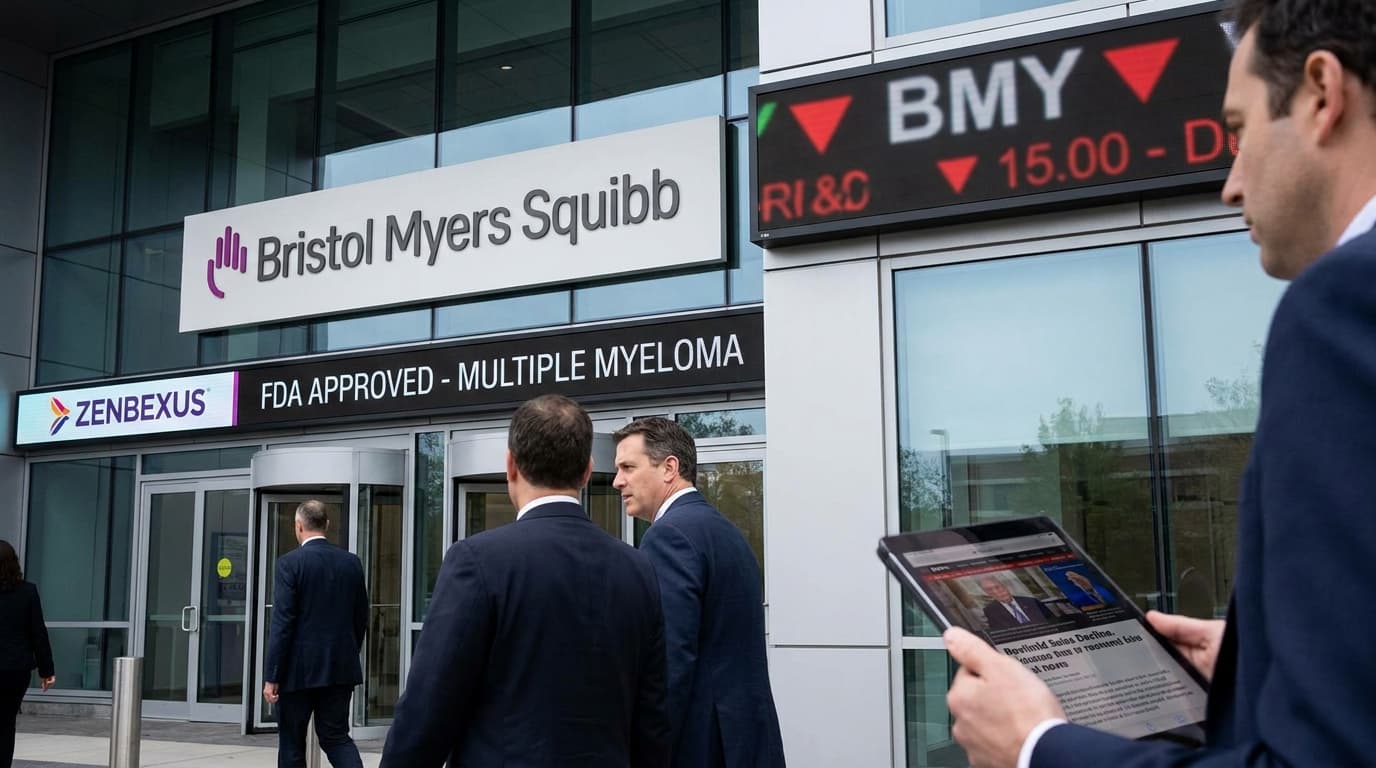
Bristol Myers Squibb Wins Zenbexus Approval, Adding A New Myeloma Drug As Legacy Sales Fall

Zenbexus is approved for patients with multiple myeloma who have undergone at least one prior line of treatment, and STAT reported the clearance marks the debut of a new class of medicine for the blood cancer. For Bristol Myers Squibb, the approval arrives as older myeloma products continue to erode, making execution on pricing, uptake and confirmatory evidence commercially important.
Bristol Myers Squibb has a new multiple myeloma product at a time when its older franchise is losing ground to generics. The FDA granted accelerated approval to iberdomide, which will be sold as Zenbexus, for use with Johnson & Johnson’s Darzalex and dexamethasone in patients who have undergone at least one prior line of treatment.
The approval matters beyond a routine label expansion. STAT reported that Zenbexus marks the debut of a new class of medicine for multiple myeloma, while BioSpace said it is the first approval from Bristol’s CELMoD platform. That gives Bristol a fresh asset in an indication where Revlimid and Pomalyst are no longer the dependable revenue base they once were.
The data
According to BioSpace, the FDA’s decision was supported by the Phase 3 EXCALIBER-RRMM study, which found that the Zenbexus-based regimen produced a significantly higher rate of minimal residual disease-negative complete response than standard of care. Bristol said MRD negativity is considered a predictor of progression-free survival.
STAT added that Zenbexus is the first drug cleared by U.S. regulators using a more sensitive measure of remission. The approval is accelerated, not full, so Bristol still needs to verify clinical benefit in a late-stage confirmatory study to secure full and continued approval.
The label also carries meaningful risk language. BioSpace reported a boxed warning for embryo-fetal toxicity and serious venous and arterial thromboembolism.
The commercial picture
Zenbexus is launching at $29,500 for a 28-day cycle, which BioSpace said was higher than William Blair had initially expected. The firm expects the drug to exceed $1 billion in annual earnings by 2031.
That pricing and forecast sit against a deteriorating base business in myeloma. Revlimid, first approved in 2005, fell 49% year on year to $425 million worldwide in the second quarter, according to BioSpace. Pomalyst, which faced generic entry earlier this year, dropped 71% to $204 million worldwide in Q2.
The strategic implication is straightforward: Bristol does not need Zenbexus only as an incremental oncology launch. It needs the product to help rebuild a myeloma franchise that is being reset by loss of exclusivity. The company has managed that transition better than the franchise-level declines suggest, posting $12.97 billion in second-quarter revenue, up 5% year on year and above the $11.73 billion consensus, while lifting 2026 sales guidance by 6% to $49.5 billion. Even so, Zenbexus arrives with real pressure to become a replacement growth driver, not just a scientific milestone.
What comes next
Zenbexus is the first approved CELMoD for Bristol, and BioSpace reported that another candidate from the platform, mezigdomide, is also under FDA review for relapsed or refractory multiple myeloma, with a decision due next May.
If Zenbexus can translate its accelerated approval into confirmed clinical benefit and meaningful uptake despite its premium price, Bristol will have more than a new product. It will have evidence that a next-generation myeloma platform can offset the revenue decline from its aging portfolio.
Join the BioIntel newsletter
Get curated biotech intelligence across AI, industry, innovation, investment, medtech, and policy delivered to your inbox.