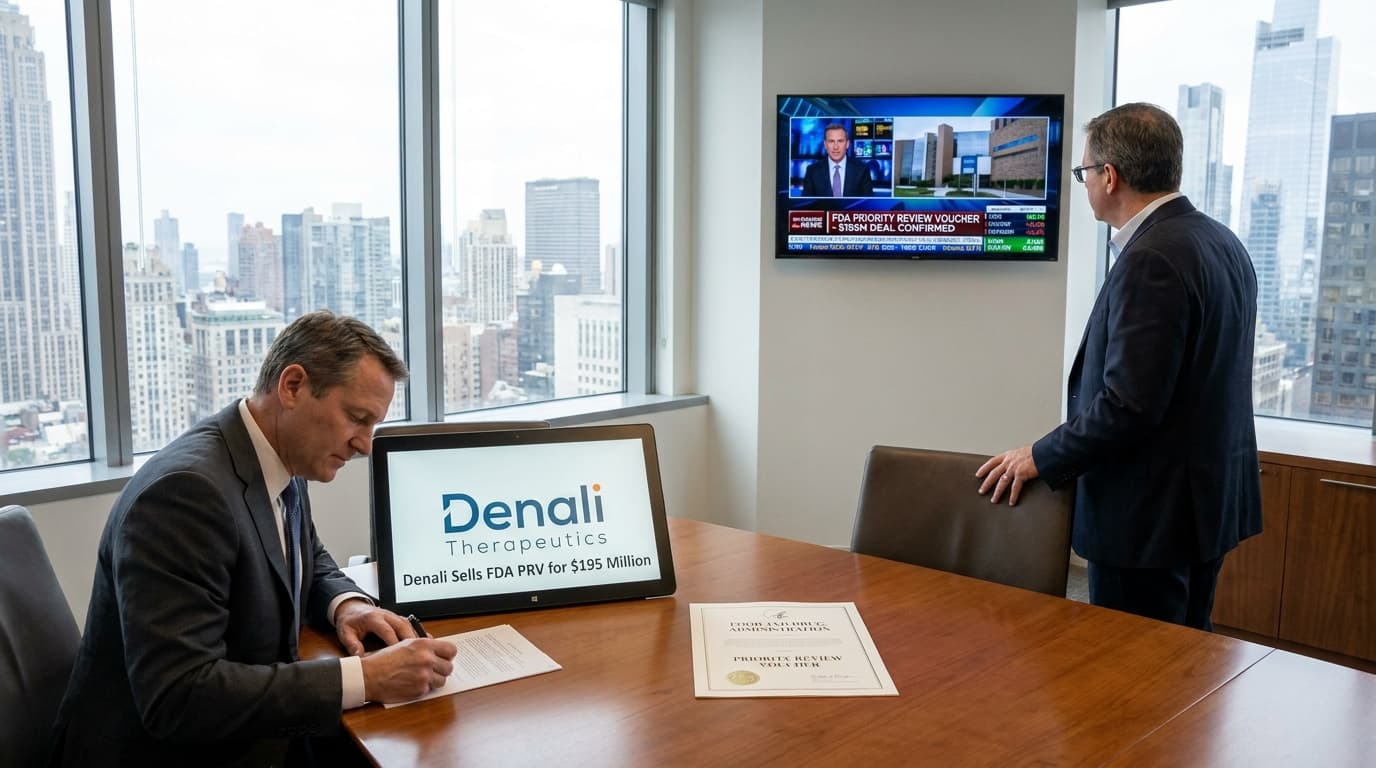
Denali Therapeutics Sells FDA Priority Review Voucher for $195 Million Amid Sustained Demand

Denali’s high-value deal demonstrates the continued strength of the FDA priority review voucher program following its renewal in 2026. As rare disease and neurodegenerative therapy investments surge, this transaction spotlights broader trends in drug development incentives and the growing market value of regulatory acceleration.
On June 19, 2026, Denali Therapeutics made headlines by selling a U.S. Food and Drug Administration (FDA) priority review voucher (PRV) for an elevated price of $195 million. This move positions Denali as the latest biotech firm to capitalize on the renewed demand for fast-tracking regulatory approvals, following the official renewal of the PRV program earlier this year. The transaction has deep implications not only for Denali’s neurodegenerative drug pipeline but also for the wider framework of rare disease incentives, biopharma financing, and regulatory policy. This in-depth analysis explores the context, motivations, and consequences of Denali’s decision while evaluating what the enduring interest in PRVs signals for the pharmaceutical and biotech sectors in 2026.
Understanding the Priority Review Voucher (PRV) Program
First introduced in 2007, the FDA PRV program was designed as a policy mechanism to encourage the development of therapies for neglected or rare diseases. Awarded as a form of incentive to drug developers who achieve FDA approval for medicines in qualifying high-need areas, a PRV guarantees the recipient priority review for a future drug—essentially shortening the FDA’s review time from the standard 10 months to just 6 months. As these vouchers can be used to accelerate promising drugs through the regulatory process, they are highly valuable; most strikingly, they can also be sold or transferred between companies. The open market for PRVs has developed into a multi-million dollar industry of its own over the last decade.
In 2026, the PRV market continues to be shaped by a complex interplay of unmet clinical need, intense competition in rare diseases and oncology, and regulatory uncertainty. With the program’s renewal sparking fresh demand, voucher prices have crept higher, reflecting both the perceived value of early market entry and the tightening supply of PRVs as issuance slows.
The $195 Million Deal: Strategic Implications for Denali
The sale of Denali’s voucher for $195 million is notable for its sheer financial scale. Compared to historic averages, this price places Denali’s deal among the top recent PRV transactions, rivaling sales in past years where prices ranged from $80 million to above $190 million depending on the market climate and the perceived value of specific drug pipelines.
For Denali, which focuses on neurodegenerative disorders such as Alzheimer’s, Parkinson’s, and ALS, the capital influx from this sale is strategically transformative. In a therapeutic area notorious for high research costs, protracted timelines, and clinical setbacks, monetizing a PRV provides a non-dilutive funding source to underpin continued R&D efforts. It allows Denali to channel resources into its lead clinical candidates, sustain its cash runway, and potentially buffer itself against the volatility of biotech capital markets in the mid-2020s.
Neurodegenerative Pipeline: Where Will the Funds Go?
While the snippet does not specify Denali’s precise plans for the new capital, it is reasonable to infer from the company’s portfolio and industry norms that funding will be prioritized for late-stage trial advancement and expanding early-stage programs. In a landscape where neurodegenerative diseases have few disease-modifying treatment options despite vast patient need, every dollar directed toward R&D translates into a possible leap in therapeutic innovation.
Denali and its peers—such as companies dedicated to tauopathies, targeting alpha-synuclein, and gene therapies for ALS—compete not just for clinical success, but also for the attention of payers, investors, and strategic acquirers. The PRV transaction thus functions as a lever for business growth, potentially positioning Denali for future licensing deals, collaborative partnerships, or even acquisition, especially if upcoming trial milestones are positive.
The Broader PRV Landscape in 2026: Why Do Prices Remain High?
The renewed buoyancy in the PRV market this year can be attributed to a perfect storm of regulatory clarity, persistent demand for first-mover advantage, and the growing role of expedited development in pharma and biotech business models. PRVs are not just tools for regulatory navigation—they are strategic assets in the increasingly high-stakes race to commercialize innovative therapies.
- Regulatory “Fast Pass”: As blockbuster launches face shorter commercial lifespans due to biosimilar and generic threats, shaving even a few months off a review can translate to hundreds of millions in additional sales. This calculation remains acute in 2026 as competitive pipelines intensify.
- Scarcity Value: With fewer qualifying diseases and more rigorous criteria over time, PRVs have become less numerous. Each new voucher is thus a scarcity asset whose market value reflects both the current landscape and anticipation of future demand.
- Investment Signaling: The willingness of buyers to pay premium prices for PRVs signals robust investor confidence in specific pipeline assets. Buyers are effectively wagering that accelerated approval confers a large enough head start to justify the outlay.
The Policy Debate: Is the PRV Program Achieving Its Goals?
Despite their popularity, PRVs are not without controversy. Policy experts have debated whether the program genuinely stimulates rare and neglected disease drug development, or simply rewards companies that would have developed such drugs irrespective of the incentive. Others contend that the high transactional prices inflate drug launch costs, with potential downstream effects on patient access and pricing.
In 2026, the reauthorization and program renewal remain hot topics. Stakeholder wishes for greater transparency in the candidate selection process, as well as the role of the FDA in adjudicating voucher issuance and redemption, color the ongoing policy discussion. But for now, the PRV market’s continued vibrancy—the Denali deal being a prime illustration—suggests that both the industry and regulators see value in maintaining this instrument.
PRVs and the Rare Disease Gold Rush
Denali’s story is also a microcosm of a broader trend: the strategic migration of biopharma R&D capital into rare diseases and high-burden neurodegenerative conditions. With traditional “blockbuster” areas such as cardiovascular and general oncology facing market saturation and pricing pressure, the rare disease and neurotherapy segments stand out for their high unmet need and strong pricing potential.
- Pipeline Diversification: Major pharmaceutical companies and nimble biotechs alike are placing larger bets on “first-in-class” and “best-in-class” neurology assets. These pushes are undergirded by breakthroughs in genetics, biomarkers, and brain delivery technologies.
- Deal-Making Momentum: Recent years have witnessed an uptick in licensing deals, asset purchases, and M&A activity centered on rare disease and neuro therapies. PRVs can function as important sweeteners in these negotiations—either as separate strategic assets or as part of bundled deals.
The 2026 Funding Climate: PRVs as a Hedge and Springboard
The $195 million PRV sale is particularly critical in the volatile funding environment of 2026. While the biotech IPO window and venture funding cycles have shown fits and starts, capital derived from PRV sales remains non-dilutive, unencumbered by market sentiment, and immediately available for reinvestment. As such, PRV-holding firms can execute ambitious R&D plans, initiate new trials, or even weather unexpected regulatory headwinds—all without further diluting their shares.
The funding flexibility conferred by PRV sales particularly empowers smaller or mid-cap innovators who may otherwise have limited access to late-stage capital. Even for larger, publicly traded companies, voucher monetization can free up resources for portfolio expansion, cross-border growth, or patient engagement infrastructure.
The Competitive Response: Are PRV Prices Sustainable?
Not every observer is bullish about the sustainability of high PRV prices. Some analysts warn that if the FDA tightens criteria or the number of qualifying drugs dwindles, scarcity-driven value could diminish. There is also the ever-present risk that a rush of redemptions could dilute the perceived market advantage of priority review. For now, however, the ongoing pace of high-profile voucher deals, the growing complexity of launch strategies, and the persistent innovation in high-need disease categories all suggest continued demand.
Conclusion: Denali’s Deal as a Bellwether for the Sector
Denali Therapeutics’ sale of its FDA priority review voucher for $195 million is emblematic of several intertwined trends in biotech and pharmaceutical innovation in 2026. The PRV program remains a potent lever for both financing and regulatory acceleration, especially in the context of rare disease and neurodegenerative pipelines. The high deal valuation reflects renewed confidence in the program’s value post-renewal, and the broader appetite for mechanisms that can de-risk and expedite drug development.
Strategically, the influx of capital supports Denali's continued push into therapies for diseases like Alzheimer’s, Parkinson’s, and ALS—areas that remain urgent priorities for healthcare systems, patients, and payers alike. Meanwhile, the robust PRV market should prompt further scrutiny from both policymakers and industry observers about the long-term efficacy and equity of such incentives. For now, however, Denali’s transaction stands as a high-water mark in a year defined by both opportunity and debate at the intersection of regulatory policy, financial strategy, and medical innovation.
Join the BioIntel newsletter
Get curated biotech intelligence across AI, industry, innovation, investment, medtech, and policy delivered to your inbox.