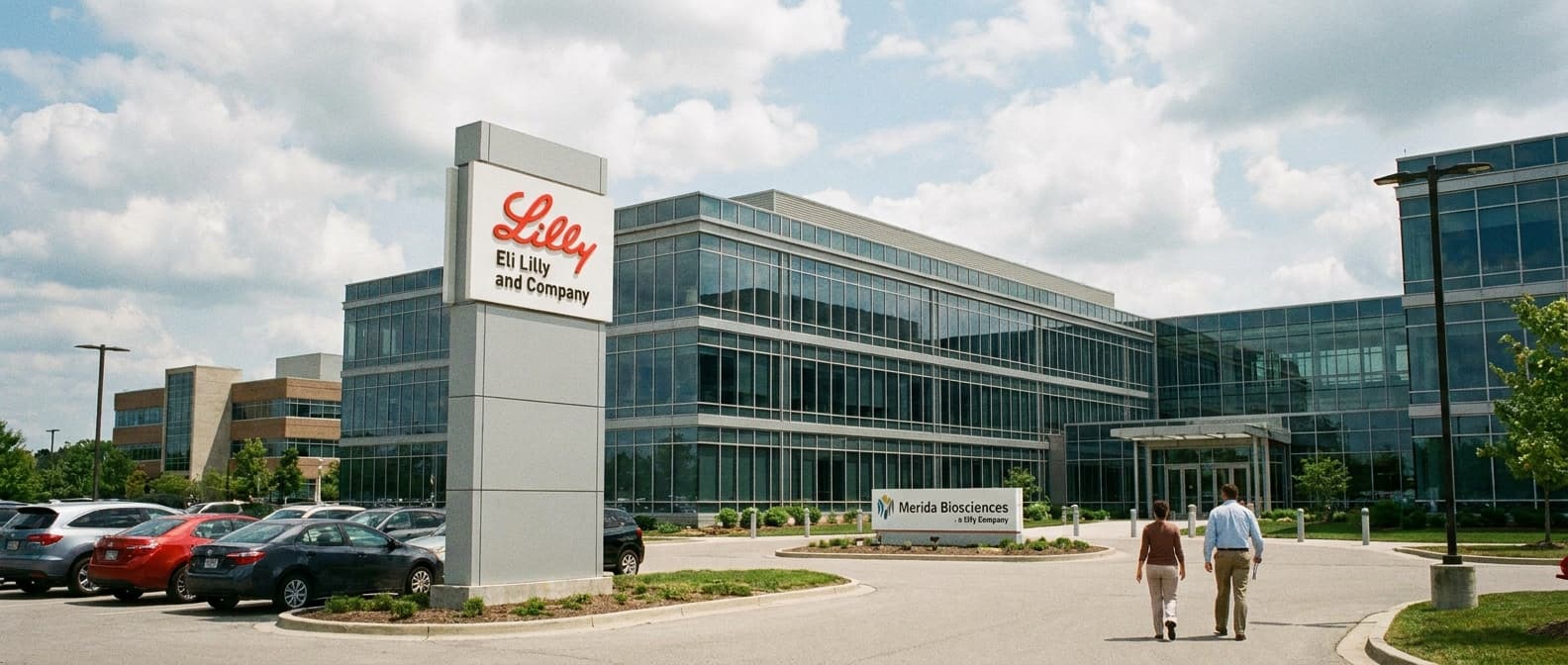
Eli Lilly Strikes Up To $2.875 Billion Merida Deal, Extending Its Autoantibody Strategy In Immunology

Lilly said it will pay up to $2.875 billion, including an upfront payment and contingent milestones, to buy Merida Biosciences, with closing expected in the fourth quarter pending clearances. The acquisition adds MER511 in Phase 1 for thyroid eye disease and Graves’ disease, MER769 in preclinical development for allergic conditions, and a platform designed to selectively target and destroy disease-causing autoantibodies.
Eli Lilly has agreed to acquire Merida Biosciences for up to $2.875 billion in cash, adding a small pipeline of autoimmune and allergic disease programs built around selective degradation of pathogenic autoantibodies. Lilly did not break out how much of the consideration is upfront versus contingent milestones, and the companies said the transaction is expected to close in the fourth quarter pending clearances.
The strategic appeal is less about late-stage revenue near term than about mechanism and platform fit. Merida emerged from stealth last year with $121 million and a thesis that targeting disease-driving antibodies directly could address the biology of autoimmune and allergic disorders without the broader immune suppression used by many current therapies. BMO Capital Markets described the acquisition as a strategic use of capital that aligns with Lilly’s earlier business development efforts while diversifying its immunology and inflammation pipeline.
The pipeline Lilly is buying
The lead program is MER511, an investigational precision therapy that Lilly said is being studied in Phase 1 for thyroid eye disease and Graves’ disease. Fierce Biotech reported that Merida began the Phase 1 study in December and that participants are receiving intravenous or subcutaneous doses.
In Graves’ disease, autoantibodies bind thyroid-stimulating hormone receptors, driving thyroid hormone production and potentially leading to thyroid eye disease. Merida’s approach is intended to deplete both the autoreactive antibodies and their source B cells. Lilly said initial Phase 1 data show robust reductions in thyroid-stimulating antibodies.
The acquisition also includes MER769, a preclinical antibody program that Lilly said has potential in food allergy, asthma and chronic spontaneous urticaria. Fierce Biotech also reported that Merida has been moving a primary membranous nephropathy program toward the clinic, though Lilly’s announcement highlighted the allergy opportunity for MER769 rather than that renal program.
Beyond individual assets, Lilly will gain Merida’s precision degradation platform, which the companies describe as a way to generate targeted biologic therapies that selectively target and destroy disease-causing autoantibodies. Francisco Ramírez-Valle, senior vice president of Lilly’s immunology research and early clinical development, said the company sees potential to apply that precision approach across a broad range of antibody-driven diseases.
The commercial picture
MER511 enters a competitive area, but with a differentiated pitch. Current Graves’ disease treatments include medicines that stop the thyroid from making hormones or block their activity, while Amgen’s Tepezza is among the treatment options for patients who develop thyroid eye disease. Fierce Biotech also noted investigational Graves’ disease programs from argenx, Immunovant, Sanofi, Biohaven and Lycia Therapeutics.
That means Lilly is not buying an uncontested market. It is buying a chance to intervene at what it sees as the underlying driver of disease. If that biology translates clinically, the asset could give Lilly a position in diseases where physicians often balance efficacy against the liabilities of broad immunosuppression.
The road here
The Merida deal is the latest in a year of aggressive external dealmaking by Lilly. BioSpace said that in roughly the first six months of the year, the company had set aside more than $25 billion in business development dollars. Recent transactions cited by the two reports include the up to $3.8 billion AtaiBeckley deal, the $6.3 billion takeover of Centessa Pharmaceuticals, the $7 billion purchase of Kelonia Therapeutics and a licensing agreement worth up to $1.9 billion with Abbisko Therapeutics.
The signal from the Merida acquisition is that Lilly is still willing to spend heavily outside its core obesity franchise, but is doing so in areas where platform biology can support multiple shots on goal. For immunology, that makes the transaction more than a single-asset bet: it is a wager that selective removal of pathogenic antibodies can become a broader development engine across autoimmune and allergic disease.
Join the BioIntel newsletter
Get curated biotech intelligence across AI, industry, innovation, investment, medtech, and policy delivered to your inbox.