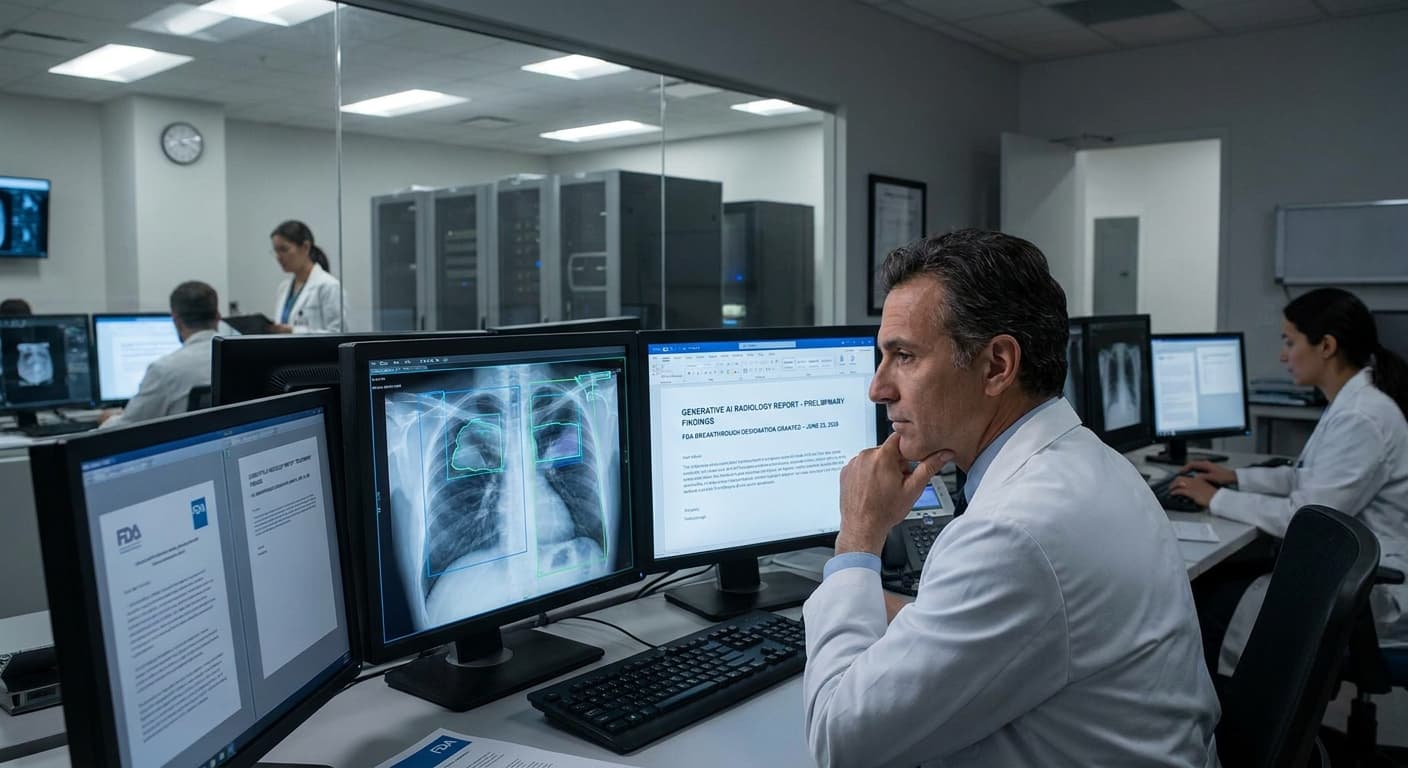
FDA Grants Breakthrough Status to Generative AI for Radiology: What It Means for Medical Imaging

In a notable move for the medical imaging sector, the FDA recently granted breakthrough designation to two devices leveraging generative AI. These devices are designed to interpret chest X-rays and automate report generation, highlighting the growing importance and clinical acceptance of artificial intelligence in radiology workflows. This development has the potential to redefine both efficiency and accuracy in imaging departments across the United States.
Introduction
On June 25, 2026, the U.S. Food and Drug Administration (FDA) granted breakthrough device designation to two advanced radiology tools powered by generative artificial intelligence (AI). These devices, according to early reports, are designed specifically for interpreting chest X-rays and drafting comprehensive radiology reports, potentially marking a watershed moment in both AI adoption and clinical radiology practice in the United States and beyond.
The breakthrough device designation is intended to expedite the review and potential approval of technologies that could provide more effective diagnosis or treatment for life-threatening or irreversibly debilitating diseases or conditions. By awarding this status to generative AI radiology tools, the FDA acknowledges the transformative potential of the technology within medical imaging, a field at the intersection of machine learning innovation and critical clinical decision-making.
This article provides a comprehensive, analytical overview of the regulatory, technological, and clinical implications of this FDA decision. We break down the details surrounding the devices, the types of AI being deployed, the anticipated impact on radiological work, and what this could mean for healthcare stakeholders. With the field of radiology already at the forefront of AI integration, these recent regulatory approvals may accelerate broader shifts toward automated and semi-automated medical imaging analysis.
The Context: AI’s Progression in Radiology
Artificial intelligence, and more specifically, generative AI, has been steadily gaining ground within healthcare. Radiology, given its decades-long dataset accumulation and well-documented imaging protocols, has emerged as a prime domain for machine learning applications. Traditional AI models have, in recent years, supported tasks such as image segmentation, abnormality detection, and workflow prioritization.
Generative AI, such as the large language models (LLMs) and vision-language models gaining prominence since 2023, takes the next logical step. It aims not merely to augment radiologists’ workflow but, in some cases, to automate the drafting of preliminary or even finalized reports based on image interpretation. This shift opens possibilities for streamlining radiology pipelines, potentially enhancing both efficiency and consistency in report quality.
The FDA’s Breakthrough Device Designation
The FDA’s breakthrough device program is reserved for medical devices that present exciting opportunities to address unmet medical needs. When two generative AI-powered radiology tools were granted breakthrough device designation for their abilities to interpret chest X-rays and generate draft radiology reports, it became clear that regulatory agencies are increasingly willing to engage with the medical AI revolution.
While the exact names of the devices were not specified in the initial release, it is understood that they focus explicitly on chest X-ray interpretation—a critical area, given the sheer volume and clinical importance of chest imaging. Chest X-rays remain ubiquitous, serving as foundational tools for diagnosing a vast range of pulmonary, cardiac, and thoracic conditions. The automation of interpretation and reporting has, for years, been the subject of research, but FDA’s engagement signals a readiness for real-world deployment.
Key Details:
- Scope: Interpretation of chest X-rays and automatic drafting of radiology reports
- Breakthrough Status: Accelerated review process, prioritized regulatory attention
- Potential Applications: High-volume settings, teleradiology, underserved hospitals, rapid turnaround for critical findings
Technological Underpinnings: How Generative AI Powers Radiology Reporting
Generative AI systems in radiology typically integrate deep learning architectures for image analysis with advanced language models that generate clinically accurate narrative reports. In the workflow validated by these FDA designations, the AI not only interprets the raw imaging data but also transforms the findings into structured, readable, and actionable medical language.
Key Features:
- Automated Abnormality Detection: AI systems scrutinize images for patterns indicative of disease, injury, or abnormality
- Contextual Language Generation: Language models, often trained on millions of prior radiology reports, synthesize findings in a format aligned with radiological standards
- Clinical Decision Support: Many systems flag critical findings, suggest relevant follow-ups, and alert clinicians in emergent situations
- Workflow Integration: Seamless integration with PACS (Picture Archiving and Communication System), RIS (Radiology Information System), and Electronic Health Records (EHR)
This holistic approach aims for both accuracy and consistency, two factors that remain perennial challenges in medical imaging. The enablement of real-time or near-real-time reporting also addresses workforce bottlenecks, particularly in high-volume and resource-limited settings.
Benefits and Potential Pitfalls
Proponents’ Viewpoints
Supporters of generative AI adoption in radiology underscore numerous potential benefits:
- Efficiency: The ability to rapidly interpret routine studies may free radiologists to concentrate on complex or ambiguous cases.
- Accessibility: Teleradiology and rural hospitals, where specialist radiologists are scarce, may benefit from improved consistency and shorter turnaround.
- Error Reduction: AI systems can serve as a second reader, helping to identify subtle findings a human may overlook.
- Standardization: Automated reporting may drive consistency in clinical documentation, reducing the variability inherent in manual reporting.
Skeptics’ Concerns
- Overreliance: There is a risk that healthcare teams may become too dependent on automated outputs, potentially bypassing appropriate clinical skepticism.
- Bias and Data Limitations: AI is only as good as the data it’s trained on. If training datasets are not representative, systems may propagate existing biases or miss rare pathologies.
- Transparency and Explainability: Many deep learning systems remain ‘black boxes,’ making it hard to scrutinize individual AI-generated decisions for transparency or regulatory validation.
- Liability Issues: The deployment of AI in diagnostic reporting poses ongoing questions about legal liability in the event of diagnostic error.
Regulatory and Policy Landscape
The FDA’s breakthrough designation for these devices is part of a broader regulatory reckoning with emerging software as a medical device (SaMD). Historically, most AI tools approved for radiology focused on binary ‘assistive’ tasks, such as flagging images for further review. Generative AI’s foray into narrative report generation raises the regulatory bar: not only is the software interpreting images, but it is also producing clinically actionable language.
FDA’s move signals that generative AI-driven tools have matured to a point where their clinical reality warrants explicit regulatory support. Moreover, the breakthrough pathway may accelerate data gathering in live clinical settings, facilitating a feedback loop that drives further model improvements and validation.
The Future: Implications for Radiologists, Health Systems, and Patients
For Radiologists
The integration of generative AI into reporting workflows will change the nature of radiological practice. Initial deployment is likely to be as a ‘second reader’ or quality control, with radiologists reviewing and editing AI-generated reports. Over time, as trust in system performance grows, the role may shift further toward high-level oversight and complex case consultation.
The embrace of such technology could be both empowering—freeing clinicians for more value-added work—and threatening, fueling longstanding concerns about job erosion.
For Healthcare Organizations
Hospitals and health systems may seize the opportunity to leverage generative AI as a means of increasing throughput, reducing diagnostic delays, and ensuring more consistent patient care. Implementing these systems, however, will require close collaboration with IT, radiology leadership, and compliance teams to address integration, workflow compatibility, and ongoing quality assessment.
For Patients
From the patient perspective, advantages could include faster diagnostic turnaround, improved accuracy, and more timely initiation of appropriate treatment. However, transparency about the role of AI in clinical decision-making will be vital for maintaining patient trust.
In summary, the FDA’s endorsement signals a shift in the shared expectations of clinicians, technologists, and regulators, with generative AI poised to become not just a supporting tool but an embedded part of care delivery.
Conclusion
The granting of breakthrough device designation to generative AI systems for chest X-ray interpretation and reporting by the FDA is a clear signal that artificial intelligence is moving beyond pilot studies and research journals into regulated, mainstream clinical medicine. While the transition from regulatory milestone to clinical ubiquity will require ongoing evaluation, trust-building, and training, the direction is now set. Across the medical technology sector and health services at large, stakeholders will closely monitor these initial deployments and their wider ramifications, both within the healthcare workforce and in patient outcomes.
Source: STAT+: FDA gives generative AI in radiology two breakthrough designation nods
Join the BioIntel newsletter
Get curated biotech intelligence across AI, industry, innovation, investment, medtech, and policy delivered to your inbox.