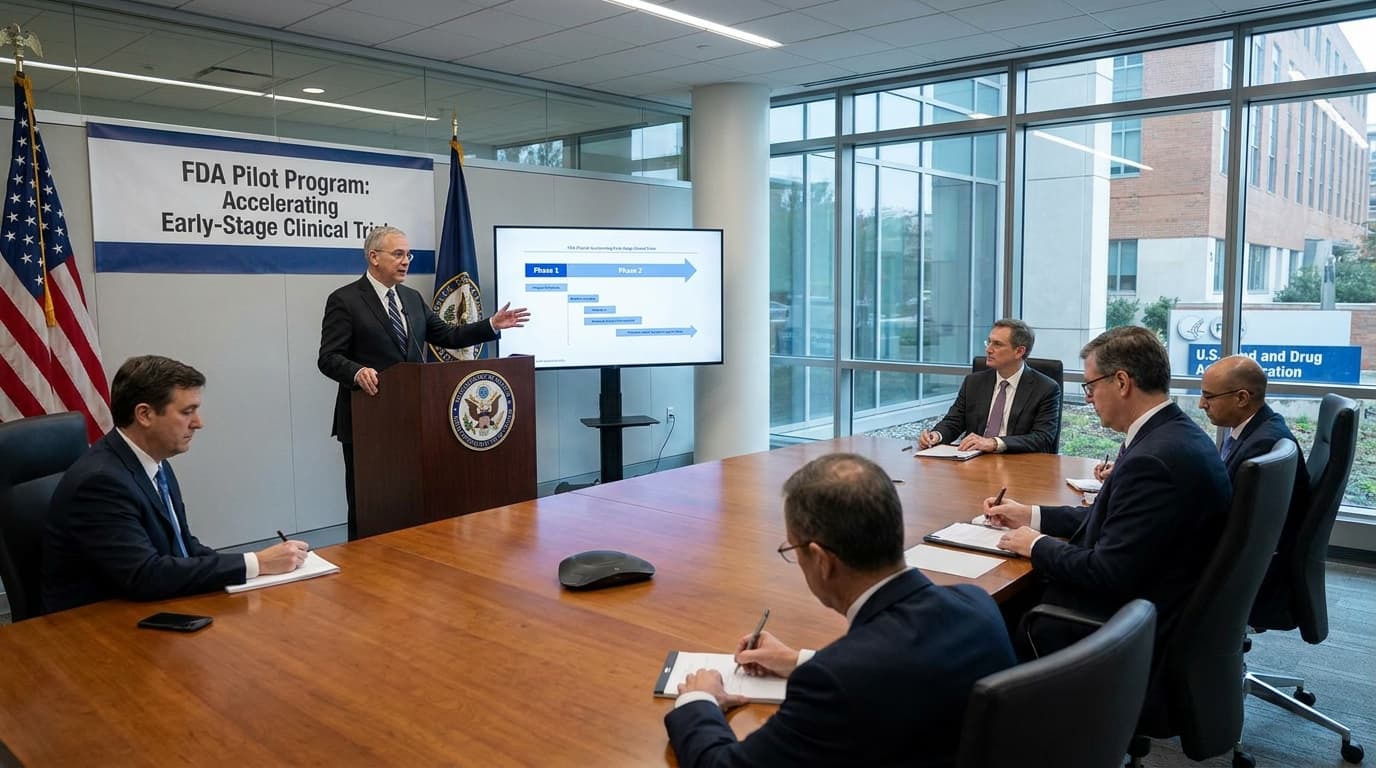
FDA to Launch Pilot Program Aimed at Accelerating Early-Stage Clinical Trials

Federal health officials are rolling out a new pilot that could transform the early phases of drug development. The initiative is part of a broader effort to boost innovation and retain international leadership in the biopharmaceutical sector.
The landscape of drug development is continually evolving, shaped by regulatory shifts, scientific advances, and intense global competition. In a significant development, the United States Food and Drug Administration (FDA) has unveiled plans for a new pilot program designed to hasten the progression of early-stage clinical trials, specifically those that use a single-study design. This initiative reflects the federal government's renewed focus on accelerating medical innovation and sustaining the country’s leadership position in the pharmaceutical and biotech sectors, especially as other nations, most notably China, demonstrate increasingly robust capabilities in life sciences.
The Motivation for Acceleration: Global Competition and U.S. Response
Drug development has always been a lengthy and resource-intensive process. Traditionally, it can take years for a potential therapy to move from the laboratory through preclinical studies and into the early phases of human testing. As scientific and economic competition intensifies globally, particularly with China's rapid rise in the biopharma industry, the U.S. has recognized an urgent need to streamline these early steps. The FDA’s new program aims to provide both regulatory clarity and logistical agility for sponsors eager to move promising therapies more efficiently into and through initial human testing.
Historical Perspective: The Pace of Innovation
Historically, early-stage — or Phase 1 and 2 — clinical trials in the United States have operated under a cautious, stepwise approach. Studies are typically small, tightly controlled, and focused predominantly on evaluating the safety profiles of new drugs or interventions. While this measured strategy has helped to protect patients and uphold scientific rigor, it has at times slowed the velocity at which new drugs reach patients, especially when compared to some international regulatory frameworks.
Within the current climate, where speed can mean the difference between clinical success and obsolescence, the FDA is seeking to balance its mandate of protecting public health with the necessity to foster innovation. Developing a regulatory environment that is transparent, responsive, and adaptable is increasingly seen as crucial for continued U.S. leadership in global drug development.
Program Features: What Is Known About the FDA's Pilot?
While specific details of the FDA’s pilot program are still emerging, initial reports indicate that it will be designed to optimize the process for early-stage, single-study clinical trials. Such studies are pivotal as they form the bridge between preclinical discovery and later-stage confirmation of efficacy and broader safety in larger patient groups. Key features likely to be emphasized in the pilot may include:
- Enhanced communication between sponsors and the FDA to clarify study design and endpoint expectations at the outset.
- Streamlined protocols that center on regulatory flexibility without compromising essential safety requirements.
- Faster initiation of first-in-human trials by limiting redundant, often bureaucratic, barriers.
- Opportunities for global alignment, recognizing that harmonized approaches may facilitate both global clinical development and regulatory submissions.
A Measured Approach to Risk
Despite the emphasis on acceleration, the FDA remains committed to its foundational principles of patient safety and scientific integrity. The agency is reportedly planning to monitor the outcomes of this pilot closely, with robust oversight to identify any potential risks that may arise from expedited processes. The goal is an agile yet responsible regulatory posture, learning from both domestic experiences and comparable international efforts.
Industry Implications: How Will Biopharma Respond?
Industry stakeholders broadly welcome the prospect of increased efficiency in early-phase trials. In recent years, major pharmaceutical companies, biotech start-ups, and academic investigators alike have expressed concern about the protracted timelines and costs associated with traditional clinical development. By reducing time to first-in-human studies—and by providing more predictable regulatory feedback—the pilot may give U.S. companies an opening to reclaim a competitive advantage in both speed and scientific rigor.
Such a program could catalyze:
- Faster translation of discovery to clinical proof-of-concept, particularly in high-need areas like rare diseases, oncology, and advanced therapeutics.
- More nimble start-up activity, as smaller companies gain greater confidence in navigating regulatory pathways.
- Improved resource utilization for major biopharma, freeing up capital and personnel for downstream development and commercialization.
International Perspective: Benchmarking Against China
China’s aggressive investment and centralized mobilization around biopharma innovation have imposed new urgency on U.S. regulators to adapt. Over the past decade, China’s National Medical Products Administration (NMPA) has rapidly modernized its regulatory review practices, increased approval speed for innovative therapies developed both domestically and internationally, and attracted growing investment from global biotech firms seeking access to China’s immense patient populations.
By launching a comparable pilot, the FDA sends a clear message: The U.S. intends to retain leadership in regulatory science while modernizing towards greater speed and adaptability. Moreover, as international regulatory agencies increasingly harmonize standards, alignment across jurisdictions could ultimately benefit multinational drug development efforts—allowing novel therapies to be studied and approved more efficiently around the world.
Potential Risks and Oversight
While the prospect of faster trials is enticing, stakeholders acknowledge that rushing too rapidly could introduce unforeseen risks—both for individual patient safety and for the broader integrity of clinical results. Careful selection of pilot projects, clear criteria for success, and ongoing transparent reporting will be essential.
Some experts caution that accelerated timelines may inadvertently skew decision-making by emphasizing speed over robustness, “winner’s curse” effects where initial findings are overvalued, or by failing to capture adverse effects that only emerge over longer observations. The FDA’s reputation as the world’s strictest, most science-based regulator, and its long-standing trust with patients and clinicians, will require that any pilot effort retain the highest standards of data quality, transparency, and protection.
Looking Forward: Measuring Success and Setting Precedents
As the pilot program gets underway, its outcomes will likely set important precedents for future FDA policy and for global harmonization efforts. Key metrics that observers will monitor include:
- Average time from preclinical nomination to first patient dosed
- Number of studies initiated and successfully completed under the pilot
- Rates of safety-related amendments or terminations
- Sponsor and patient satisfaction with regulatory clarity and communication
- Instances of international alignment in study design and regulatory decisions
If the pilot delivers on its promises, it could provide a blueprint for broader modernization of U.S. clinical trial oversight, extending beyond early-stage studies to encompass the entire spectrum of drug development. On the other hand, any missteps will be closely scrutinized, both by domestic critics and by global competitors eager to benchmark regulatory performance.
Final Thoughts: A Milestone Moment for U.S. Drug Development
The introduction of this FDA pilot program represents a milestone in how American regulators are responding to the evolving challenges and opportunities in biomedical innovation. In a world where scientific advancements are coming faster than ever and regulatory environments are becoming the new battleground for global competitiveness, the stakes are high.
For patients, the promise is that urgently needed medicines could reach them more quickly—without compromising on safety. For industry, the hope is a more predictable, flexible, and innovation-friendly landscape. For government, the imperative is clear: sustain and extend leadership in the global race to turn discovery into real-world medicine.
As this story develops, BioIntel will continue monitoring updates, providing analysis on pilot progress, regulatory signals, and industry reaction.
Sources: STAT News
Join the BioIntel newsletter
Get curated biotech intelligence across AI, industry, innovation, investment, medtech, and policy delivered to your inbox.