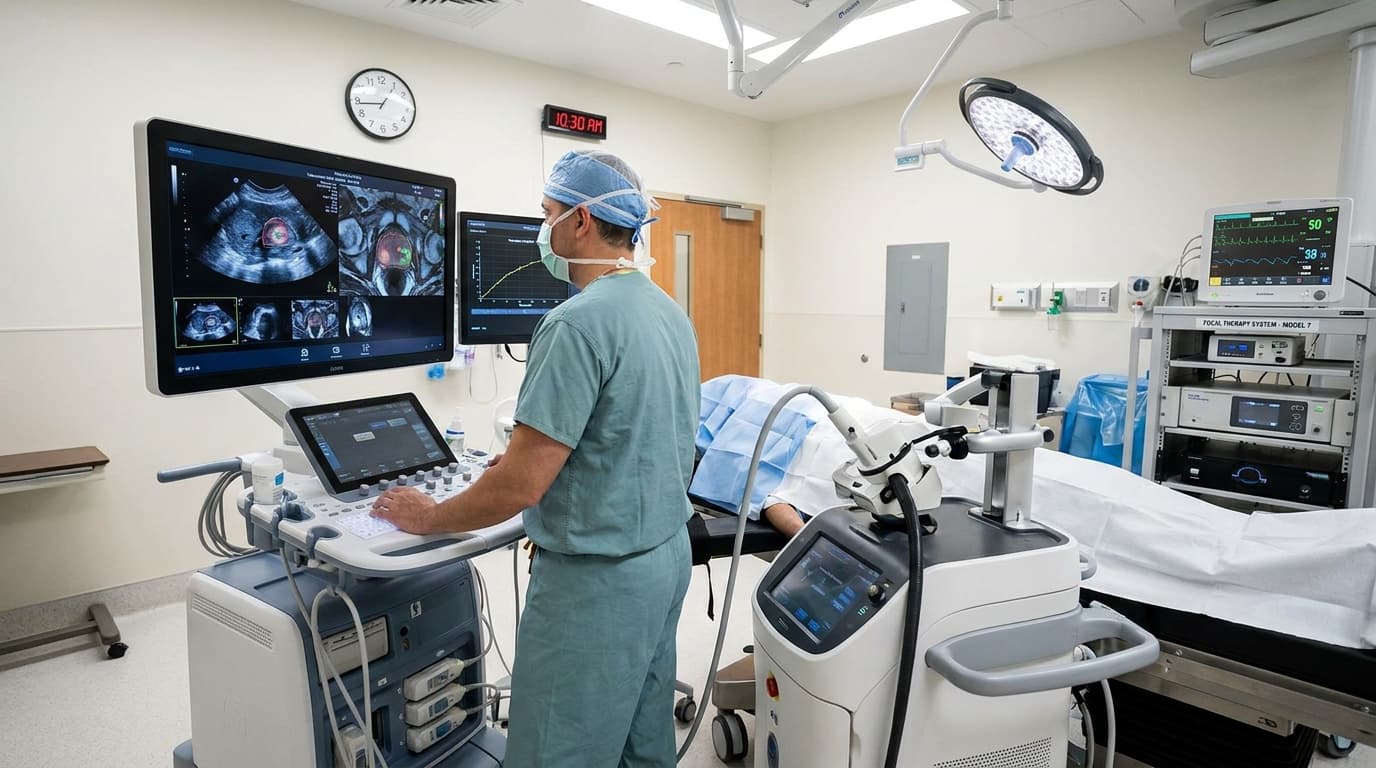
Focal Therapy Posts 0.1% Prostate Cancer Mortality At 10 Years, While U.S. Guidelines Still Call It Experimental

Focal therapy aims to destroy MRI-visible prostate lesions without removing or irradiating the whole gland, offering a less aggressive option than surgery or radiation for some patients with localized disease. A recent 10-year U.K. study reported 0.1% prostate cancer mortality, but the American Urological Association still says the approach should be limited to studies and prospective registries.
For most localized solid tumors, organ-sparing treatment is standard thinking. In prostate cancer, care has more often remained binary: men with disease beyond low-grade cases suitable for active surveillance typically receive surgery or radiation to the whole gland, despite risks that include incontinence and erectile dysfunction.
Focal therapy is trying to carve out a middle ground. The approach targets lesions visible on MRI scans and destroys them with tools that can freeze, heat, burn, or electrocute cancer cells, often in a single session and sometimes in a doctor’s office. That convenience, combined with a lighter side-effect profile, has made it increasingly attractive to patients and to some urologists. But its status remains contested, because long-term randomized evidence against standard treatment is still limited.
The data
Supporters gained a notable argument last month from a U.K. study that found only 0.1% of patients treated with focal therapy had died of prostate cancer 10 years after treatment, a result described as comparable to survival outcomes for standard treatments. The same study also reported higher satisfaction rates and lower levels of side effects than other treatments.
That is the kind of long-term outcome focal therapy advocates have wanted as MRI technology improves lesion identification and as the treatment gains visibility at meetings of urologists. Even so, many specialists still want clearer evidence from randomized trials directly comparing focal therapies with surgery or radiation before treating the survival data as practice-changing.
The guideline gap remains large. The American Urological Association says focal therapy is still experimental. Its guidance acknowledges focal therapy as an option for intermediate-risk cancer, but says it should be performed only as part of studies and in prospective registries.
Another recent paper adds to concerns about how the treatment is being used in practice. Published last week, it found that half the patients receiving focal therapy had either higher-risk or lower-risk cancers, including patients whose disease guidelines say should receive no immediate treatment and instead be followed with active surveillance.
The commercial picture
Focal therapy is not a single product but a group of Food and Drug Administration-authorized tissue-destruction technologies. The main methods in use are cryotherapy, laser ablation, and high intensity focused ultrasound, or HIFU. Which technology gets used typically depends on the lesion’s shape and location. Localized radiation is not considered focal therapy.
Recent procedure data show how the mix has shifted. Cryotherapy accounted for nearly 80% of focal therapy procedures in 2010, but by 2023 had fallen to 20%. Laser ablation represented about 45% of procedures, while HIFU, the fastest-growing modality, reached 35% in 2023.
Despite years of interest, uptake is still low. Recent data show 1.3% of prostate cancer patients in the U.S. received focal therapy. Under AUA guidelines, only about 10% to 20% of prostate cancer cases would qualify for focal therapy as part of studies: patients with intermediate-risk cancer, whether favorable or unfavorable, who could otherwise consider active surveillance as well as surgery or radiation therapy.
Coverage also remains a friction point. STAT cited patients paying out of pocket because many commercial insurers do not cover focal therapy, though Medicare does. One patient, a 48-year-old from Denver with a family history of aggressive prostate cancer, said he paid about $17,000 out of pocket and chose focal therapy instead of active surveillance, radiation, or surgery.
Why the split persists
The appeal is easy to see when compared with standard care. Prostatectomy requires longer recovery and causes initial incontinence in nearly all patients; while most regain bladder control within a year, 5% to 10% can have permanent incontinence. Erectile dysfunction is also common, and more than half of men undergoing surgery lose sexual function in the medium to long term. Radiation therapy has fewer long-term side effects, but it can still cause temporary incontinence and erectile dysfunction and usually requires several weeks of daily treatment.
By contrast, focal therapy is usually completed in one session lasting from 40 minutes to a couple of hours. Some patients need a catheter afterward, in one case for close to a month, but the side-effect burden is generally limited unless the lesion sits in a location sensitive for erectile dysfunction.
That tradeoff is the real signal in the debate. Focal therapy is no longer short on technical feasibility or patient demand; it is short on the kind of comparative evidence and disciplined patient selection that would move it from a niche offering into mainstream prostate cancer care.
Join the BioIntel newsletter
Get curated biotech intelligence across AI, industry, innovation, investment, medtech, and policy delivered to your inbox.