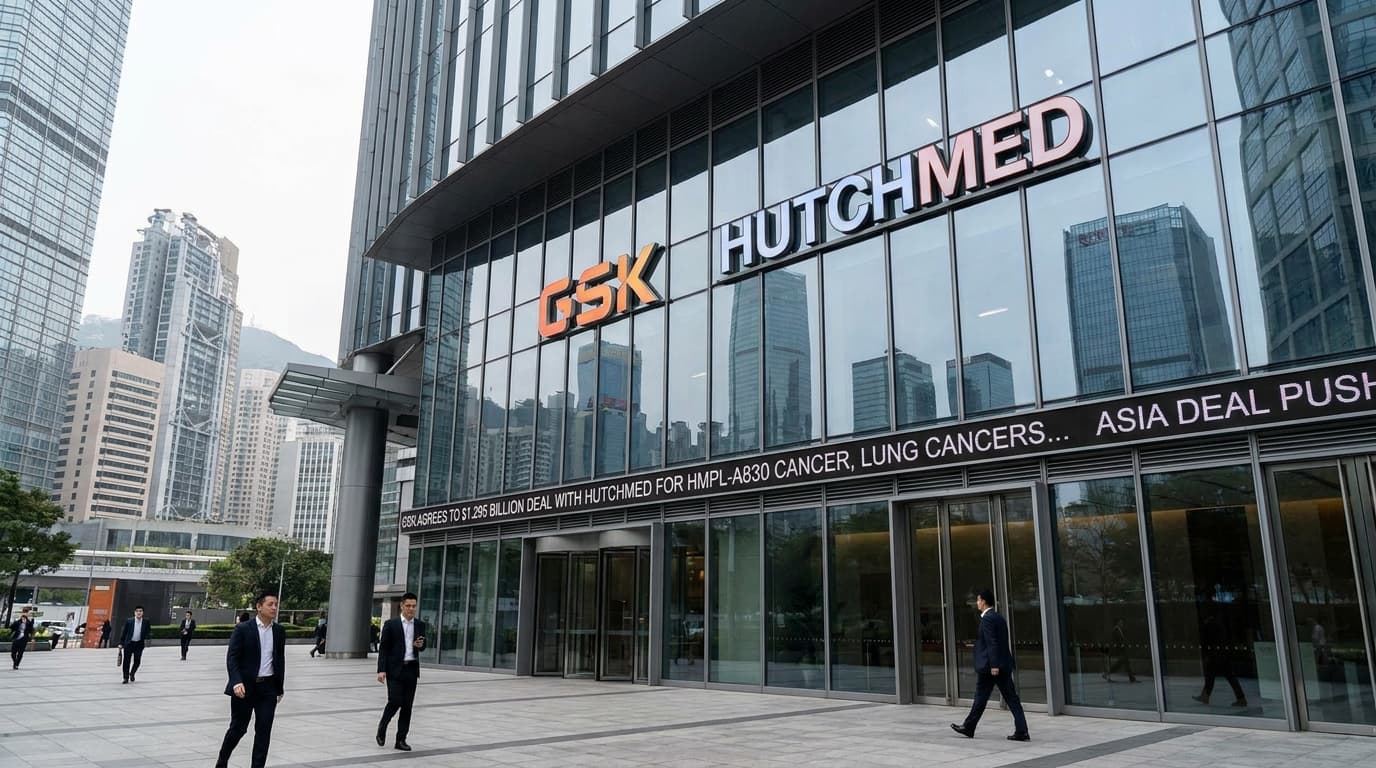
GSK Bets Up To $1.295 Billion On Hutchmed’s HMPL-A830, Extending Its Asia Deal Push

GSK has licensed worldwide rights to HMPL-A830 outside mainland China, Hong Kong, Macau and Taiwan, where Hutchmed retains control. Initial development will focus on colorectal, pancreatic and lung cancers, with Hutchmed running Phase 1 before GSK takes over later-stage development and commercialization.
GSK has agreed to pay Hutchmed $110 million upfront for rights to HMPL-A830, with total deal value described as either up to $1.295 billion or as $110 million plus up to $1.185 billion in development, regulatory and commercial milestones across the two source reports. Hutchmed is also eligible for royalties on net sales.
The agreement gives GSK worldwide rights to develop and commercialize the asset except in mainland China, Hong Kong, Macau and Taiwan, where Hutchmed keeps full control. For GSK, the transaction adds another externally sourced oncology program from Asia as the company continues to build through licensing and M&A.
The Asset
HMPL-A830 is described as an investigational therapy that combines an EGFR-targeting monoclonal antibody with a small-molecule payload designed to inhibit KRAS. Fierce Biotech described it as a preclinical KRAS-EGFR-antibody conjugate slated to enter trials later this year, while BioSpace said Hutchmed characterizes the construct as an antibody-targeted therapy conjugate.
The companies said the design is intended to deliver a KRAS inhibitor directly to EGFR-expressing tumors while also blocking EGFR and KRAS signaling. GSK’s Hesham Abdullah said the dual KRAS-EGFR mechanism has the potential to improve on current standard of care.
Initial development will focus on colorectal, pancreatic and lung cancers. The companies said those tumor types have the highest incidence of patients with KRAS-altered tumors.
Deal Structure And Strategy
Hutchmed will be responsible for Phase 1 studies, after which GSK will take over subsequent clinical development. BioSpace said GSK will then lead all later development, while Fierce Biotech said GSK will assume all R&D responsibilities and commercialization outside the retained Asian territories.
The signal in the deal is less about near-term clinical data than about where GSK is sourcing pipeline options. This is another case of the company using Asian biotech relationships to access differentiated assets before proof-of-concept readouts, accepting early development risk in exchange for broader commercial rights.
BioSpace placed the Hutchmed agreement in a wider pattern. In January, GSK paid $20 million upfront and promised up to $265 million in milestones in a deal with South Korea’s Alteogen tied to a subcutaneous version of Jemperli. In June, GSK agreed to acquire China’s Siran Biotechnology for $1 billion. The company also bought RAPT Therapeutics for $2.2 billion in January and acquired Nuvalent Bio for $10.6 billion in June.
For Hutchmed, the structure preserves control in selected Asian markets while shifting much of the global development and commercialization burden to GSK once the program reaches the clinic.
Join the BioIntel newsletter
Get curated biotech intelligence across AI, industry, innovation, investment, medtech, and policy delivered to your inbox.