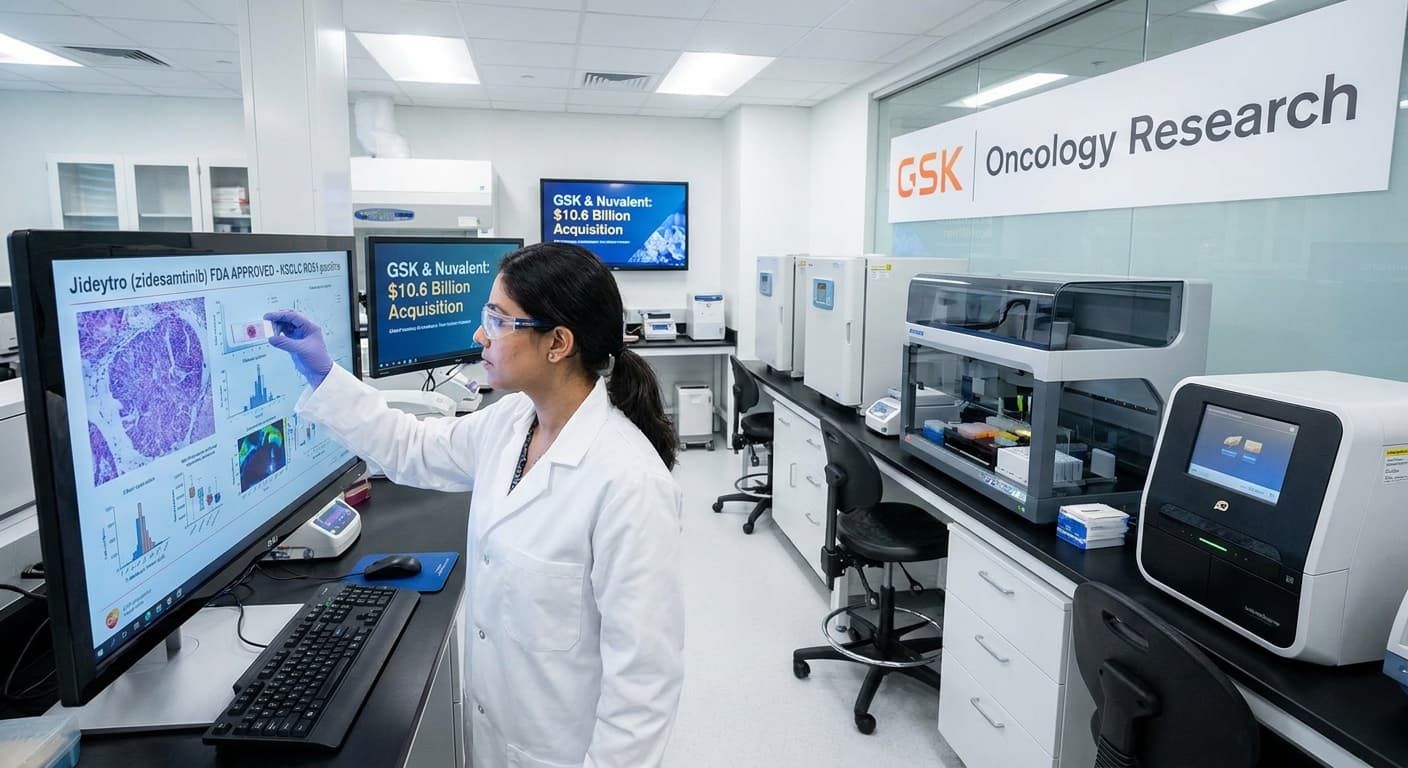
$10B M&A Pays Off as GSK Secures First FDA Approval for Lung Cancer Drug Jideytro

GSK's recently acquired molecule Jideytro (from Nuvalent) has received FDA approval for advanced non-small cell lung cancer driven by ROS1 genetic alterations. This development marks an important outcome of a $10.6 billion merger and positions GSK for a new presence in the competitive lung cancer drug market.
In what is set to reshape GSK’s oncology pipeline and send ripples through the broader biopharma sector, the pharmaceutical giant has achieved a breakthrough with the U.S. Food and Drug Administration’s approval of Jideytro. This new therapy, aimed at advanced cases of non-small cell lung cancer (NSCLC) that are specifically driven by ROS1 genetic alterations, originates from a molecule developed by Nuvalent, Inc.—a firm GSK acquired for $10.6 billion.
Context: High-Stakes Acquisition and the Scientific Race
The acquisition of Nuvalent by GSK earlier this year was closely watched by analysts and market observers, both for its scale (a $10.6 billion outlay) and its implied R&D pipeline priorities. Nuvalent’s assets were considered among the most promising for targeting specific genetic drivers in difficult-to-treat cancers. The FDA approval of Jideytro effectively validates GSK’s strategic bet, providing the company with its first foothold in a targeted lung cancer therapy niche that is both scientifically challenging and commercially promising.
Therapeutic Target and Clinical Significance
Non-small cell lung cancer remains one of the leading causes of cancer-related mortality globally. Within this group, patients with ROS1-positive tumors comprise a distinct molecular subset. For these individuals, standard therapies can be limited by both efficacy gaps and drug resistance. The approval of Jideytro enhances the therapeutic options for this segment, aligning with the broader trend toward precision oncology, in which therapies are tailored to the unique molecular signatures of each patient’s cancer.
While precise clinical data from the pivotal trials underpinning the FDA decision are not available from the headline, it is reasonable to infer that Jideytro demonstrated clear clinical benefit for the FDA to grant approval. The ability to address a previously under-served subset of NSCLC patients fits with the industry’s focus on genetic testing, companion diagnostics, and new small-molecule drugs that exploit actionable genetic alterations.
Implications for the Biopharma Sector
GSK’s regulatory win is notable not only for the clinical implications for NSCLC patients but also for the sector’s wider appetite for high-value M&A involving clinical-stage biotech innovators. Over the past several years, big pharma companies have increasingly sought external innovation through acquisitions—especially in cancer, where drug development timelines can be highly variable and rewards potential remains high for validated first-in-class or best-in-class therapies.
This transaction and its successful regulatory outcome demonstrate that M&A, when tightly aligned to scientific due diligence and emerging clinical needs, can rapidly accelerate a large pharma’s competitive posture. GSK, historically seen as a more modest player in the oncology space compared to competitors like Roche, Merck, or AstraZeneca, now joins the upper ranks of lung cancer drugmakers by virtue of this approval.
The Road Ahead: Market Dynamics and Strategic Questions
With FDA approval secured, GSK must now transition from regulatory success to commercial execution. The advanced NSCLC category is mature and heavily contested, with both blockbuster multi-kinase inhibitors and next-generation molecularly targeted agents vying for physician attention and patient adoption. Key questions for the coming months include:
-
Market Positioning: Can Jideytro demonstrate sustained efficacy and safety compared to existing standards of care? How will oncologists incorporate the drug into treatment sequencing for ROS1-positive NSCLC patients?
-
Commercial Uptake: Will GSK’s commercial infrastructure effectively drive uptake given its relative newness to the class? What pricing and reimbursement strategies will be deployed, and how will payers respond to another entry targeting a small but critical subset of patients?
-
Future Trials and Combinations: Will follow-on studies expand Jideytro’s label either as a monotherapy or in combination with emerging immunotherapies or other targeted agents? How will competing clinical programs from other biotechs and big pharmas shape market evolution?
The Broader Industry Context: Precision Oncology Momentum
The era of precision oncology continues to gather pace, with major investments in biomarker-driven drug development, companion diagnostic integration, and regulatory frameworks that favor rapid approval for top-tier innovation. GSK’s Jideytro is now part of this narrative, demonstrating that targeted drugs addressing defined molecular alterations can quickly ascend from R&D to broad clinical use.
For biopharma innovators and investors, the key takeaway is that substantial R&D-driven M&A can indeed produce timely, high-impact regulatory wins when the underlying science delivers. GSK’s latest milestone further underscores the competitive logic that underpins the sector’s dealmaking: external innovation, when well-executed and properly integrated, can augment in-house pipelines in ways that direct internal R&D may struggle to match.
Conclusion: Watch This Space
The FDA approval of Jideytro marks not only a clinical milestone for patients with ROS1-driven advanced NSCLC but also a strategic inflection point for GSK. The move will be closely watched by competitors, investors, and researchers seeking to decode the evolving map of lung cancer treatments and the strategic calculus of biopharma M&A. The long-term impact will depend on how clinical adoption unfolds, how rapidly GSK can scale commercial access, and how the broader oncology community responds to this new treatment option.
Sourced from: MedCity News
Join the BioIntel newsletter
Get curated biotech intelligence across AI, industry, innovation, investment, medtech, and policy delivered to your inbox.