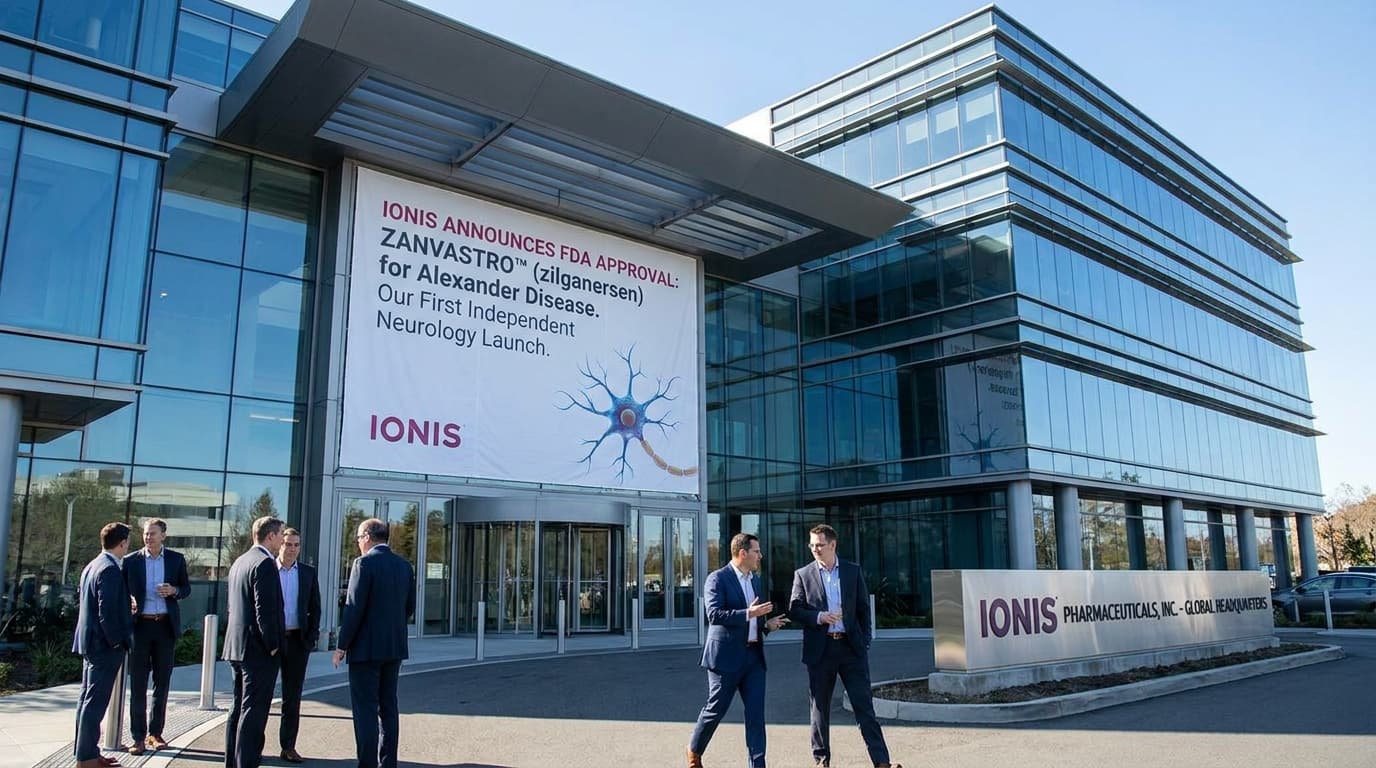
Ionis Wins FDA Approval For Zanvastro In Alexander Disease, Opening Its First Independent Neurology Launch

Zanvastro, formerly zilganersen, is an antisense oligonucleotide that lowers production of GFAP, the protein that accumulates in Alexander disease. For Ionis, the approval adds a commercial foothold in neurology as it prepares other RNA-based programs, including its Phase 3 effort in Angelman syndrome.
Ionis Pharmaceuticals has secured FDA approval for Zanvastro, formerly zilganersen, as the first disease-modifying treatment for Alexander disease, an ultrarare genetic leukodystrophy that previously had no approved treatment options. The approval arrived more than two weeks before the therapy’s Sept. 22 PDUFA date.
The decision gives Ionis its first independent neurology launch. While the company has a long history in the field through partnered medicines such as Spinraza and Qalsody, this is the first time it will commercialize its own neurology drug after building out its commercial infrastructure under CEO Brett Monia.
The data
Alexander disease affects as few as one in 3 million people worldwide and is caused by changes in the GFAP gene that lead to overproduction and toxic accumulation of the GFAP protein in glial cells in the central nervous system. That process can damage neurons and myelin over time, contributing to motor and cognitive dysfunction, loss of independence, and impaired control of swallowing, airway protection and purposeful movements.
Zanvastro is an antisense oligonucleotide designed to bind RNA and decrease the body’s production of GFAP. The FDA said it is the first therapy to directly target the protein buildup that drives the disease.
According to Ionis, the therapy met the primary endpoint in a Phase 3 trial that enrolled 49 patients ages 5 years and older. Patients who received a 50-mg dose of Zanvastro showed statistically significant and clinically meaningful stabilization of gait speed on the 10-meter walk test at week 61 versus patients who received no treatment.
The agency also described results from a separate open-label substudy in four patients younger than 2 years old. Because walking speed was not considered a reliable measure of progress in that age group, the study used a broader motor-skills assessment that included standing, walking, running and jumping. In that cohort, children treated with Zanvastro improved on the measure while the control group declined. The approval covers patients of all ages with Alexander disease.
The source material also adds an important limit on expectations. Amy Waldman of Children’s Hospital of Philadelphia, the lead investigator on Ionis’ Phase 3 trial, said stability is the main goal in rare leukodystrophies such as Alexander disease and that permanent neurologic damage is not expected to be reversed. That matters for how the approval is likely to be used in practice: the regulatory win rests on slowing progression in a degenerative disorder rather than on a claim of cure.
The commercial picture
For Ionis, Zanvastro extends a year in which the company has been moving from a platform developer toward a company launching its own products. The biotech already notched an independent commercial step in the cardiovascular field with Tryngolza, which won what William Blair called a “major market expansion” in June after its initial 2024 approval in familial chylomicronemia syndrome.
Zanvastro now gives Ionis a parallel foothold in neurology. In strategic terms, that matters beyond the very small size of Alexander disease itself. An approved product can help establish field teams, treatment-center relationships and operational experience that may support later launches in related rare neurologic conditions.
The road here
Ionis’ neurology credentials were built largely through partnerships before this approval. In 2016, Ionis and Biogen won approval for Spinraza, the first FDA-approved treatment for spinal muscular atrophy. In April 2023, the partners added Qalsody, described in the source as just the fourth-ever therapy for amyotrophic lateral sclerosis and the first to treat a genetic form of the disease.
That history gives context to why Zanvastro stands out internally. Ionis has been in neurology for years, but until now had not launched one of its own medicines in the category.
The approval also arrives as the company advances obudanersen in Angelman syndrome through the Phase 3 REVEAL study. That program faces a tougher mood after Ultragenyx reported that its own Angelman antisense candidate, apazunersen, failed a Phase 3 trial. Even so, Zanvastro shows that Ionis can convert a rare neurologic RNA program into an approved product, which is a meaningful operating signal as it tries to build a broader independent neurology business.
Join the BioIntel newsletter
Get curated biotech intelligence across AI, industry, innovation, investment, medtech, and policy delivered to your inbox.