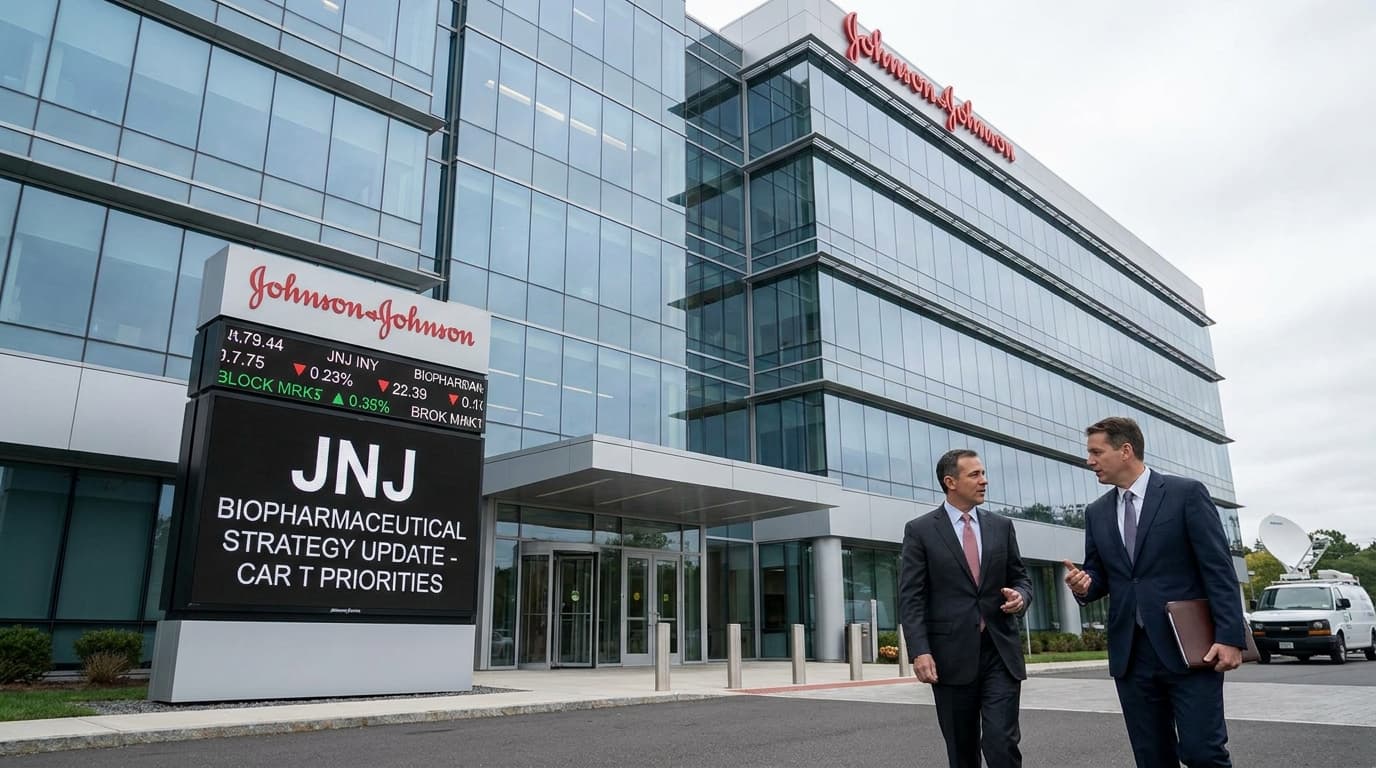
J&J Returns Prizlon-Cel To AbelZeta, Reordering Its CAR T Priorities After Early LBCL Data

AbelZeta said rights to prizlon-cel were returned in July, ending J&J’s hold on a large B cell lymphoma asset it had licensed for $245 million upfront through its former Janssen subsidiary. The strategic signal is not about the quality of a single early dataset so much as how large pharmas are pruning external cell therapy bets while adding capital to newer priorities such as in vivo CAR T.
Johnson & Johnson has given up rights to prizloncabtagene autoleucel, or prizlon-cel, an investigational CAR T therapy for third- or later-line large B cell lymphoma that it had previously licensed from AbelZeta Pharma.
AbelZeta said in a Sunday release that the rights were returned in July. The decision removes from J&J’s portfolio an asset that had shown strong early activity in relapsed or refractory large B cell lymphoma, and it suggests a reprioritization inside the company’s broader CAR T strategy rather than a simple read-through on the program’s underlying concept.
The road here
Through its former Janssen subsidiary, J&J paid $245 million upfront in May 2023 for the exclusive right to develop and commercialize prizlon-cel, along with other CAR T assets, outside the Greater China region. The companies also agreed to certain development, regulatory and sales milestones, though those amounts were not disclosed.
In December that year, the companies amended the deal to give J&J the option to obtain exclusive rights to prizlon-cel in China as well. The financial terms of that arrangement were also not disclosed.
The program’s status had already become less visible in J&J materials. BioSpace noted that prizlon-cel no longer appears on J&J’s pipeline page. The company had listed the asset, under the name JNJ-4496, in its full-year 2025 report in January, but it was no longer included in the first quarter presentation in April.
The data
In June last year, J&J reported Phase 1b results for prizlon-cel in large B cell lymphoma. Among dosed patients with relapsed or refractory LBCL who had received one prior line of therapy, all patients responded to treatment, and eight of 10 had a complete response.
For the 12 patients receiving the candidate as a third-line treatment, the overall response rate was 92% and the complete response rate was 75%.
At the time, analysts from Truist Securities described the results as “compelling” and said they represented what they viewed as an “encouraging step up” from Gilead’s Yescarta, which BioSpace identified as the current standard of care in LBCL. According to its label, Yescarta has a 65% complete response rate in the second-line setting.
The portfolio signal
J&J has not publicly explained the return of prizlon-cel, and BioSpace said it had reached out for details on both that decision and the status of the broader partnership. Without that explanation, the safest industry read is not to overinterpret one asset handback as a verdict on bispecific CAR T in lymphoma.
What is clear from the source is that J&J is shifting capital within cell therapy. Late last month, the company paid $785 million upfront and earmarked up to $140 million to partner with Sail Biomedicines on in vivo CAR T therapies for immune indications. That deal also gives J&J the option to acquire Sail in the future for $2.58 billion.
That contrast matters. J&J is stepping away from an ex vivo oncology CAR T asset that had posted promising early numbers while committing larger current capital to a platform aimed at in vivo CAR T. For AbelZeta, the return restores control over prizlon-cel. For J&J, it points to a narrower set of priorities in a CAR T market where platform selection is starting to matter as much as individual response rates.
Join the BioIntel newsletter
Get curated biotech intelligence across AI, industry, innovation, investment, medtech, and policy delivered to your inbox.