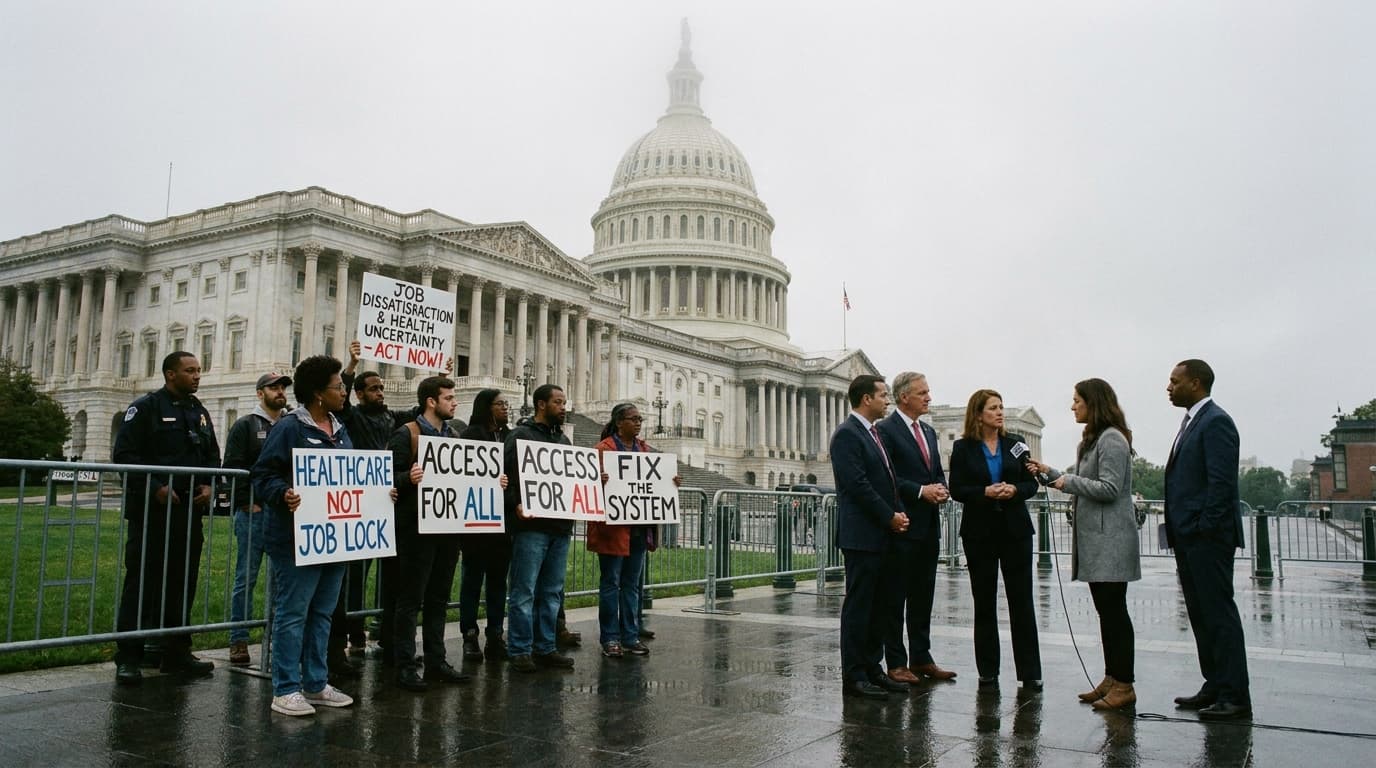
Job Dissatisfaction and Health Care Access Uncertainty Grows in the U.S., New Study Finds

Growing job dissatisfaction and uncertainty over healthcare access are converging in the U.S., according to a new study and supplementary reporting. The findings underscore how the nation's healthcare system shapes labor markets, household well-being, and public health, making this a pivotal moment for policymakers and employers to reconsider entrenched benefits structures.
Introduction
The state of workplace satisfaction and healthcare access in the United States continues to draw considerable scholarly and policy interest. In the latest developments, a new study has shone a spotlight on the combined effects of job dissatisfaction and the persistent problem of uncertain health care access. This long-standing challenge has been exacerbated by economic pressures, evolving workforce expectations, and concerns heightened by recent large-scale events.
Background: A Nation at the Crossroads of Employment and Health
For decades, the United States has linked healthcare access to employment more closely than most other developed countries. This system, while designed to provide stability and coverage for many, has also created vulnerable points in the safety net—not least, the phenomenon known as "job lock." This occurs when workers feel unable to leave unsatisfying or unfulfilling jobs for fear of losing employer-sponsored health insurance. According to a growing body of evidence, job lock is not only a drag on personal well-being but also an impediment to labor mobility, entrepreneurship, and broader economic dynamism.
The new study, as outlined in the recently published article, builds on this foundation and lays bare the continued friction experienced by millions of Americans as they navigate their work and health coverage options.
Key Findings of the Study
The study's headline finding is particularly striking: Job dissatisfaction is on the rise across major sectors of the U.S. labor force. Coupled with this trend is the deepening uncertainty about healthcare access, especially as shifting economic circumstances and policy changes threaten to disrupt the coverage protections on which so many depend.
Among the details reported:
- A significant proportion of U.S. workers express ambivalence or active dissatisfaction with their current job roles.
- For many, the health insurance provided by their employer is the primary reason for staying in a given position, even when it is otherwise unsatisfying.
- The complexity and cost of securing comparable insurance independently—through public exchanges or private markets—often serves as a powerful deterrent to changing jobs or pursuing self-employment.
- Recent marketplace dynamics, such as the disenrollment of 4.5 million people from the Supplemental Nutrition Assistance Program (SNAP) and lessons from large-scale disasters like the Hawaii wildfires, have put additional pressure on the public and policymakers to confront these issues head-on.
The Human Dimension: Stories from Workers
Beneath the statistics are the stories of ordinary Americans trapped by the current system. Workers report feeling stuck in unfulfilling positions out of a realistic fear of losing access to essential care for themselves or their dependents. For the millions facing chronic health conditions or relying on ongoing medication, the prospect of losing insurance is far from theoretical—it represents a real threat to health and financial stability.
Job dissatisfaction is not a trivial matter; it is deeply entangled with mental health outcomes. Workers facing unyielding pressure, poor management, or workplace toxicity are at increased risk of depression, anxiety, and related illnesses. Yet, the perceived risk of losing employer-provided health benefits keeps many from seeking new opportunities or advocating for workplace changes.
Intersections with Broader Health Policy Debates
The timing of this study is noteworthy, coming as legislators and health policy experts debate potential reforms to employer-sponsored insurance, public coverage options, and workplace protections. In recent years, shifts in Medicaid policy, the ongoing recalibration of the Affordable Care Act marketplaces, and proposals around portable benefits have all featured prominently in national discourse. However, the persistence of job lock and the unevenness of health access continue to raise thorny questions about equity, efficiency, and the role of employers in providing social welfare.
Additionally, the political context remains fraught. Ongoing debates about health insurance coverage, benefit adequacy, and public subsidies are as fierce as ever. The disenrollment from SNAP cited in the article, for instance, highlights how swiftly circumstances can change for millions of households, particularly in the absence of robust and universal protections.
Policy Implications and Proposals
Some policymakers and thought leaders have called for decoupling health care from employment entirely. Their arguments stem from observations in countries where health coverage is universal and not contingent on job status, which tend to report higher labor mobility, stronger small business growth, and arguably more contented workforces.
Others propose incremental reforms, such as strengthening public marketplaces, expanding Medicaid access, or introducing a public insurance option within existing frameworks. There is also interest in legislative fixes to reduce or eliminate pre-existing condition exclusions, limit discrimination based on health status, and provide tax credits or other subsidies to smooth transitions.
Whatever the path forward, it is clear from the study that continued inaction risks both individual hardship and broader economic malaise. The costs of job lock and coverage instability extend beyond the directly affected workers, touching on wider issues of productivity, public health, and even innovation.
Employer Challenges and Evolving Benefits Strategies
Employers are also stakeholders in this conversation. Business leaders and human resources professionals recognize that dissatisfaction and forced retention due to benefit lock-in is counterproductive. Progressive companies are experimenting with expanded benefits, flexible work arrangements, and even direct contributions to portable insurance accounts in an effort to reduce employee stress and turnover.
Nevertheless, for many mid-sized and small businesses, the complexity and expense of managing health benefits remain daunting. The administrative burden—alongside the inherent risk of destabilizing coverage for employees—has led some to advocate for greater government involvement or pooled risk solutions.
Lessons from Recent Crises: Hawaii Wildfires and Beyond
The article references the health recovery following Hawaii’s wildfires as an illustrative example of how disaster can drive both innovation and renewed attention to systemic weaknesses. In disaster recovery contexts, health care and social supports are often decoupled from employment, at least temporarily, offering a glimpse of alternative models for care and support.
The urgent challenge, as underscored by both the wildfires and economic shocks such as mass SNAP disenrollment, is to ensure that coverage and care extend to all, regardless of employment status or income.
The Road Ahead: Questions for Policymakers, Employers, and Individuals
The issues described by the study raise several critical questions for the road ahead:
- What are the social and economic costs of tying health coverage so closely to employment in the U.S. context?
- How can policymakers create a more resilient and flexible insurance landscape that protects transitions between jobs, careers, and life stages?
- In what ways can employers adapt to better serve worker needs while balancing competitive advantages and cost concerns?
- What lessons can be drawn from disaster recovery and emergency response efforts that might inform broader health system reform?
- How do public programs and safety-net policies intersect with private coverage, and how can redundancies or gaps be minimized?
Conclusion
Job dissatisfaction is not merely a workplace management or personal problem. It intertwines with broader social, economic, and policy determinants—and nowhere is this more visible than in the ongoing debate over health care access. The study’s findings lay down a marker for those inside and outside the policy arena, highlighting the urgent need to address both the lived reality of job lock and the deeper uncertainties around health coverage. Going forward, the analysis and attention this issue receives will likely play a considerable role in shaping not just labor markets, but also national debates around equity, health, and economic productivity.
For a closer look at the study and its implications, consult the original reporting at STAT News.
Join the BioIntel newsletter
Get curated biotech intelligence across AI, industry, innovation, investment, medtech, and policy delivered to your inbox.