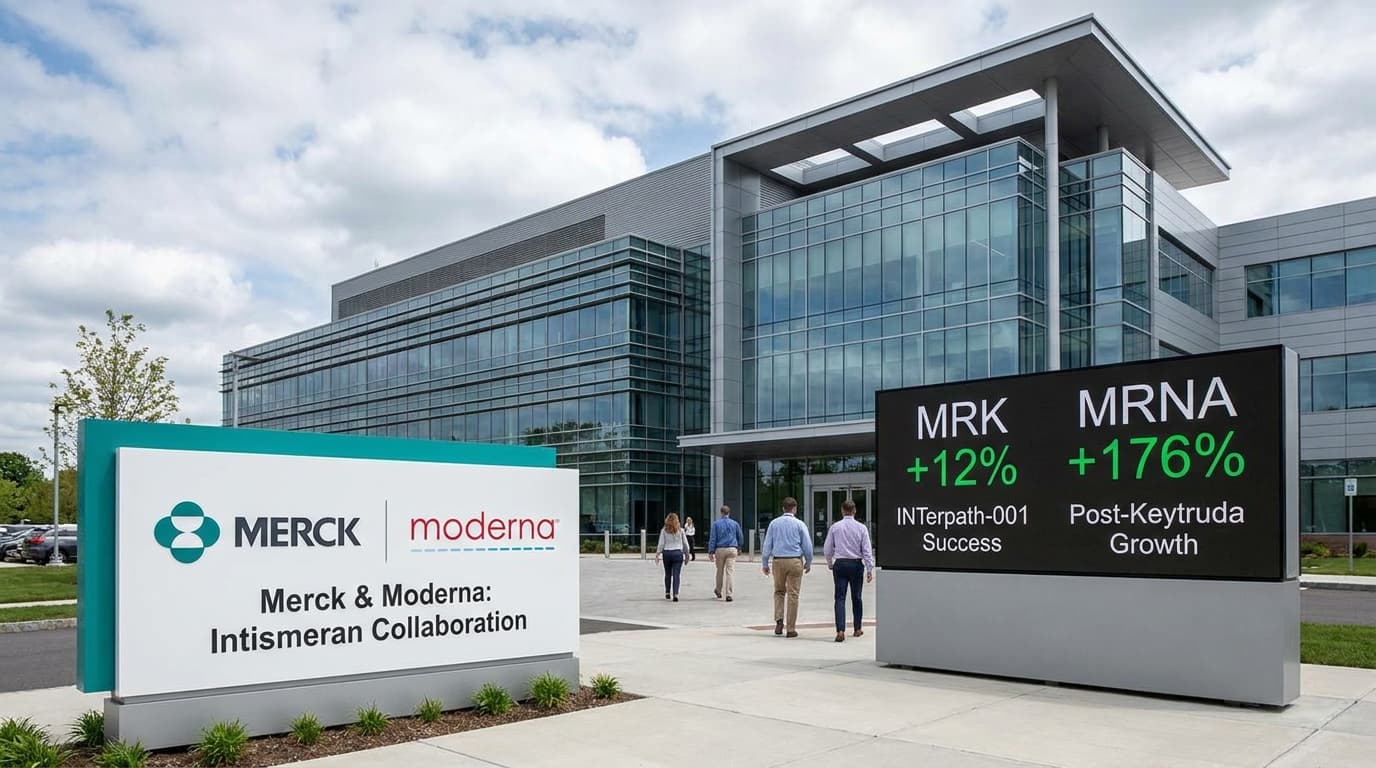
Merck And Moderna Advance Intismeran After INTerpath-001 Success, Clarifying Post-Keytruda Revenue Options

Patients treated with Keytruda plus intismeran autogene lived longer without recurrence than patients on Keytruda alone in the Phase 3 INTerpath-001 study. For Merck, the significance is broader than one melanoma readout: it adds a new potential revenue stream as the company prepares for Keytruda’s patent slide starting in 2028.
Merck’s Phase 3 success with Moderna-partnered intismeran autogene in cutaneous melanoma did more than validate an individualized cancer vaccine approach. It gave investors a clearer basis for thinking about Merck’s oncology growth options as Keytruda, still one of the industry’s biggest products, begins sliding off patent in 2028.
The immediate market reaction reflected that shift in expectations. Merck shares ended Wednesday up 12% at $152.20, while Moderna shares rose 176% to $174.38 after the companies said the INTerpath-001 trial met its primary endpoint of recurrence-free survival. Patients who received Keytruda plus the mRNA-based vaccine lived longer without their cancer returning than those who received Keytruda alone.
The Commercial Picture
The strategic importance for Merck is that intismeran now looks less like an optional research effort and more like a candidate contributor to the company’s post-Keytruda plan. BMO Capital Markets wrote that “Merck sentiment continues to improve as Keytruda solution becomes clearer,” adding that while Merck may not be able to outright grow through the Keytruda loss of exclusivity, updates like INTerpath-001 support the view that it has a meaningful revenue growth strategy beyond the drug.
That matters because Keytruda has been approved in dozens of oncology indications and rose to the top of pharma’s sales rankings before being recently overtaken by Eli Lilly’s GLP-1 franchise. Merck has already been trying to prepare for the eventual decline through other oncology assets, including antibody-drug conjugates such as the TROP2-directed candidate sac-TMT, and through lifecycle management that included an FDA green light last September for a subcutaneous version of Keytruda.
What changed this week is that the Moderna collaboration appears to have moved into that same planning conversation. BMO said investors had viewed neoantigen programs such as INTerpath-001 as risky because of mixed data to date and the novelty of the approach. With many expecting failure, the positive result creates a new asset of consequence in a part of the pipeline that had not been carrying much weight in investor models.
BMO predicted the melanoma program alone could be worth $2 billion in unadjusted peak revenue. Across multiple indications, the firm put the opportunity at $5.6 billion in unadjusted peak revenue. Merck will split profits 50/50 with Moderna, but even a shared economics structure can still matter if the market had previously assigned little value to the program.
The Road Here
Before the readout, Merck’s post-Keytruda narrative depended heavily on whether newer internal assets and line extensions could compensate for biosimilar and pricing pressure later this decade. The company had also tried to extend the franchise by pursuing a new formulation, though the source notes that Keytruda will still begin losing patent protection in 2028 despite those efforts.
In that context, intismeran’s success does not remove the scale of the challenge, but it does diversify the set of answers. The vaccine combines with Keytruda rather than replacing it outright, which is commercially useful in the near term and strategically useful longer term because it shows Merck can still extract additional oncology value from a franchise nearing exclusivity loss.
Guggenheim noted that more detailed data from INTerpath-001 will be presented at an upcoming medical meeting. The firm said that if those data are as encouraging as they now appear, intismeran could become an important part of Merck’s growth story as it navigates biosimilar and pricing pressure for Keytruda starting later this decade.
What To Watch
The next question is whether melanoma can translate into other tumors. Intismeran is also being tested in renal cell carcinoma, lung cancer and other advanced types of melanoma. According to BMO, the Phase 2 renal cell trial will read out first in April 2027.
That expansion path is the real signal for the broader Merck story. A positive melanoma trial is meaningful, but the larger strategic value comes if the companies can show this individualized vaccine approach has utility beyond a single setting. BMO said translation from melanoma to other solid tumors is not certain, while also arguing there is now more reason to be optimistic about those indications after the INTerpath-001 result.
Join the BioIntel newsletter
Get curated biotech intelligence across AI, industry, innovation, investment, medtech, and policy delivered to your inbox.