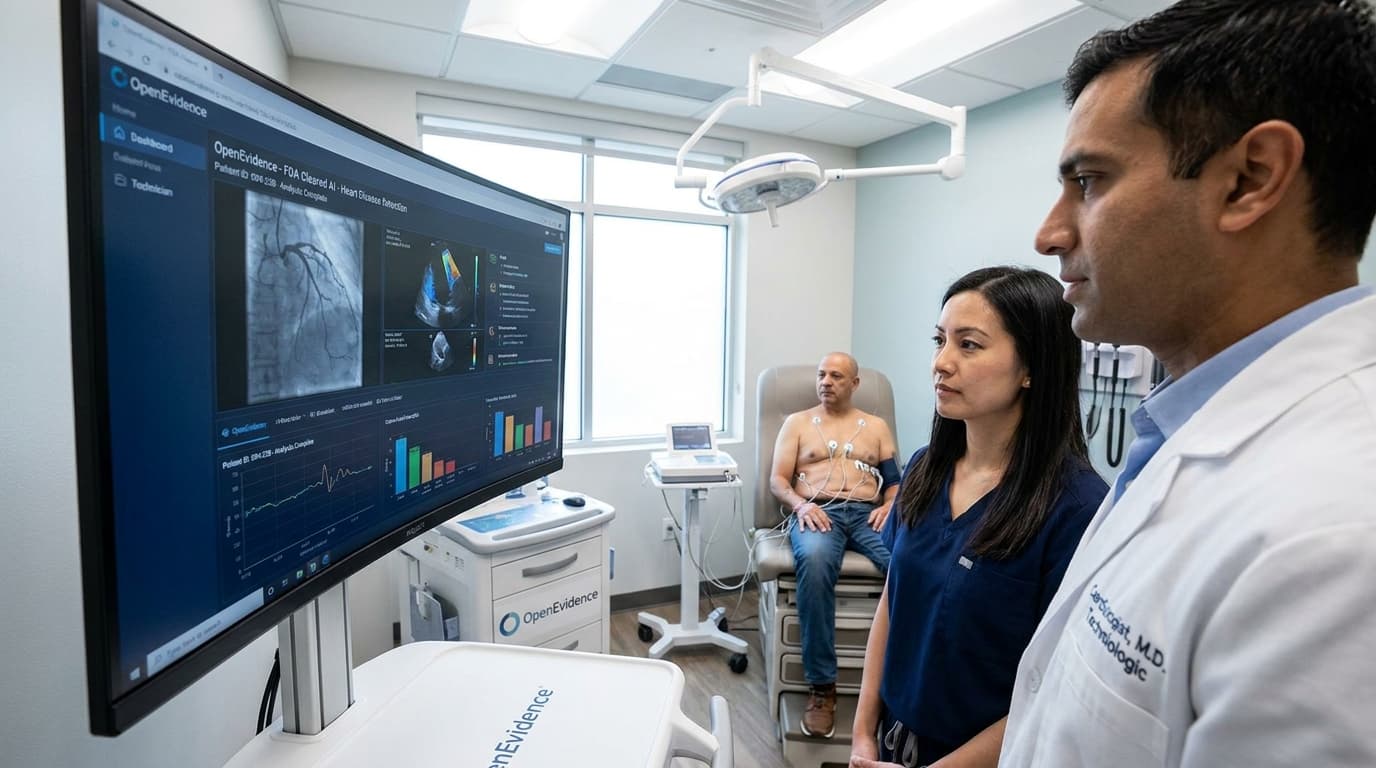
OpenEvidence to Integrate FDA-Cleared AI for Heart Disease Detection: A Closer Look at Tech’s Growing Role in Cardiology

As OpenEvidence prepares to integrate a newly FDA-cleared AI tool into its platform for heart disease detection, the intersection of machine learning and cardiovascular healthcare takes a significant leap forward. This development draws attention not only for its clinical applications, but also for the broader context of how regulated artificial intelligence is reshaping treatment paradigms and approaches to chronic disease worldwide.
Introduction
OpenEvidence, a prominent player in the health technology sector, is making headlines with its decision to integrate a newly FDA-cleared artificial intelligence (AI) solution designed for detecting heart disease. The platform’s focus on AI-powered diagnostics reflects the escalating role of machine learning and automation in medicine, specifically in cardiology—a domain historically dependent on nuanced clinical judgments and complex, multifactorial risk assessments.
This move raises multiple questions: What are the regulatory and clinical implications of deploying AI in such a critical area of medicine? How does this advance fit into the larger landscape of AI adoption in healthcare? And, importantly, what’s next for clinicians, patients, and competing health tech vendors? Here, we unpack the latest announcement and explore its broader significance across the digital health sphere.
Understanding the News: What OpenEvidence is Implementing
According to STAT Health Tech, OpenEvidence is set to deploy new AI technology, which has recently received FDA clearance, focused specifically on detecting heart disease. The FDA’s regulatory stamp is nontrivial—while AI projects abound in the research ecosystem, only a narrow segment achieve the level of validation needed for clinical use in the United States. OpenEvidence’s integration marks a transition point from theoretical promise to practical, sanctioned deployment.
What Does It Mean to Have FDA Clearance?
FDA clearance is a signal that a medical device or software—here, an AI algorithm—has demonstrated an acceptable level of safety and efficacy relative to other devices on the market. For AI in cardiology, this often implies rigorous retrospective and prospective validation, examination of potential for bias, and a demonstrated improvement or equivalency to existing diagnostic pathways such as physician interpretation or traditional risk scoring tools.
The focus on heart disease is no coincidence: Cardiovascular diseases remain the leading cause of mortality worldwide, representing billions in healthcare expenditures and affecting millions of lives each year. Early detection offers enormous potential for improving patient trajectories and reducing hospitalizations.
The AI Revolution in Cardiology: Context and Catalysts
Historical Perspective: Diagnostic Tools and Their Evolution
The field of cardiology has been at the forefront of adopting technological advances, from EKGs and echocardiography to stress tests and remote telemetry. However, each leap in diagnostic fidelity and usability has depended, in large measure, on innovations from both device manufacturers and software developers. AI is increasingly being positioned as the next inflection point, promising greater speed, precision, and scalability than many previous modes of innovation.
Why Heart Disease?
Heart disease poses unique diagnostic challenges. Conditions such as coronary artery disease or arrhythmias often present with variable, non-specific symptoms. Early detection requires not just raw data, but sophisticated interpretation of complex biomarkers—an area tailor-made for AI and machine learning. By ingesting large volumes of data from EKGs, imaging, patient history, and even genomics, AI can potentially surface patterns that elude even experienced cardiologists.
From Research to Reality: How Does the AI Work?
While specifics about the algorithm are not detailed in the source, it is typical for FDA-cleared cardiology AIs to rely on deep learning models trained on large, well-annotated datasets. These models learn to identify abnormalities, such as those in electrocardiograms (EKGs) or imaging results, with sensitivity and specificity sometimes matching or exceeding generalist clinicians.
The value proposition is clear: more rapid triage, reduction in diagnostic errors, and potential to catch rare or early-stage pathology that might otherwise be overlooked in a busy clinic.
Regulatory and Clinical Challenges
While AI’s potential is significant, it is not without its challenges. The FDA’s clearance process has grown more robust in recent years, with a focus on algorithm transparency (“explainability”), data provenance, and ongoing monitoring of post-market performance. Key concerns remain:
-
Bias and Generalizability: Algorithms trained on limited or non-diverse data sets risk underperforming in populations underrepresented in training cohorts, posing potential risks to health equity.
-
Physician Trust and Workflow Integration: Even with FDA clearance, uptake depends on seamless workflow integration and sustained clinician trust in AI outputs. Training, support, and professional society endorsement may all be necessary to drive real-world adoption.
-
Continuous Learning vs. Static Approval: As AI models “learn” and adapt, there is a regulatory debate on when—and how—subsequent model updates require additional FDA scrutiny.
Industry Impact: Digital Health Competitiveness Intensifies
The incorporation of AI into cardiology is not unique to OpenEvidence. Major device manufacturers, health systems, and digital health startups have all entered this space, each vying to demonstrate superior outcomes and value. FDA clearance, however, remains a differentiator, and OpenEvidence’s willingness to submit its tech to this level of oversight may help establish credibility in a crowded market.
Furthermore, regulatory endorsement could attract additional investment and partnerships, especially as payers increasingly seek to reimburse digital tools that drive measurable improvements in chronic disease management.
Broader Implications for Healthcare Stakeholders
For Clinicians
Physicians and care teams should anticipate a gradual but marked increase in the availability and sophistication of AI-powered support tools. Continued education—both on the strengths and limitations of these tools—will become vital.
For Patients
Patients stand to benefit from more timely, accurate diagnoses. However, they may also need reassurance about data privacy, algorithmic accuracy, and the continuing presence of human oversight in the diagnostic process.
For Regulators and Policymakers
Emergence of AI as a mainstream diagnostic aid underscores the need for evolving frameworks that can keep up with technological advances while safeguarding public safety and promoting equitable access.
Next Steps and Unanswered Questions
It remains to be seen how quickly OpenEvidence’s new tool will be adopted in clinical settings, and what metrics will define its success. Will the algorithm prove valuable in rural or resource-constrained hospitals as well as academic centers? How will it handle edge cases or ambiguous presentations?
Further, will this integration open the door to reimbursement by government and private payers? Clinical adoption at scale often depends on clear pathways to coverage and payment.
Conclusion
OpenEvidence’s move to add FDA-cleared AI for heart disease detection spotlights the accelerating intersection of regulatory rigor and ambitious innovation in digital health. As policymakers, clinicians, patients, and competing vendors watch closely, the story may serve as a bellwether for broader AI adoption across chronic disease management and the future of care delivery.
For now, the conversation around regulated AI in healthcare continues to grow more urgent—and more complicated—as technology outpaces traditional modes of clinical decision support. The successful implementation and scale-up will provide valuable lessons not just for the field of cardiology but for digital medicine more broadly.
Join the BioIntel newsletter
Get curated biotech intelligence across AI, industry, innovation, investment, medtech, and policy delivered to your inbox.