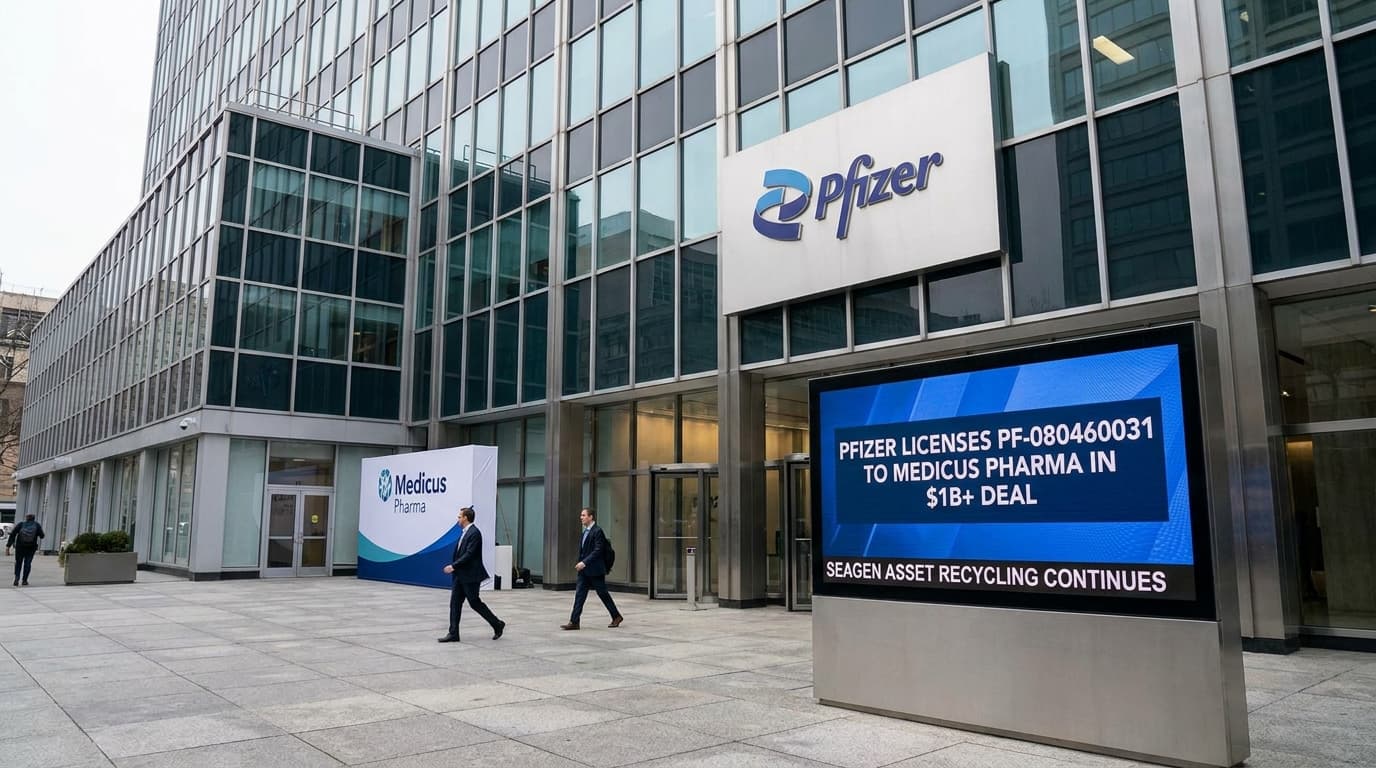
Pfizer Transfers PF-08046031 To Medicus In Up To $1B-Plus Deal, Extending Seagen Asset Recycling

Medicus will pay $12 million upfront and another $15 million on Sept. 2, 2027, according to an SEC filing, while Pfizer also contributed $2 million to support the program. The transaction shows how large acquirers can keep economic exposure to discontinued assets without carrying full development costs.
Pfizer has found a buyer for PF-08046031, an antibody-drug conjugate it picked up in the $43 billion Seagen acquisition and then discontinued earlier this year. Medicus Pharma is paying $12 million upfront for rights to the drug, with Pfizer also eligible for royalties and more than $1 billion in development, regulatory and sales milestones if the asset reaches the market.
According to a filing with the Securities and Exchange Commission cited by Fierce Biotech, Medicus also owes Pfizer another $15 million on Sept. 2, 2027, the first anniversary of the deal. Pfizer separately contributed $2 million to help Medicus begin work on the program.
Deal structure and program control
PF-08046031, also called CD228V, targets melanotransferrin, or CD228, a protein that Fierce said is highly expressed in melanoma and several other solid tumors. There are currently no approved drugs that target CD228.
Medicus is responsible for development, but the agreement gives Pfizer more than a passive economic interest. Medicus must provide development plans and budgets to Pfizer for review and comment, and Pfizer has the option to fund all or part of product development after a trial has started that Fierce described as pivotal.
That structure suggests Pfizer is keeping a way back into the asset if later-stage data improve, while shifting near-term execution risk and cost to Medicus.
The road here
Pfizer’s discontinued phase 1 trial of PF-08046031 began in May 2025 and primarily focused on advanced melanoma while also exploring lung, head-and-neck and esophageal tumors. The company had shelved the ADC earlier this year before striking this out-license.
The broader signal is that Pfizer is continuing to sort through the Seagen portfolio it bought in 2023, using external deals to preserve upside from programs it no longer wants to advance internally. Fierce noted that another ADC acquired in the Seagen buyout recently failed a phase 3 lung cancer study, the first late-stage data readout for a former Seagen asset. In that context, the Medicus agreement looks less like a simple divestiture than a portfolio-management move aimed at monetizing a deprioritized program without fully severing exposure.
Join the BioIntel newsletter
Get curated biotech intelligence across AI, industry, innovation, investment, medtech, and policy delivered to your inbox.