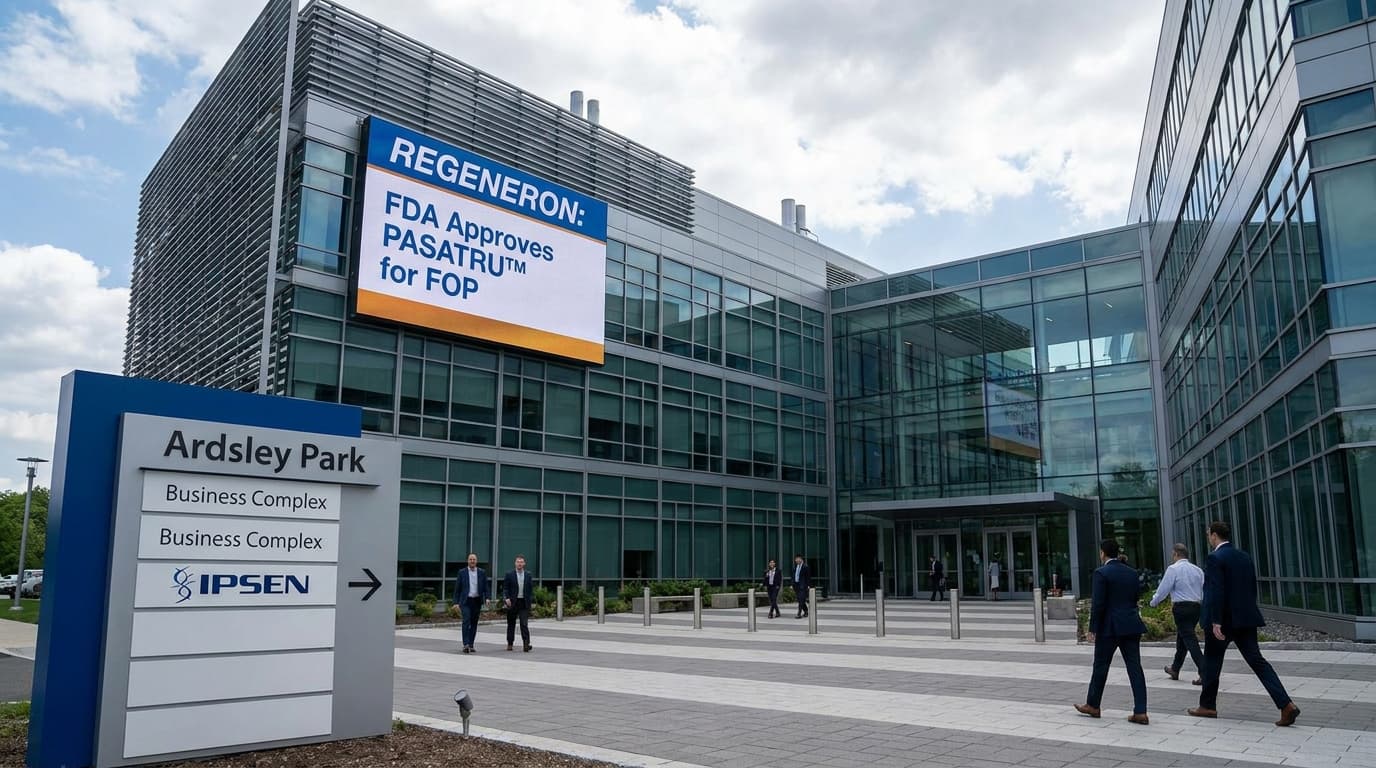
Regeneron Wins Pasatru Approval In FOP, Opening A Second U.S. Drug Market Against Ipsen

The approval covers Pasatru, also known as garetosmab and REGN2477 during development, to reduce new heterotopic ossification lesions and clinician-assessed flare-ups in adults with FOP. The launch changes the structure of a market that had only one approved drug, with Mirum Pharmaceuticals also approaching an FDA decision on zilurgisertib by Sept. 26.
Regeneron has won FDA approval for Pasatru in fibrodysplasia ossificans progressiva, giving the company its first commercial foothold in an ultrarare bone disease where it helped identify the biology behind pathological bone formation. The approval covers adults with FOP and allows use of the antibody to reduce the formation of new heterotopic ossification lesions and clinician-assessed flare-ups.
The decision also turns FOP from a single-product U.S. market into a competitive one. Ipsen’s Sohonos, approved in 2023 after a development program marked by clinical and regulatory setbacks, had been the only FOP drug on the market. Regeneron now enters with an infused antibody and a mechanism tied directly to the company’s earlier discovery that Activin A is the ligand responsible for heterotopic ossification in FOP.
The data
Pasatru, called garetosmab and REGN2477 during development, won approval on Phase 3 results showing that two doses reduced total new heterotopic ossification lesions versus placebo. Investigators recorded 19 new lesions in the 21 patients on placebo and three new lesions in the 42 patients treated across two Pasatru dose cohorts.
The recommended starting dosage is 10 mg/kg, the higher of the two doses studied in Phase 3. Patients receive the antibody intravenously for one hour every month. If a patient does not tolerate that dose, they can step down to 3 mg/kg, the lower Phase 3 dose, while still receiving a 60-minute monthly infusion.
Regeneron said Pasatru was designed for use across a range of care settings, including at home when appropriate. That is not a minor logistical feature in FOP, where mobility often deteriorates as bone forms in muscles, tendons, ligaments and other connective tissues. Regeneron said most patients are wheelchair-bound by age 30.
The commercial picture
FOP remains a very small market, with about 900 people diagnosed with the disease, but the approval is strategically meaningful because a second entrant can expand treatment choice even in a narrowly defined population. Ipsen disclosed that, in the first half of 2026, Sohonos contributed to the €11.4 million ($13.4 million) in sales generated by its rare disease drugs apart from Iqirvo and Bylvay.
That revenue figure does not isolate Sohonos, but it does show that FOP is currently a commercial niche within a broader rare disease business rather than a large standalone franchise. Regeneron’s opportunity, then, is less about headline market size than about whether its clinical profile and treatment format can shift physician preference in an ultrarare setting where patient access and administration burden matter.
Competition may not stop at two products. Mirum Pharmaceuticals has predicted that zilurgisertib, which it licensed from Incyte, could generate peak sales of more than $200 million. The drug is under review at the FDA, with an approval decision date of Sept. 26, and Mirum is seeking approval for patients 12 years of age and older.
The road here
Regeneron’s FOP program traces back to 2015, when company researchers published a paper describing the unexpected discovery of Activin A as the driver of heterotopic ossification in mouse models of FOP. The company moved the anti-Activin A antibody into a Phase 1 trial in 2016.
That history gives the approval added weight. In rare disease, companies often commercialize assets acquired after the core biology has been established elsewhere. Here, Regeneron is bringing to market a drug that emerged from its own mechanistic work, turning a target discovery into an approved product.
The approval is still narrow in one important respect. Regeneron’s Phase 3 study enrolled only adults, while Mirum is already seeking an adolescent label extension down to age 12. Regeneron plans to start a trial in children and adolescents this year. That leaves the company with a near-term commercial win, but also with label expansion work ahead if it wants to defend position in a market that may soon have multiple competitors with differing age coverage.
Join the BioIntel newsletter
Get curated biotech intelligence across AI, industry, innovation, investment, medtech, and policy delivered to your inbox.