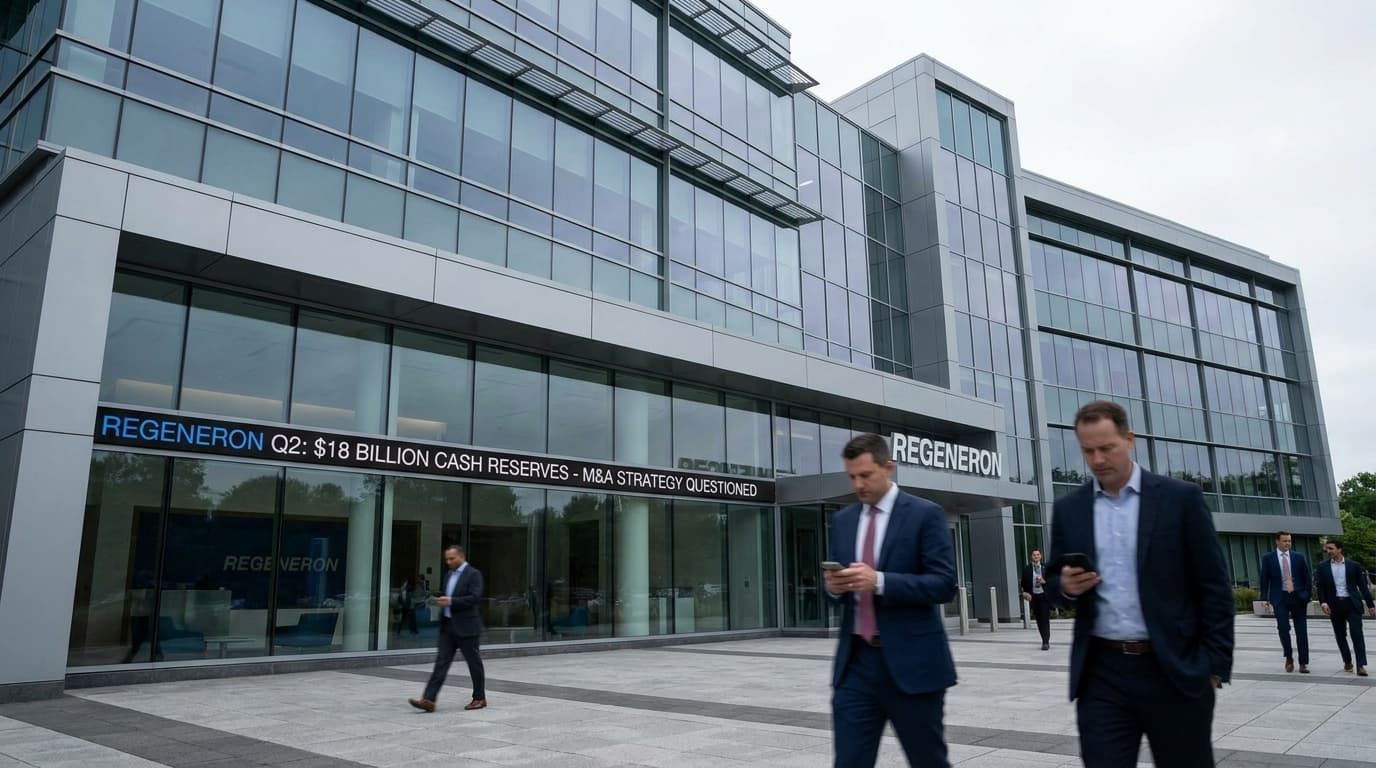
Regeneron’s Cautious M&A Strategy Under Scrutiny Despite Strong Q2 Performance

Regeneron has faced mounting pressure from investors and industry watchers to engage more actively in mergers and acquisitions (M&A), following an exceptionally strong second quarter that has built an $18 billion war chest. However, the company’s reticence to pursue major deals is attracting renewed scrutiny amid recent clinical setbacks, raising questions about its long-term growth strategy in a rapidly consolidating industry.
As Regeneron reports a standout second quarter in 2026, with strong financials propelling its cash reserves to a formidable $18 billion, new and more pointed debates emerge regarding its reluctance to participate aggressively in biopharma mergers and acquisitions. The company’s notable stockpile not only reflects prudent financial management and operational outperformance but also puts its strategic choices under a sharper microscope. This tension is heightened by recent disappointments in Regeneron's clinical pipeline, with trial setbacks creating urgency around the case for pursuing external growth.
Financial Highlights: War Chest in Focus
The company’s Q2 numbers reveal healthy revenue growth, operational efficiency, and a steadily accumulating cash position. Regeneron’s R&D investments are ongoing, but even after expenditures, the company’s ability to amass major capital stands out among its peers. Analysts and shareholders alike have characterized Regeneron’s current financial standing as robust—a testament to years of consistent product performance and, perhaps, conservative portfolio management.
Heightened Calls for M&A Activity
With many competitors turning to M&A as a vehicle for pipeline growth and innovation access, Regeneron’s aversion to bold dealmaking is coming under intense scrutiny. Investors are increasingly vocal, suggesting that continued organic growth may not be enough to sustain momentum in an environment where larger players are actively fortifying pipelines through acquisition. Peer companies, faced with similar clinical uncertainties, have often turned to acquisitions to offset risk and diversify.
The expectation grows that Regeneron should leverage its cash-rich balance sheet to pursue value-accretive targets—whether younger biotechs with breakthrough science or late-stage assets that could fill therapeutic gaps.
Clinical Trial Setbacks and Pipeline Uncertainty
The debate over dealmaking is further fueled by Regeneron’s recent clinical disappointments. Trial setbacks, while part of the inevitable risk of drug development, become more material when alternative strategies for mitigating these risks are available. The question confronting Regeneron leadership—and, by extension, its investors—is whether a more aggressive M&A stance could have cushioned or offset internal R&D challenges.
Industry Perspective: The Role of M&A in Biopharma Survival
Deal activity across biopharmaceuticals continues to shape the landscape, with players of all sizes looking beyond their own walls to maintain growth and pipeline robustness. In this context, Regeneron’s “aversion” to acquisitions stands in contrast to market trends. Stakeholders point out that holding large reserves risks erosion of competitive advantage if not strategically deployed. Especially in times of pipeline volatility, M&A can offer an insurance policy against scientific risk concentration.
Cultural and Strategic Considerations
Regeneron has a history of favoring innovation sourced internally, priding itself on scientific discipline and development expertise. This approach has served the company well, underpinning several notable commercial successes. Yet, the shifting industry dynamics and intensifying competition in therapeutic innovation have prompted many to argue this approach may now be too conservative.
The cultural question thus arises: should Regeneron pivot in response to market pressures, or double down on its established ethos?
Analyst and Shareholder Reactions
Market responses have been mixed. Some remain confident in Regeneron’s foundational strength and long-term prospects as an innovator, even without bold external growth moves. Others, especially those seeking faster returns or diversification of risk, worry that inaction could translate into missed opportunities at a time when competition for the best assets remains intense.
Ongoing communication from company leadership about the rationale and thresholds for considering deals will be essential to shape perception and investor trust.
The Competitive Landscape and Forward Outlook
With an $18 billion war chest, Regeneron retains flexibility that few of its rivals can match. The main question is whether the company will choose to use its considerable resources to pursue immediate pipeline reinforcements, or whether it will remain steadfast in its historical restraint. The outcome will not only define the next chapter for Regeneron but may also set a tone for other companies facing similar dilemmas in the current biotech environment.
Conclusion
Regeneron’s Q2 performance underscores its operational and financial strength, but also places a spotlight on the strategic decisions that will dictate its future. As clinical trial risks and emerging competition threaten to outpace organic growth, the chorus calling for dealmaking grows louder. Whether Regeneron’s next move aligns with this pressure, or remains true to its internal focus, will remain one of the major industry narratives in the coming quarters.
Source: BioSpace
Join the BioIntel newsletter
Get curated biotech intelligence across AI, industry, innovation, investment, medtech, and policy delivered to your inbox.