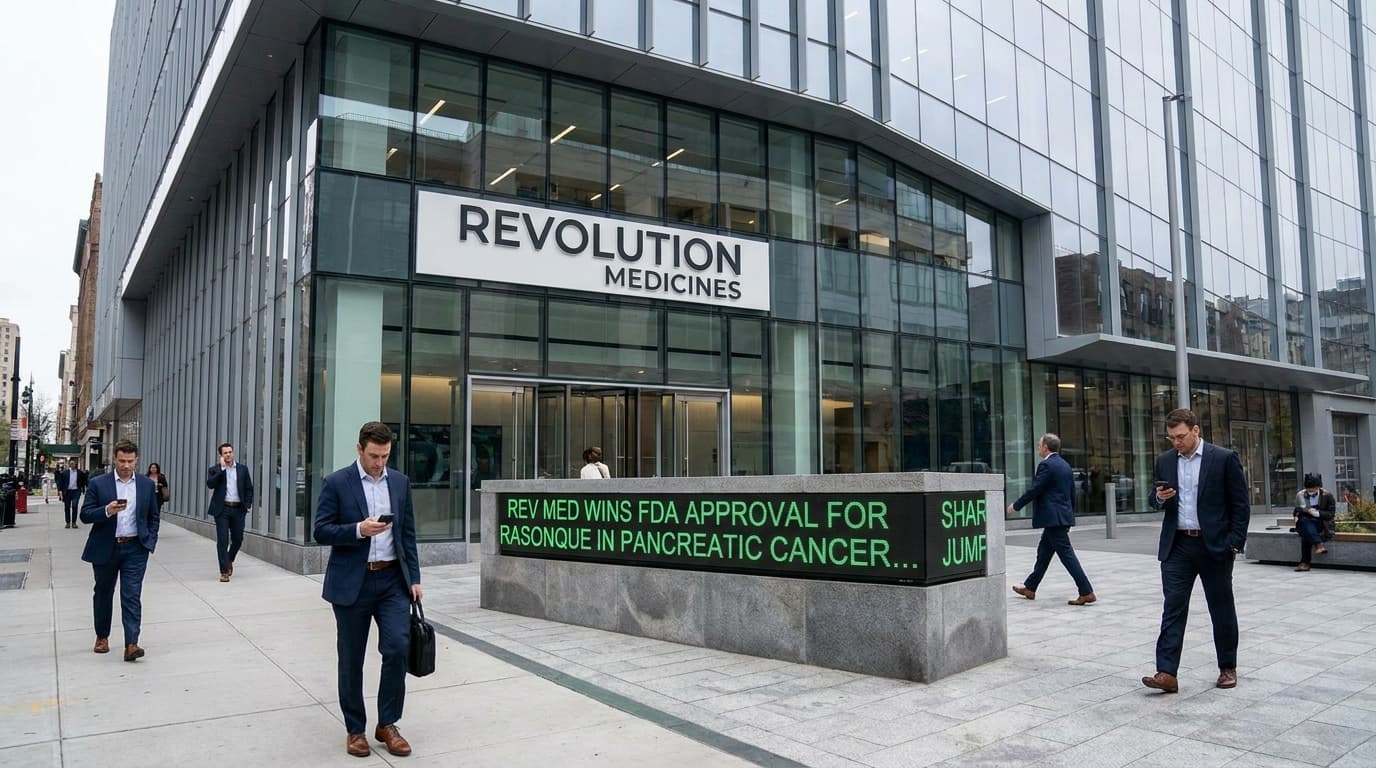
Revolution Medicines Wins FDA Approval For Rasonque In Metastatic Pancreatic Adenocarcinoma, Months Ahead Of Deadline

Rasonque was cleared for adults with metastatic pancreatic adenocarcinoma who have received at least one prior systemic therapy or are not candidates for multiagent systemic therapy. The approval arrived more than half a year before the Prescription Drug User Fee Act deadline after a review that included the FDA’s Commissioner’s National Priority Voucher program.
Revolution Medicines has secured FDA approval for daraxonrasib, which will be sold as Rasonque, for adults with metastatic pancreatic adenocarcinoma. Across the event’s sources, the approval is framed as an unusually important advance in a cancer setting where treatment gains have been scarce and outcomes remain poor.
The label covers patients who have received at least one prior systemic therapy or who are not candidates for multiagent systemic therapy, according to BioSpace. Fierce Biotech described the product as a pill for patients with pretreated pancreatic adenocarcinoma. The decision came more than half a year before the deadline set by the Prescription Drug User Fee Act, Angelo de Claro, M.D., director of the FDA’s Oncology Center of Excellence, said in an agency press release cited by Fierce Biotech.
The Data
The approval was backed by phase 3 results from the RASolute 302 trial. BioSpace reported that patients treated with daraxonrasib achieved median overall survival of 13.2 months, compared with 6.7 months for chemotherapy. STAT likewise described Rasonque as a second-line treatment in advanced pancreatic cancer and said the medicine was supported by a trial in which median overall survival reached 13.2 months versus 6.7 months with standard chemotherapy.
Fierce Biotech added that Revolution Medicines first drew broad attention in April when daraxonrasib posted a phase 3 win by doubling overall survival, then presented additional analyses at the American Society of Clinical Oncology meeting in May showing that the drug also doubled progression-free survival. Fierce also reported that, in comments at the conference, chief development officer Alan Sandler, M.D., said patients given Rasonque showed better quality of life metrics as well as longer survival.
The disease context helps explain the speed of the review. BioSpace said pancreatic cancer has a 13% survival rate five years after diagnosis, and that 90% to 95% of pancreatic cancer cases diagnosed in the U.S. each year are pancreatic adenocarcinoma. The strategic signal is straightforward: a clear survival benefit in a disease with few effective options can still move the FDA quickly, especially when the effect size appears large enough to alter treatment expectations.
The Road Here
The FDA reviewed the drug under the Commissioner’s National Priority Voucher program, Fierce Biotech and BioSpace reported. Acting FDA Commissioner Kyle Diamantas said in an agency statement, cited by both outlets, that the approval provides “a critical new option for patients facing an extraordinarily difficult and historically hard-to-treat cancer.” De Claro said the drug showed “unprecedented results in an area of high unmet need,” according to Fierce Biotech and BioSpace.
BioSpace also noted that the FDA had already cleared early access to patients with the disease back in May. That sequence suggests the agency had been preparing for earlier use of the therapy even before the full approval arrived.
The Commercial Picture
STAT called Rasonque the first medicine to attack a genetic cause of advanced pancreatic cancer, while Fierce Biotech described the Ras protein as a long-standing target that had been considered undruggable. Fierce said Revolution Medicines designed daraxonrasib so that it glues Ras to cyclophilin A, shutting off Ras’ ability to drive cell growth and division.
That mechanism matters beyond a single launch. Revolution Medicines is now entering pancreatic cancer with a product that is both clinically differentiated in the reported data and tied to a broader RAS inhibitor platform. Fierce Biotech said the company is racing to move the medicine into earlier lines of therapy while also advancing other RAS inhibitors, including zoldonrasib.
STAT quoted Andrew Ko, a medical oncologist at the University of California, San Francisco, saying, “It will be transformative in the way we treat pancreas cancer. It’s the biggest development we’ve had in pancreas cancer in decades.” Even allowing for that enthusiasm coming from a clinician rather than a regulator, the combination of early approval, survival data and a mechanistic foothold in Ras-driven disease gives Revolution Medicines a rare position: not just a newly approved oncology product, but a potential platform validation in one of the industry’s most difficult tumor types.
Join the BioIntel newsletter
Get curated biotech intelligence across AI, industry, innovation, investment, medtech, and policy delivered to your inbox.