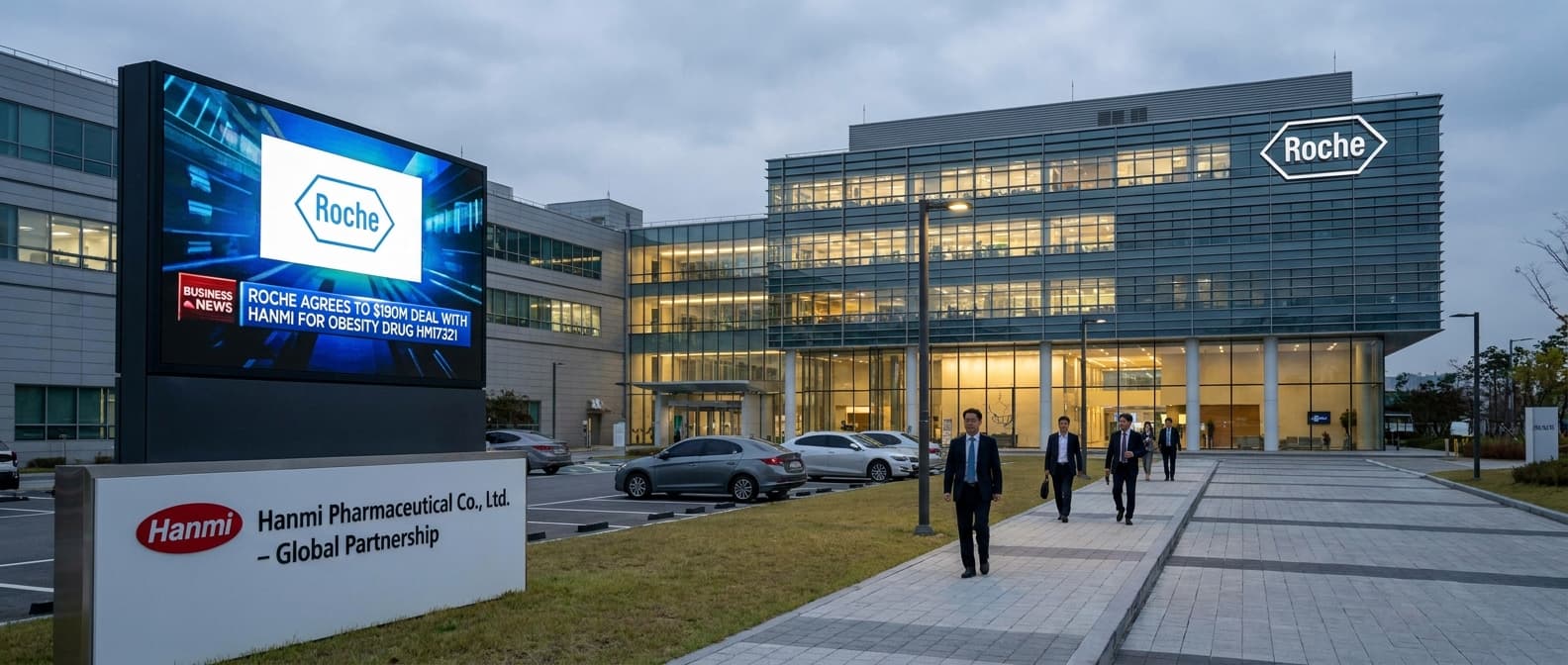
Roche Pays $190 Million Upfront For Hanmi Obesity Drug, Adding A Non-Incretin Muscle-Preservation Bet

Roche’s Genentech unit is taking global rights to HM17321 outside South Korea, while Hanmi completes the ongoing phase 1 study before Genentech assumes later development. Strategically, the deal broadens Roche’s obesity portfolio beyond GLP-1 and GIP programs toward body-composition claims that next-generation obesity developers increasingly want to own.
Roche is expanding its obesity pipeline with a licensing deal for Hanmi Pharm’s HM17321, an investigational UCN2 analog that both companies are positioning as a non-incretin approach to weight loss with lean-mass preservation in mind. Under the agreement, Genentech will pay $190 million upfront, with additional development, regulatory and commercial milestone payments that could bring the total to up to $2.3 billion, plus tiered royalties on sales.
The asset gives Roche a way to differentiate inside a crowded obesity market where current leaders have built their positions on GLP-1-based medicines. Hanmi said HM17321 is designed to reduce fat mass while increasing or preserving lean mass, addressing a tradeoff that both sources describe as a limitation of existing GLP-1 therapies.
The data
HM17321 is an investigational peptide that mimics urocortin-2 and binds the CRF2 receptor, according to BioSpace, while Fierce Biotech describes it as a clinical-stage UCN2 analog. Hanmi said the non-incretin mechanism could make the therapy a first-in-class option designed to simultaneously promote weight loss and preserve lean body mass.
The evidence disclosed so far is early. The companies said HM17321 has been linked to weight reduction as a monotherapy and in combination with GLP-1-based therapies in preclinical testing. BioSpace added that animal studies pointed to significant reductions in weight and fat mass, along with improvements in lean mass.
Hanmi has already moved the program into phase 1. BioSpace reported that the company is recruiting 90 healthy volunteers in a study assessing safety and tolerability, while Fierce said the trial includes healthy volunteers and individuals with obesity. Hanmi will complete that study before Genentech takes over phase 2 development and beyond.
The scientific bet is not entirely conventional for obesity. Fierce noted that UCN2 is a signalling protein elevated in people with chronic heart failure and that Eli Lilly explored the mechanism in a heart failure program that was scrapped back in 2019. Roche is effectively wagering that Hanmi can translate a long-discussed link between UCN2 biology and reduced muscle atrophy into a clinically useful obesity medicine.
The commercial picture
For Roche, the deal is less about entering obesity than about refining how it competes there. The company has said it wants to become one of the “top three” players in weight loss, and it has been building a broad cardiometabolic portfolio rather than relying on a single mechanism.
That portfolio already includes enicepatide, the dual GLP-1/GIP receptor candidate Roche has aimed to bring to market by 2030, the oral GLP-1 CT-996 from the Carmot acquisition, and petrelintide, the long-acting amylin analog it is partnering on with Zealand Pharmaceuticals. Fierce also highlighted emugrobart, an anti-latent myostatin sweeping antibody in phase 2 in combination with Lilly’s Mounjaro that is designed to increase muscle mass.
Adding HM17321 suggests Roche sees muscle preservation as a portfolio theme, not a side claim. If obesity treatment economics and physician demand shift from pure pounds lost toward body composition and metabolic quality, developers with multiple ways to target fat loss while protecting muscle could have more flexibility in combinations and positioning.
The road here
Roche has been stepping up its obesity ambitions since last year, including through its $2.7 billion buyout of Carmot Therapeutics in December 2023, as BioSpace noted. The company has also kept dealmaking active outside obesity, but this Hanmi pact stands out because it pushes into a less-explored mechanism rather than adding another incretin-style asset.
Hanmi, for its part, has been active in business development this year. Fierce reported that the South Korean company bought Aptose Biosciences and licensed a phase 2 GLP-2 agonist to Lilly for $75 million upfront as a potential short bowel syndrome treatment. This agreement with Roche is larger and places a bigger spotlight on Hanmi’s ability to generate assets that larger pharma companies see as differentiated.
Join the BioIntel newsletter
Get curated biotech intelligence across AI, industry, innovation, investment, medtech, and policy delivered to your inbox.