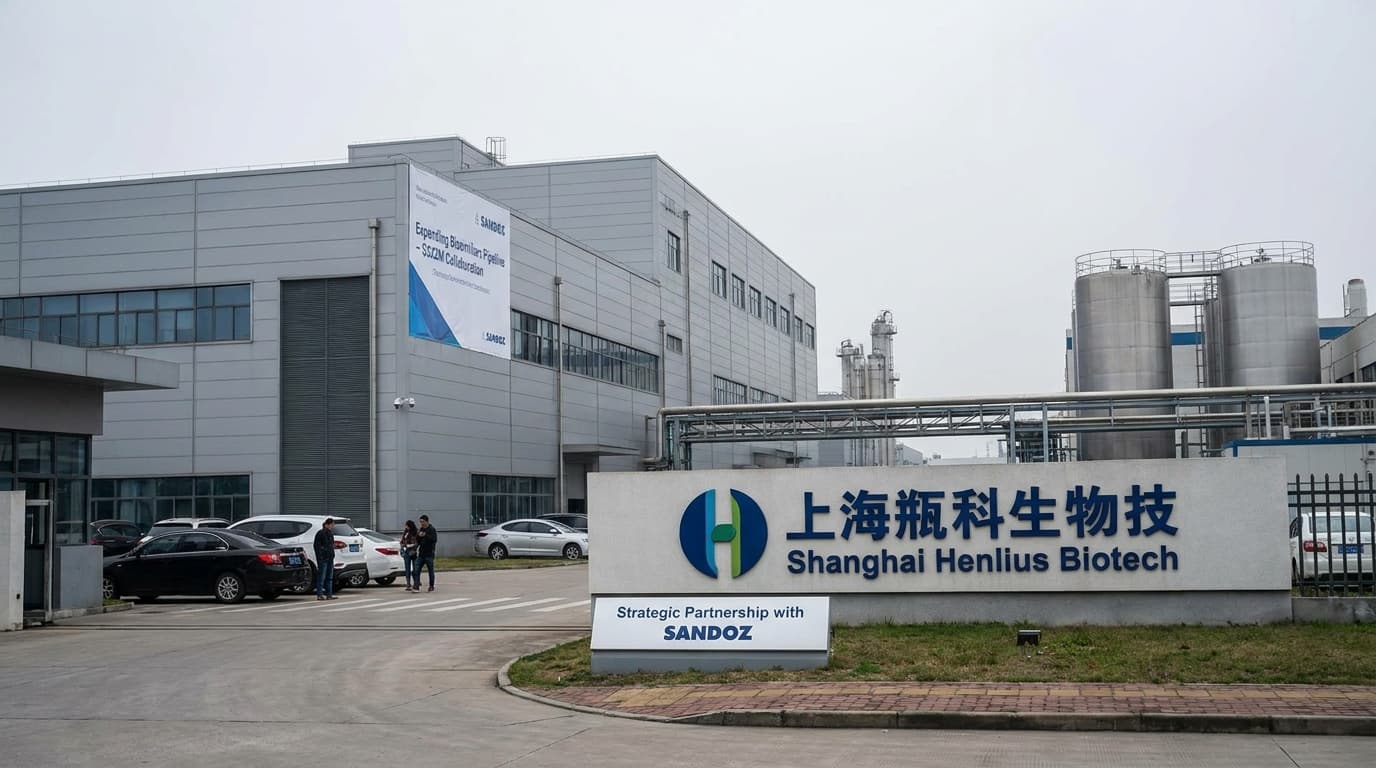
Sandoz Strikes Up To $322 Million Henlius Biosimilars Deal, Expanding A 39-Asset Pipeline

The collaboration gives Sandoz ex-China rights to an initial group of biosimilars, with Henlius responsible for development and manufacturing. For Sandoz, the deal ties near-term pipeline expansion to a business line that grew 22% in the second quarter while its larger generics unit was flat.
Sandoz has agreed to pay up to $322 million to collaborate with Shanghai Henlius Biotech on up to 10 biosimilars, extending a push into a part of the business that is growing faster than its core generics franchise. The deal starts with ex-China rights to biosimilars of Amgen’s Repatha (evolocumab), Eli Lilly’s Erbitux (cetuximab) and GSK’s Benlysta (belimumab), plus an option on a recombinant human hyaluronidase called rHuPH20.
Near-term payments tied to the initial assets could reach $100.5 million. Sandoz can then add more biosimilars to the collaboration up to the maximum deal size of 10 drugs and $322 million in initial fees and milestone payments.
The Commercial Picture
The agreement links Sandoz to products aimed at large established biologic markets, though the programs are at different stages and face different patent timelines. Henlius has begun clinical development of the Erbitux biosimilar. The proposed Repatha and Benlysta biosimilars are in technical and early development, respectively.
That mix matters because market opportunity and timing are not the same across the three initial assets. In 2024, the last year that Lilly disclosed Erbitux sales, the product generated $627.4 million worldwide, up 5% year-on-year. Repatha hit $3 billion in sales last year, while Benlysta generated £1.8 billion ($2.4 billion) for GSK.
The patent picture is also uneven. Amgen lists U.S. and European Repatha patents that expire between 2028 and 2033. GSK has Benlysta patents that expire as late as 2035. Erbitux lost patent protection years ago, but it has remained without biosimilar competition, which researchers have linked to the antibody’s “unique structural complexity.” For Sandoz, that makes the collaboration less a single launch bet than a staged set of shots on goal across different competitive windows.
Manufacturing And Strategy
Henlius will handle development and manufacturing. The company has three manufacturing sites in China with total capacity of 84,000 liters. European authorities have certified all of the plants, and two facilities with combined capacity of 60,000 liters are good manufacturing practice-certified by U.S. regulatory agencies. The sites already supply China, North and Latin America, Europe and Southeast Asia.
That infrastructure is a central part of the deal’s logic. Sandoz is buying access not only to molecules but also to a manufacturing base that has already cleared important regulatory checks in multiple regions. In biosimilars, commercial execution depends on dependable supply and regulatory-ready production as much as on molecule selection.
Following the transaction, Sandoz’s biosimilar pipeline features 39 assets. The company reported 22% growth in biosimilar sales in the second quarter, and with its larger generics business flatlining, biosimilars accounted for one-third of total sales in the quarter. The signal is straightforward: Sandoz is using partnerships to lean harder into a segment where demand and margin potential appear stronger than in traditional generics.
Upcoming patent expirations on blockbuster biologics could widen that opening further. Products with sales of about $180 billion are set to lose patent protection in 2027 and 2028, led by Merck’s Keytruda. This Henlius agreement does not address that wave directly in every case, but it positions Sandoz with more optionality as the next biosimilar cycle builds.
Join the BioIntel newsletter
Get curated biotech intelligence across AI, industry, innovation, investment, medtech, and policy delivered to your inbox.