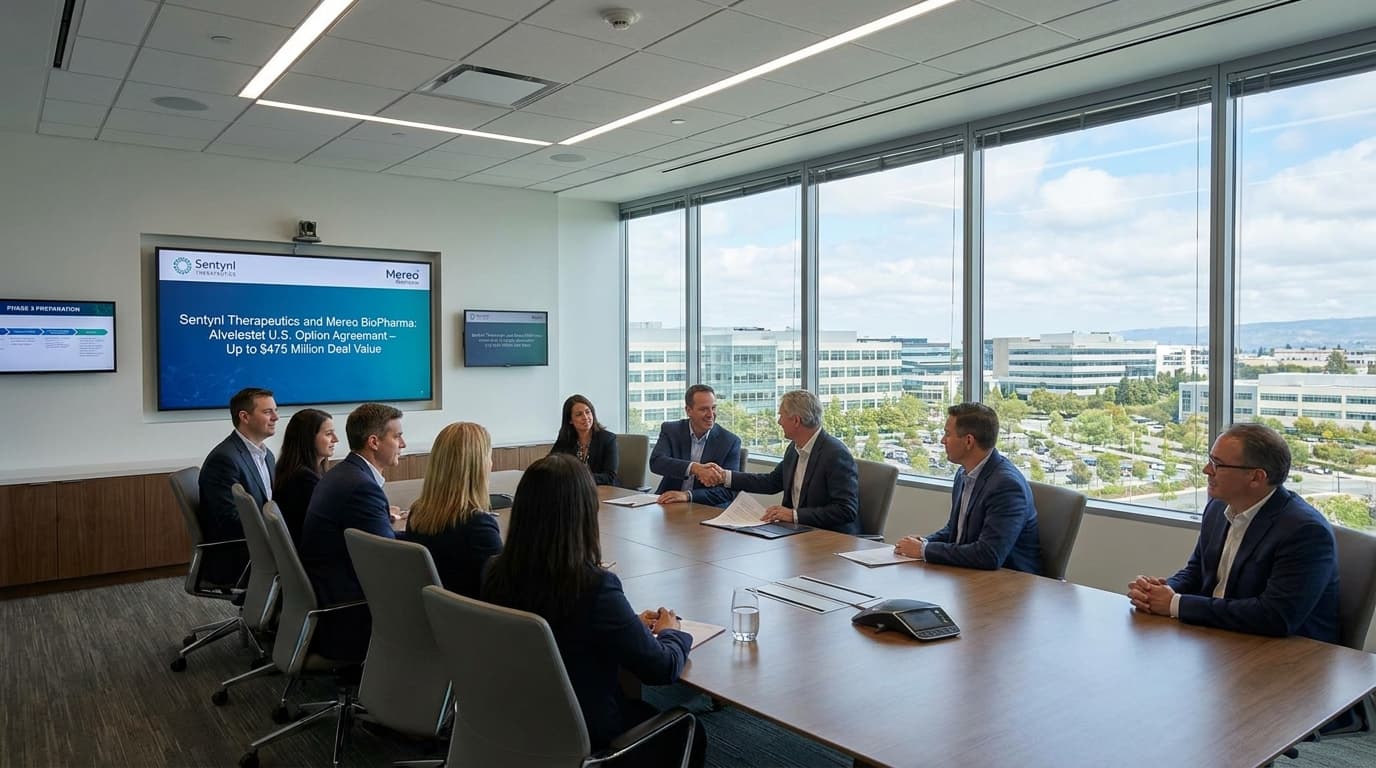
Sentynl Secures U.S. Option On Alvelestat In Up To $475 Million Deal, Giving Mereo A Path Into Phase 3

The transaction centers on alvelestat, an investigational oral neutrophil elastase inhibitor for alpha-1 antitrypsin deficiency-associated lung disease. For Sentynl, the option structure creates a staged bet on a rare disease asset; for Mereo, it brings a commercial partner candidate and financing tied to getting the program to a new drug application submission.
Sentynl Therapeutics has signed an exclusive option agreement for the U.S. rights to Mereo BioPharma’s investigational drug alvelestat, putting up a package worth up to $475 million if it chooses to move ahead. Under the Tuesday agreement, Sentynl paid an undisclosed fee for the option to market the drug in the U.S., and if it exercises that option it will pay $40 million to Mereo covering the deal’s upfront and R&D payments until submission of a new drug application.
Beyond that, Sentynl has offered up to $435 million in potential milestones and double-digit tiered royalties on net U.S. sales of alvelestat. The structure matters because it lets Sentynl, a California-headquartered subsidiary of Zydus Lifesciences, stage its commitment around a late-stage development plan instead of paying a full upfront license cost before Phase 3 begins.
The asset
Alvelestat is a small molecule blocker of neutrophil elastase, an enzyme that Mereo says plays a key role in inflammation and has been implicated in destruction of lung tissue. The drug is being developed for alpha-1 antitrypsin deficiency-associated lung disease, or AATD-LD, a rare genetic respiratory disorder caused by a lack of the AATD protein that normally protects the lungs against damaging enzymes such as neutrophil elastase.
According to the BioSpace report, symptoms include shortness of breath and chronic coughs, and can progress to asthma and bronchiectasis. The company estimates that around 50,000 to 80,000 patients in the U.S. have AATD-LD, which gives the program a defined rare-disease commercial target if efficacy and regulatory execution hold up in late-stage testing.
The data and development path
Mereo’s Phase 2 data, released in May 2023, showed an 83.5% reduction in neutrophil elastase activity for the lower dose of alvelestat and a 93.3% suppression in the higher-dose group. Mereo said at the time that both effects were significantly superior to placebo.
Those results are biomarker-heavy rather than an approval package on their own, but they were enough for Mereo to subsequently align with the FDA on a Phase 3 design for alvelestat. That step lowered one development uncertainty: the companies are not starting late-stage planning from scratch, and the Sentynl agreement now supplies a mechanism to fund that next step.
Mereo had said in January 2024 that it was looking for potential development partners to take alvelestat forward. The new agreement appears to answer that need directly. According to the release cited by BioSpace, the deal will help Mereo initiate its late-stage program, which could be launched early next year.
The commercial picture
For Mereo, the option structure monetizes a program that had scientific momentum but needed outside support to advance. For Sentynl, it is a rare-disease commercial expansion bet with capped initial exposure and larger payouts deferred to exercise, development, regulatory, and commercial milestones.
That is a practical setup for an investigational asset in a defined but relatively small U.S. population. If Sentynl exercises the option, it would move from observer to commercial lead in the U.S.; if it does not, Mereo retains the asset without having sold it outright at a pre-Phase 3 valuation.
The broader signal is that late-stage rare-disease assets with a clear mechanism, prior regulatory alignment, and measurable mid-stage pharmacologic effects can still attract structured licensing deals even when sponsors are not in position to self-fund Phase 3. In this case, the money is not just headline value. It is tied to a specific strategic bottleneck: getting alvelestat from a partnered asset search into an actual late-stage program.
Join the BioIntel newsletter
Get curated biotech intelligence across AI, industry, innovation, investment, medtech, and policy delivered to your inbox.