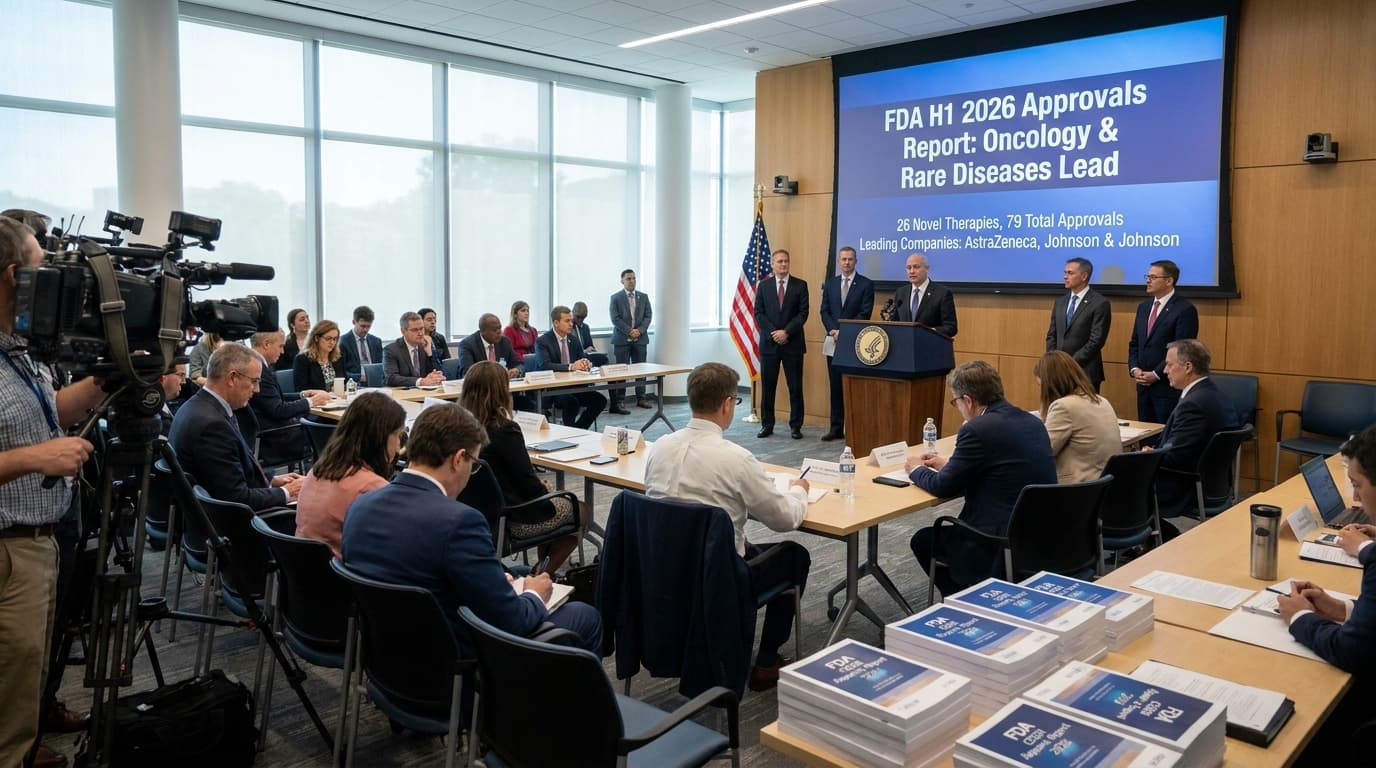
Cancer & Rare Disease Dominate FDA Approvals in H1 2026 as AstraZeneca, J&J Lead the Pack

The U.S. Food and Drug Administration approved 26 new therapies during the first six months of 2026, with oncology and rare diseases accounting for a significant proportion. This report contextualizes these figures, highlights industry implications, and examines the outsize role played by AstraZeneca and Johnson & Johnson during this period.
Introduction
The U.S. Food and Drug Administration (FDA) plays a pivotal role in shaping the drug development landscape, with its approvals serving as bellwethers for industry innovation and public health progress. In the first half of 2026, FDA approval trends point unmistakably to two areas of continued emphasis: oncology and rare diseases. According to new reporting, 26 novel therapies crossed the regulatory finish line in H1 2026, with 4 treatments for cancer and 6 for orphan indications. Meanwhile, AstraZeneca and Johnson & Johnson (J&J) accounted for an impressive 11 of the FDA’s 79 total approvals, which also include supplemental indications and label expansions alongside novel agents.
Breakdown of Approvals: A Closer Look
Oncology (Cancer)
Cancer remains a major driver of pharmaceutical R&D investment and innovation. The approval of four new cancer therapies in the first half of 2026 underscores persistent unmet clinical needs as well as the high scientific and commercial rewards associated with oncology drug development. While the snippet does not specify the exact drugs or cancer types targeted, this volume affirms oncology as a perennial area of focus for both established biopharma leaders and emerging biotechnology companies.
Rare (Orphan) Diseases
Orphan indications—often defined in the U.S. as conditions affecting fewer than 200,000 patients—accounted for six of the 26 new drugs. This focus is significant for several reasons:
- Regulatory Incentives: The FDA’s Orphan Drug Act continues to provide attractive incentives for companies addressing rare diseases, including tax credits, fee waivers, and market exclusivity.
- Unmet Need: Many rare diseases currently lack any approved therapies, making each new approval a meaningful advance for patients and families.
Total Agency Approvals
Alongside the 26 novel drug approvals, the FDA granted a total of 79 approvals in the period—including supplemental approvals (e.g., additional indications, dosage regimens) that may extend use of existing therapies to new patient populations or disease areas. AstraZeneca and J&J together garnered 11 of these nods, putting them at the forefront of industry output for the period.
Leading Companies: AstraZeneca and Johnson & Johnson
AstraZeneca and Johnson & Johnson are both established titans in biopharmaceutical innovation. Their combined 11 approvals represent a significant achievement, reflecting not only robust internal pipelines but also strategic acquisition and partnership activity that has characterized both organizations in recent years.
- AstraZeneca: As a consistent leader in oncology, respiratory, and cardiovascular drug launches, AstraZeneca’s dominance in FDA approvals is testament to its global R&D investment and pipeline management.
- Johnson & Johnson: J&J’s expansive pharma division often leverages its diverse therapeutic focus and scale to maintain a steady cadence of regulatory successes.
Such a high approval tally in just six months indicates effective regulatory strategy, capitalizing on both incremental advances (supplemental approvals) and true innovation (novel drugs).
Industry Implications and Analysis
The Oncology Pipeline: Still Surging
Despite recent questions about saturation and competition in oncology, the number of new FDA-approved cancer therapies remains high. While specific details about these treatments are not provided in the snippet, industry observers should expect continued funneling of resources toward personalized and targeted cancer medicines, particularly those leveraging immunotherapy, precision medicine, and next-generation modalities such as cell and gene therapies.
Rare Disease Focus Broadens
Persistent momentum in orphan drug approvals is equally notable. Though rare disease programs often face clinical, operational, and economic challenges, their rewards are significant—both from a reimbursement and societal impact perspective. Drugmakers have increasingly responded to payer incentives, advocacy, and scientific insights to prioritize rare diseases, especially as the broader market becomes more competitive.
Regulatory Environment: A Supportive Backdrop
The FDA’s steady approval rate suggests no major delays or regulatory bottlenecks in early 2026, despite the political and funding headwinds that sometimes affect agency decision-making. Analysts will watch closely to see if this pace keeps up through the remainder of the year and whether the mix of oncology, rare, and mainstream approvals shifts.
The Role of Supplemental Approvals
With 79 total approvals including supplements, there is clear evidence that companies are strategically maximizing the value of existing assets. Supplemental approvals (e.g., new uses for already-approved drugs) often face lower technical risk than first-in-class approvals, but can be immensely valuable for patients and company balance sheets.
Broader Context: Behind the Numbers
Scientific and Commercial Forces
Several industry-wide forces likely contributed to this period’s data:
- Scientific Progress: Advances in molecular biology, genomics, and computational drug design continue to feed pipelines with more precise and targeted agents.
- Pricing and Value Pressures: Both payers and regulators have heightened scrutiny on cost and real-world value, prompting companies to focus on high-need patient segments where value demonstration may be clearer.
- Clinical Trial Innovation: The COVID-19 pandemic accelerated adoption of remote monitoring, adaptive trial designs, and real-world evidence, all of which help companies generate higher-quality data for approvals.
Company Strategies
Given their scale, AstraZeneca and J&J are particularly adept at:
- Strategically acquiring promising assets (either via partnerships or M&A)
- Efficiently shepherding new indications for existing products through the regulatory process
- Harnessing digital, real-world, and traditional evidence for smart submission strategies
Challenges on the Horizon
Even as the numbers for H1 2026 reflect strongly on industry innovation, challenges remain:
- Reimbursement Uncertainty: Even after FDA approval, commercial success depends on favorable payer coverage and patient access decisions.
- Globalization and Local Market Nuances: Agencies in Europe, Asia, and other regions may not always accord the same approvals, sometimes complicating global launches.
- Competition: Especially in oncology and rare diseases, competition for both patients (for new trials) and market share continues to intensify.
Conclusion: A Sign of Industry Health and Changing Focus
FDA approval patterns remain one of the most closely watched signals of biopharma industry health. With oncology and rare diseases again leading new drug launches in 2026, and powerful incumbents like AstraZeneca and J&J accounting for outsize shares of regulatory wins, the sector continues to evolve in both predictable and surprising directions.
Stakeholders—including investors, clinicians, patient advocates, and policymakers—will be keen to track how these numbers translate into real-world impact over the rest of the year and beyond.
Source: BioSpace
Join the BioIntel newsletter
Get curated biotech intelligence across AI, industry, innovation, investment, medtech, and policy delivered to your inbox.