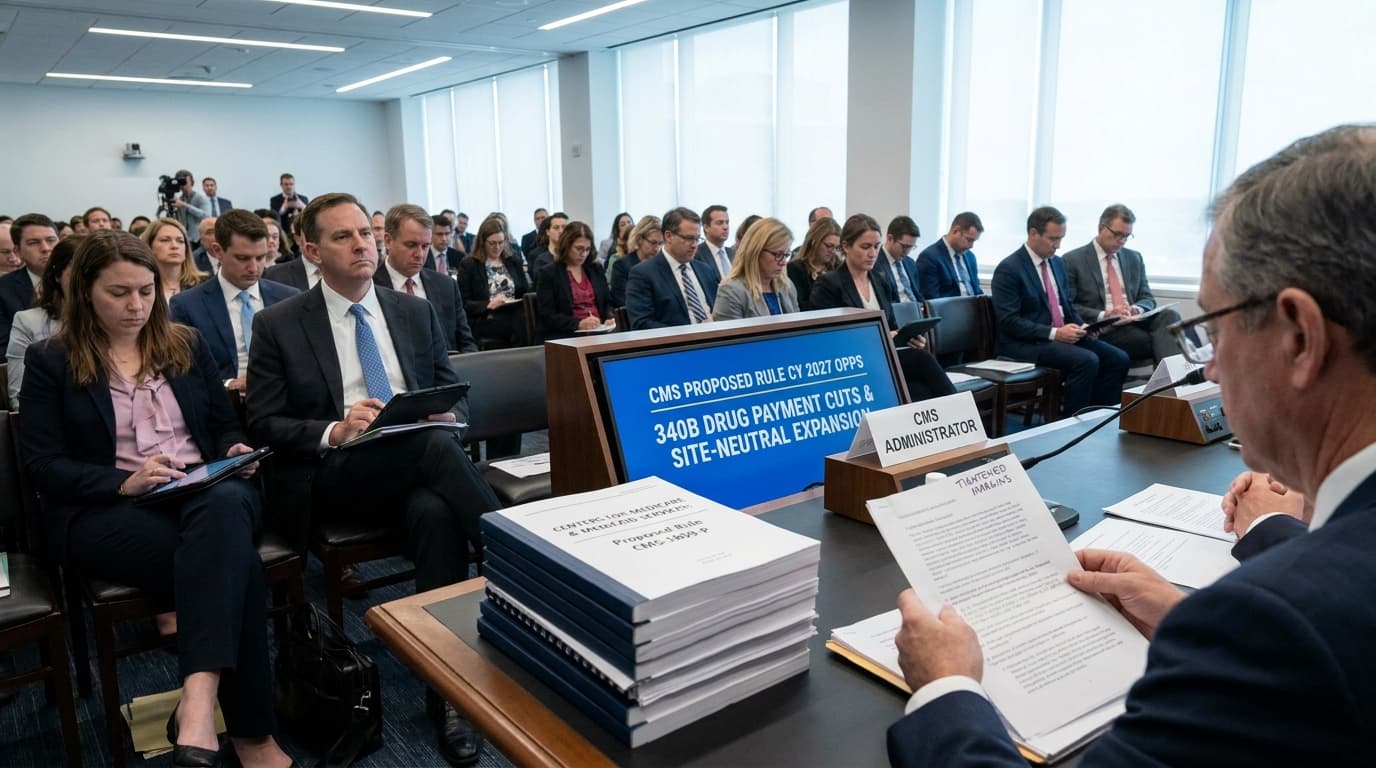
CMS Proposes Sweeping Changes to 2027 Outpatient Payment Rule, Sparking Hospital Sector Concerns

The Centers for Medicare & Medicaid Services has released its draft 2027 outpatient payment rule, proposing fundamental changes that reshape the hospital reimbursement landscape. Key provisions include a 2.4% base rate increase, further restrictions on 340B drug payments, and new site-neutral payment rules for off-campus imaging. Healthcare providers warn that the proposed rule may tip many hospitals into negative margins.
Introduction
On July 6, 2026, the Centers for Medicare & Medicaid Services (CMS) unveiled a proposed outpatient payment rule for the 2027 fiscal year that has swiftly become a flashpoint for debate among healthcare providers, policy advocates, and analysts. The rule proposes a raft of changes that touch on nearly every corner of outpatient reimbursement, ranging from adjustments in the base payment rates to controversial cuts in the 340B drug program and the continued expansion of site-neutral payment policies. As providers pore over the details, the mood across the hospital sector is one of deep concern, with many forecasting that the rule’s cumulative effect would push institutions—particularly safety-net and rural hospitals—further into the financial red.
This article takes a comprehensive look at what’s in the new CMS proposal, provides context on its most significant provisions, and explores the sector’s reaction and likely downstream effects for hospitals, clinicians, and patients.
Key Provisions of the CMS 2027 Outpatient Payment Rule
1. 2.4% Base Rate Increase
The most immediate, headline change is a planned 2.4% increase in the base outpatient payment rate for hospitals. At first glance, this might appear as a positive development—any increase in federal payment rates is welcomed by healthcare providers, given their persistently rising input costs. However, given general cost inflation in healthcare (which often outpaces general inflation), many provider groups argue that the 2.4% bump is unlikely to meaningfully improve financial sustainability, especially when viewed alongside the rule’s offsetting cuts elsewhere.
2. 340B Drug Payment Cuts
A central—and hotly debated—element of the proposal is a steep reduction in payments to hospitals participating in the federal 340B Drug Pricing Program. The 340B program enables certain hospitals to purchase outpatient drugs at significant discounts, with the intention of reinvesting the savings into care for vulnerable patients. CMS’s new 2027 rule, if finalized, would further curtail payments for 340B-acquired drugs, building on several years of policy tension between federal regulators and the hospital sector.
Policy analysts believe this move could, in aggregate, mean that hospitals dependent on 340B revenue streams, especially urban safety-net hospitals and clinics serving large uninsured populations, might face substantial funding gaps. Advocates for the rule argue it is designed to curb practices where 340B profits are used in ways lawmakers see as outside the program’s originally intended scope.
3. Expansion of Site-Neutral Payment Policies
Perhaps the most technically complex—yet increasingly consequential—piece of the proposed rule is an expansion of site-neutral payment provisions to off-campus imaging services. Site-neutral policies aim to equalize Medicare payments for similar services delivered in different settings (for example, in a hospital outpatient department versus a physician office). Proponents claim this levels the playing field and reduces incentives for hospitals to purchase physician practices solely to obtain higher reimbursement rates. Critics, however, worry that applying site-neutral logic to more services will disproportionately affect hospitals’ capacity to cross-subsidize essential community care from these service lines, further straining revenues.
Given the quickly evolving landscape of outpatient care delivery, with more and more procedures performed outside of traditional inpatient settings, site-neutral policy is likely to remain a central battleground for payment reform debates in years to come.
Hospital Sector Reaction: Bracing for Financial Impact
Provider Group Warnings
In response to the proposed rule, provider groups immediately raised concerns that, rather than providing financial relief, the cumulative effects of the payment updates, drug payment adjustments, and site-neutral expansions would actually push many hospitals’ overall Medicare outpatient payments “into negative territory.” This phrase—used by several national provider organizations in early press releases—underscores the belief that, when accounting for rising labor costs, persistent supply chain disruptions, new reporting requirements, and the real-world impact of payment cuts, many hospitals will simply be unable to break even on their Medicare outpatient business.
Safety-net, rural, and ‘essential hospitals’ are expected to be hardest hit. These institutions tend to have more limited patient and service line diversification, narrower margins, and greater dependence on federal reimbursement and 340B program flexibility. Rural providers, in particular, fear that further reductions in outpatient payment could accelerate facility closures—an already mounting crisis in many states.
Sector-by-Sector Breakdown
While all hospitals are likely to be affected by the rule, the precise impact will vary:
- Academic medical centers may have more flexible financing but face outsized service costs and higher proportions of government-insured patients.
- Community and rural hospitals typically have smaller cash reserves and fewer high-margin service lines to offset losses.
- Specialty hospitals and outpatient clinics heavily reliant on Medicare patients may need to radically rethink service offerings and operational models.
Policy Rationale and the Broader Policy Arena
CMS and supporters of the new rule argue that the proposal is designed to focus Medicare’s resources where they are needed most, streamline and rationalize payment systems, and align with broader efforts at cost control. By trimming perceived excesses in outpatient drug markups and neutralizing site-based payment disparities, they contend that Medicare can reduce gaming of the system while remaining fiscally responsible.
On the other side, critics insist that this rationalization, on net, means less money for providers who are already stretched thin. The debate echoes longstanding contention between policymakers focused on curbing ‘healthcare overpayments’ and providers tasked with meeting rising patient needs with fewer resources.
The proposal also plays out amid mounting political and economic pressure to rein in total Medicare spending, even as the population ages and healthcare demand increases. Lawmakers, CMS, and the hospital industry remain locked in a delicate negotiation over how best to allocate finite resources without risking patient access or provider solvency.
Looking Ahead: What’s Next?
Public Comments and Policy Iteration
The proposed rule enters a public comment period, during which hospitals, advocacy groups, and affected stakeholders will have the opportunity to provide detailed feedback. This iterative process sometimes results in significant changes to the final rule, depending on the weight and quality of stakeholder responses, political pressure, and emerging data about real-world impacts.
Potential Litigation and Political Scrutiny
Given the centrality of 340B revenue and site-neutrality policy battles, litigation is a near-certainty should the rule be finalized in anything resembling its current form. Legal resistance from hospital advocacy groups and affected entities is likely, as are efforts by members of Congress to intervene or press for changes either through oversight or legislative action. The 340B drug payment issue alone has resulted in court challenges in recent years, and new restrictions could reignite that legal front.
Possible Hospital Strategic Responses
Hospitals will likely respond to the rule in several ways. Some may accelerate existing efforts to diversify revenue streams, seek operational efficiencies, or cut less profitable service lines. Others could redouble lobbying efforts or push for state-level policy interventions to shore up finances. Hospitals already on the brink may be forced to consider mergers, acquisitions, or even closure if the proposal is implemented as written.
Implications for Patients and the Public
For patients—especially those relying on safety-net and rural hospitals—the biggest risk is that critical services may be scaled back or lost altogether. Reduced hospital revenue could translate into tighter eligibility criteria for charity care, longer wait times, or more limited access to expensive therapies that 340B revenue had previously subsidized.
Conclusion
The proposed 2027 outpatient payment rule from CMS brings with it a suite of sweeping changes that extend far beyond a modest base rate update. By simultaneously boosting basic payment rates, slashing 340B drug reimbursements, and extending site-neutral payment policies, CMS’s draft rule aims to reshape the financial bedrock of hospital outpatient care. As the sector weighs in over the next several months, the outcome of public comment, regulatory review, and potential legal challenge will define not only how America’s hospitals are paid—but whether many can keep their doors open to serve their communities. The implications for providers, policymakers, and patients alike cannot be overstated.
Source: What to Know About CMS’ New Proposed Outpatient Payment Rule
Join the BioIntel newsletter
Get curated biotech intelligence across AI, industry, innovation, investment, medtech, and policy delivered to your inbox.