Definium Said DT120 Cut GAD Symptoms By 5.4 Points In Phase 3, Setting Up A Second Readout Next Month

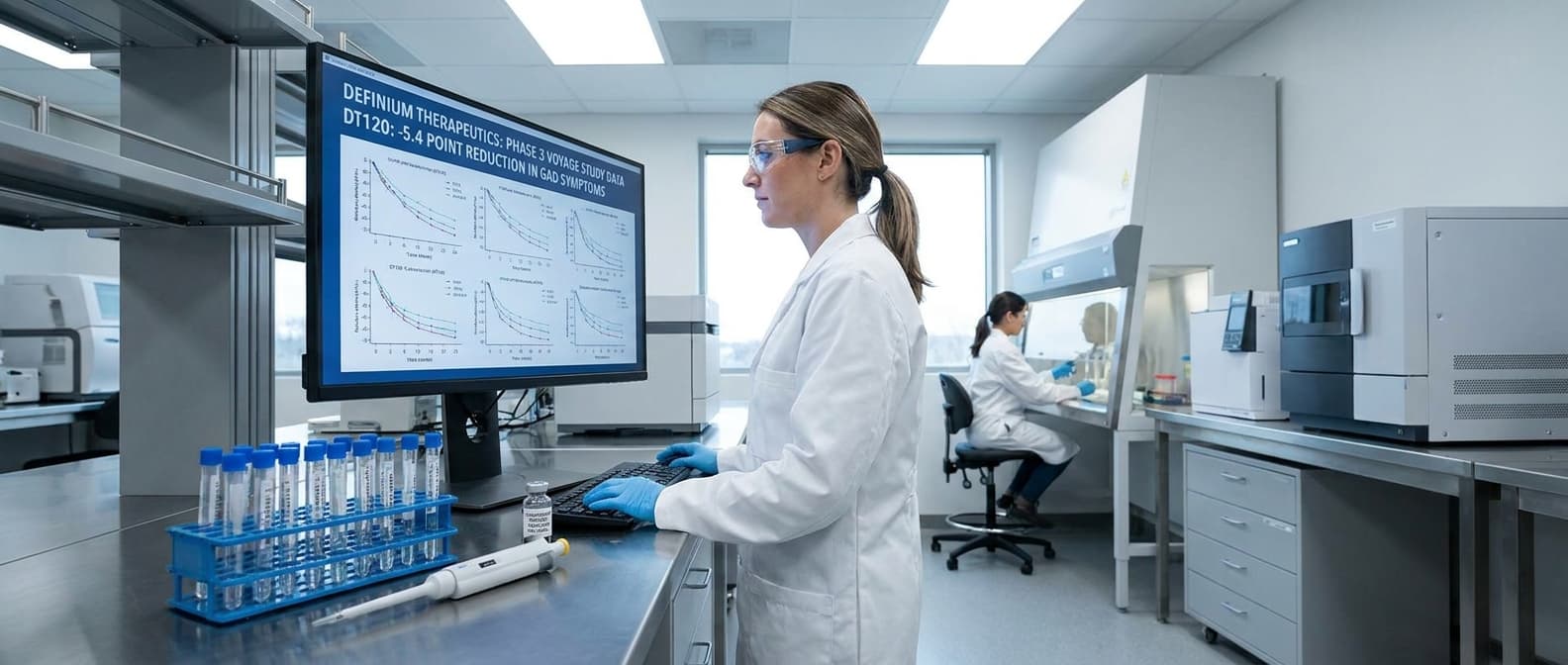
In the 12-week Voyage study of 214 adults, Definium said DT120 produced a statistically significant placebo-adjusted reduction of 5.4 points from baseline on a clinician-administered anxiety scale, with p < 0.0001. The company now has late-stage wins in generalized anxiety disorder and major depressive disorder, but the commercial and regulatory case in anxiety still depends on whether Panorama confirms the effect next month.
Definium Therapeutics reported a positive Phase 3 result for DT120 in generalized anxiety disorder, giving the company its second late-stage success this summer and strengthening the case that a single-dose psychedelic medicine could support a broader psychiatry franchise rather than a one-indication niche product.
The update matters because expectations were already elevated. BioSpace reported that Jefferies called the outcome “one of the strongest [placebo-adjusted] efficacy benefits” seen in generalized anxiety disorder, while Stifel described the data as “a clean win.” For Definium, the immediate question is no longer whether DT120 can produce one favorable readout, but whether a second Phase 3 study can confirm the result strongly enough to support a new drug application.
The data
The new findings came from Voyage, a 12-week Phase 3 study in 214 adults with generalized anxiety disorder. Definium said the trial met its primary and key secondary efficacy endpoints. Participants who received the single-dose oral candidate, also called lysergide tartrate, experienced a statistically significant placebo-adjusted reduction of 5.4 points from baseline on a clinician-administered industry scale of anxiety symptoms.
That result was modestly better than the 5-point drop Wall Street analysts had projected, and Definium reported a p-value of less than 0.0001 on the primary endpoint. The company also said efficacy emerged rapidly, with changes starting as early as the second day.
Safety is a central part of the investment argument for any late-stage psychedelic program, and the company said the profile in Voyage was favorable and consistent with prior studies. According to the BioSpace report, no serious adverse events occurred, most patients were ready for discharge after six hours, and no suicidality signal or behavior was recorded.
Definium CEO Rob Barrow said on a Wednesday investor call that, to the company's knowledge, Voyage showed both the largest nominal change and largest standardized effect size observed in a study of this kind in generalized anxiety disorder. He also argued that the magnitude was more than twice as large as that of drugs approved today. Those are company claims rather than an external comparison, but they frame how Definium is trying to position DT120: not simply as another psychiatric entrant, but as a differentiated efficacy story.
How it compares with earlier work
The Phase 3 anxiety result came in below the placebo-adjusted 7.7-point symptom reduction Definium reported in Phase 2b among 40 participants. BioSpace said analysts largely expected some drop-off because the Phase 3 study enrolled a larger patient population.
Voyage also included fewer patients with comorbid major depressive disorder than the earlier study. Stifel said that was a strategic choice intended to help Definium more clearly isolate the effect on generalized anxiety disorder symptoms and anticipate potential regulatory questions around pseudospecificity.
This anxiety result follows a separate Phase 3 success in major depressive disorder reported in June, where DT120 delivered an 8.1-point placebo-adjusted change in symptoms over six weeks. Jefferies said after the latest update that, in its view, single-dose DT120 has now produced profound efficacy across three Phase II/III datasets spanning indications.
What to watch
Definium has moved DT120 into a 40-week extension phase for generalized anxiety disorder and is awaiting data from a second late-stage anxiety study, Panorama, next month. BioSpace reported that Panorama is slightly larger than Voyage and uses a somewhat different design, including a subtherapeutic dose arm as another comparator.
That next readout carries outsized importance. Stifel wrote that success in Panorama would position Definium to file a new drug application for generalized anxiety disorder likely sometime in the first half of next year. DT120 already has FDA Breakthrough Therapy designation in the indication.
The commercial upside being discussed is large but still contingent on confirmation. Jefferies had previously forecast at least $1.5 billion in peak sales in generalized anxiety disorder and said in its Wednesday note that the Street may start to entertain higher peak sales if the second Phase 3 data support the first. Definium is also developing DT120 in post-traumatic stress disorder, with a late-stage trial slated to launch next year.
The signal from Voyage is that psychedelic drug development is beginning to be judged less on novelty and more on repeatability. Definium now has one more hurdle before the market treats DT120 as a likely filing candidate rather than a promising data story.
Join the BioIntel newsletter
Get curated biotech intelligence across AI, industry, innovation, investment, medtech, and policy delivered to your inbox.