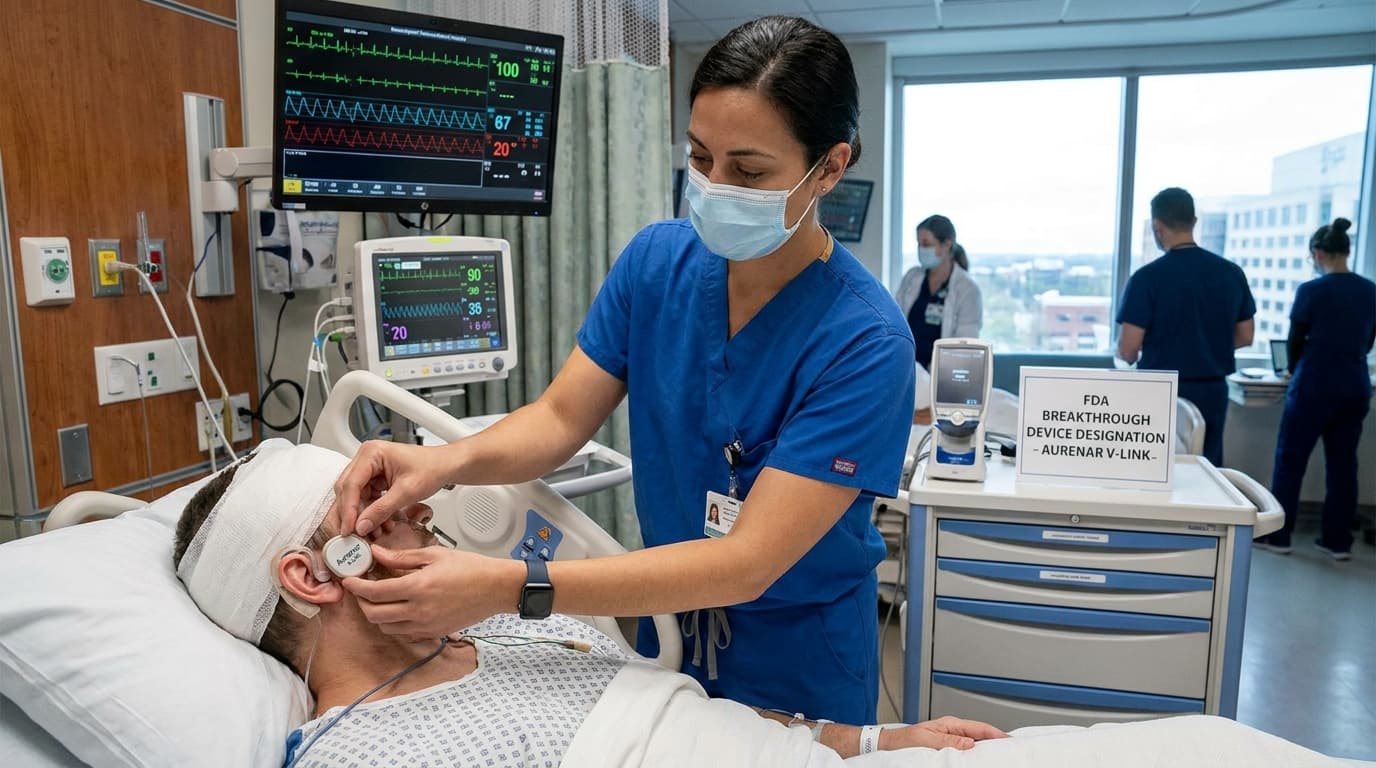
Ear-Based Device Receives FDA Breakthrough Designation for Brain Bleed Complications

With the FDA awarding breakthrough device designation to Aurenar’s V-Link, a novel ear-based nerve stimulation device, clinicians and patients may soon see a transformative approach to addressing the risks of brain hemorrhage. Results from early trials show a remarkable reduction in cerebral vasospasm, a major complication after a brain bleed, igniting discussions over the future of non-invasive neuroprotection.
In a significant move for neurocritical care, Aurenar’s V-Link has secured the U.S. Food and Drug Administration’s breakthrough device designation, potentially heralding a new era in the prevention of post-brain hemorrhage complications. This ear-based, non-invasive medical device leverages nerve stimulation technology with the primary aim of diminishing the incidence and severity of cerebral vasospasm—a dangerous, often life-threatening complication that can follow subarachnoid hemorrhage and other forms of brain bleed.
A New Approach to Neuroprotection
Brain bleeds, whether traumatic or spontaneous, are a leading cause of neurological disability and mortality worldwide. One of the most challenging complications in these scenarios is cerebral vasospasm, a phenomenon where blood vessels in the brain constrict following hemorrhage, causing delayed ischemic injury, stroke, and potential long-term deficits.
Current first-line approaches to combatting vasospasm include pharmacological agents, intensive monitoring, and, in some cases, invasive procedures. However, these options are far from perfect. They may carry significant risks, side effects, and often fail to prevent the cascade of secondary injury mechanisms that can exacerbate patient outcomes. This is where Aurenar’s V-Link, an ear-based nerve stimulator, is generating excitement within both clinical and regulatory circles.
How the V-Link Device Works
V-Link is designed to target specific neural pathways by delivering controlled, non-invasive stimulation through the ear. The underlying science is rooted in the fact that certain branches of the vagus nerve, accessible from the auricular region, can modulate neurovascular inflammation, tone, and healing. By activating these pathways, the V-Link seeks to blunt the process that leads to vasospasm and thus reduce secondary injury risk.
The device is simple in appearance but sophisticated in operation. Early trial results have shown that using V-Link can cut the rate of cerebral vasospasm by more than 40% compared to current standards. This reduction is clinically meaningful, as vasospasm is a leading cause of delayed deterioration in patients recovering from hemorrhagic events.
FDA’s Breakthrough Device Program: Accelerating Innovation
The FDA’s breakthrough device program is designed to expedite the development and review of medical technologies that have the potential to provide more effective treatment or diagnosis for life-threatening or irreversibly debilitating diseases or conditions. By awarding this designation to V-Link, the FDA signals both the device’s promise and an intent to fast-track its regulatory review, potentially bringing it to the hands of clinicians faster than standard pathways allow.
The implications of breakthrough status are broad. Not only does it facilitate earlier conversations with agency reviewers, but it often unlocks more robust support for additional studies, streamlined FDA communication, and priority review status. In practice, this could translate into real-world availability of V-Link in neurocritical care units sooner, provided that subsequent human trials replicate current findings on safety and efficacy.
What Early Trials Reveal
Aurenar’s early clinical evaluation of V-Link focused on patients at risk for vasospasm following subarachnoid hemorrhage. The trial, while preliminary, stood out for its rigorous controls and relatively large sample size for an early-stage device. Notably, V-Link’s use did not result in elevated adverse low-frequency side effects, and patient tolerance was high—a crucial element for uptake in acute care settings.
The key finding: V-Link reduced the incidence of clinically significant vasospasm by over 40%. Patients treated with the device were also less likely to experience delayed cerebral ischemia, and early neurocognitive function assessments were encouraging compared to standard care groups. Though these findings are early, the magnitude of impact and the device’s non-invasive nature make it a subject of intense interest among neurosurgeons and critical care neurologists.
The Significance for Patient Care
If future trials corroborate these results, V-Link could represent a turning point in acute neurocritical care. Brain bleed patients, who currently face long ICU stays, medication regimens with potentially harmful side effects, and invasive monitoring procedures, may soon have access to a preventive intervention that requires only non-invasive ear stimulation several times a day. Such an approach could not only improve outcomes but also drastically reduce healthcare costs associated with long-term care, rehabilitation, and recurrent hospitalizations.
Furthermore, the user-friendly design—resembling a small wearable or earpiece—suggests that V-Link could be easily adopted by hospital staff without extensive training. Given the ongoing strain on healthcare resources nationwide, the prospect of a simple yet effective tool that can be used at the bedside is appealing for both small community hospitals and major metropolitan stroke centers alike.
Remaining Questions and the Road Ahead
While the FDA breakthrough designation is a momentous milestone, questions remain. Experts caution that larger and more diverse trials will be needed to truly determine V-Link’s efficacy and safety across patient populations. The real-world performance of the device—outside the stricter confines of a clinical trial—will also be an important metric once it enters broader clinical use.
On the industry side, there are also key cost and reimbursement factors to be addressed. Will payers recognize and cover such preventive neurostimulation in their policies? Can Aurenar scale manufacturing to meet potential demand as evidence builds for clinical utility? These are questions that healthcare administrators, policymakers, and technology evaluators will watch closely in the coming year.
Context in the Neurotechnology Landscape
V-Link’s progress comes at a time of heightened interest in non-invasive neuromodulation across medical specialties. From transcranial magnetic stimulation for mood disorders to external vagus nerve stimulators for migraine, the convergence of wearable technology, patient-centric design, and neuroscience is creating new possibilities for non-pharmacological interventions.
In acute neurology, specifically, the demand for tools that can be rapidly deployed—often at the point of care—is surging. As critical care teams continue to grapple with limited ICU bed availability, resource constraints, and the ongoing aftermath of COVID-19 on the acute care system, innovations like V-Link represent a hopeful step toward more efficient, less invasive management strategies for complex brain injuries.
Stakeholder Reactions and Industry Impact
Leading neurologists have welcomed the announcement, calling the FDA’s decision a validation of the urgent unmet need in brain hemorrhage care. Patient advocacy organizations have likewise expressed optimism, suggesting that preventive neuromodulation could become a new category in the standard of care if larger studies confirm early findings.
Device manufacturers and technology investors will, no doubt, monitor regulatory developments closely. Medical technology, especially in the realm of brain health, is a notoriously challenging space for innovation due to high risks, technical challenges, and complex clinical endpoints. The breakthrough device designation not only de-risks further development for Aurenar but could also provide a model for other companies seeking to carve new paths in neuro-intervention.
Looking Ahead: The Promise of Non-Invasive Neurostimulation
With Aurenar’s V-Link now on the FDA’s fast track, careful attention will turn to upcoming trials, peer-reviewed publications, and real-world evidence. While much work remains, the alignment of regulatory incentives, scientific momentum, and clinical enthusiasm sets the stage for a potentially transformative shift in brain hemorrhage care.
As research in neurostimulation and neuromodulation expands, the V-Link’s story will continue to be watched closely across the neurological community, technology industry, and regulatory landscape. Pending further validation, the device could become a mainstay in a new standard of care for brain bleed patients—one that prizes prevention, simplicity, and patient-centered technology.
Source: MedCity News
Join the BioIntel newsletter
Get curated biotech intelligence across AI, industry, innovation, investment, medtech, and policy delivered to your inbox.