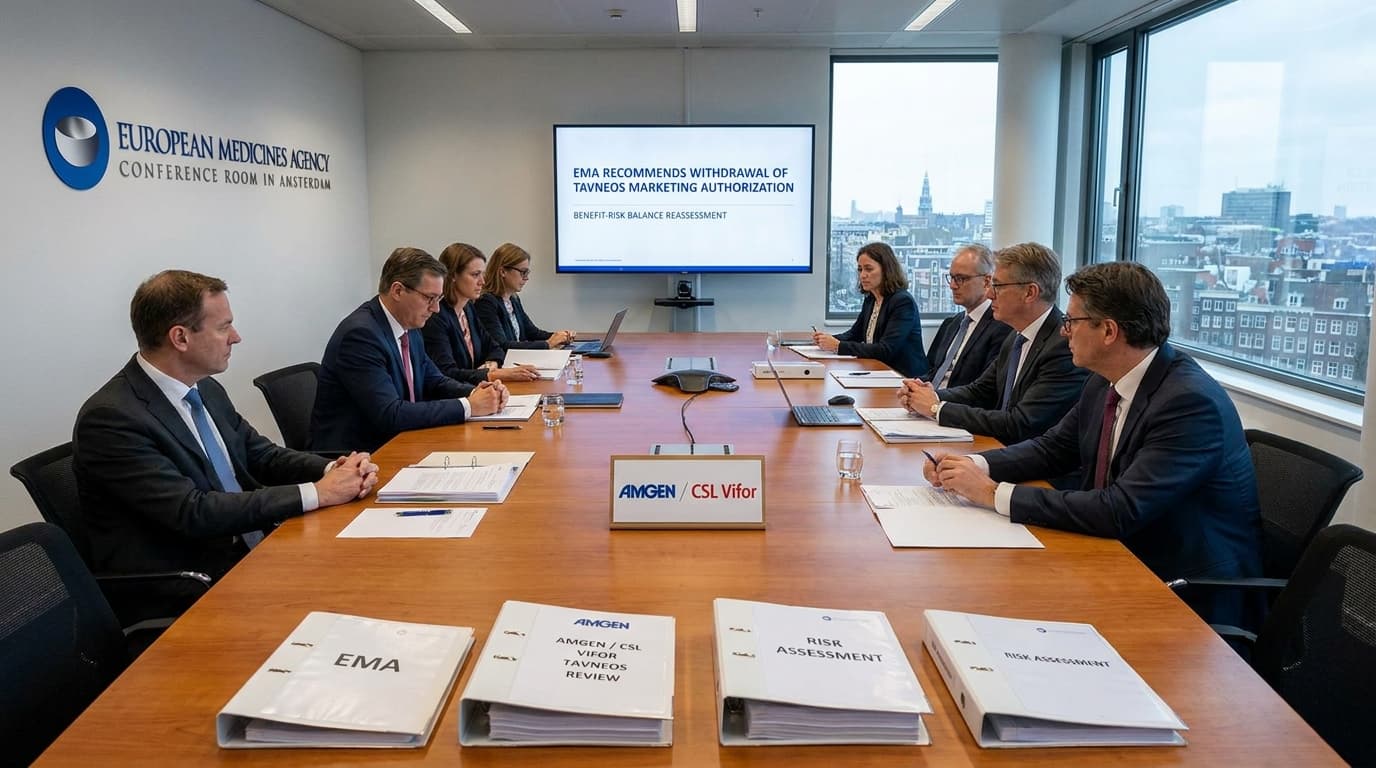
EMA Recommends Withdrawal of Amgen/CSL Vifor’s Tavneos: Assessing the Risks, Implications, and Next Steps

The EMA’s recent stance against Tavneos marks a pivotal development for Amgen and CSL Vifor, as scrutiny over drug safety and market authorization intensifies. As the FDA contemplates a similar move in the United States, the biopharmaceutical landscape braces for regulatory ripple effects that extend well beyond a single product withdrawal.
Executive Summary
In an event that is poised to have far-reaching implications for the immunology and inflammatory disease markets, the European Medicines Agency (EMA) has recommended withdrawing the marketing authorization for Tavneos, an Amgen drug marketed across Europe by CSL Vifor. While product withdrawals are a relatively infrequent occurrence for established pharmaceuticals with prior regulatory green lights, Tavneos’s journey underscores the complex interplay of risk, benefit, and regulatory oversight in drug lifecycle management. With the U.S. FDA preparing to review the drug’s status in an upcoming hearing, this regulatory warning resonates loudly throughout the international biopharma sphere.
The Regulatory Decision: Background and Context
Tavneos was originally authorized in Europe as a treatment for certain severe inflammatory conditions, specifically designed to combat segments of the population susceptible to life-threatening immune responses. As with most sophisticated immunomodulators, initial approvals were granted based on available clinical trial data and then subject to ongoing post-marketing surveillance. Over time, however, emerging safety signals and evolving assessments of therapeutic benefit began to shift the risk/benefit profile of the drug. The EMA’s Committee for Medicinal Products for Human Use (CHMP) has now determined that these considerations tip the scales strongly enough to warrant a reversal of market approval.
The move is notable for several reasons. On a practical level, it affects physicians and patients who have come to rely on Tavneos as part of their therapeutic strategy. On a strategic level, it serves as a case study for regulatory bodies navigating the fine line between patient access and drug safety, especially after a drug has reached the market. The potential knock-on effects on both the manufacturer’s pipeline and general investor sentiment about specialty pharmaceuticals cannot be understated.
Understanding the EMA’s Reasoning: When Benefits No Longer Outweigh Risks
Regulatory authorities base their actions on the best available data, including not just isolated incidents or adverse outcomes, but also the collective evidence amassed during a drug’s entire lifecycle, including real-world data from post-approval use. In the case of Tavneos, the EMA determined that recent safety data and a reassessment of efficacy outcomes ultimately pushed the product outside the threshold of an acceptable benefit-risk ratio. The specifics of the risk reevaluation, for now, have not been extensively detailed in the public domain, but the implication is that serious adverse events—possibly new signals or a higher-than-expected incidence—tilted the balance unfavorably.
Historically, such withdrawals may stem from a combination of factors: new patterns of adverse effects, diminished efficacy compared to expectations or competitor therapies, or insufficient risk management strategies. For multinational pharmaceuticals, uniformity of action between the EMA and FDA is often sought but not always achieved in the same timeframe. With Tavneos, European authorities have taken the initiative, creating pressure for their U.S. counterparts to defend or revise their own stance.
Global Echoes: The FDA’s Pending Review in the United States
As this regulatory storyline plays out in Europe, the U.S. FDA is preparing for a comparable review, with a hearing reportedly planned for Tavneos’s market status. Typically, such agency moves indicate a serious concern or at least a reexamination prompted by new data shared from either global regulator or manufacturer communications. Whether the FDA will align with the EMA’s decision remains to be seen, but such a situation frequently results in a temporary suspension of prescribing or tight control via Risk Evaluation and Mitigation Strategies (REMS).
The situation is complex for stakeholders on both sides of the Atlantic. Patients may experience disruption in therapy, providers must accommodate rapidly evolving guidelines, and manufacturers—Amgen and CSL Vifor in this case—face heightened scrutiny and reevaluation of the commercial viability of not just Tavneos but potentially their broader immunology franchises.
Implications for Patients, Providers, and Global Market Access
Disruption of Care
A drug withdrawal is not merely a regulatory maneuver; it can have a tangible impact on the treatment landscape for conditions where alternatives may be limited. Patients stabilized on Tavneos may now find themselves needing to switch medications, sometimes to less effective or more poorly tolerated therapies. Providers must work swiftly to identify alterative regimens and communicate new risk assessments to their clinical teams and patient populations. The process of medical transition is far from frictionless, particularly for chronic, severe conditions.
Pharmaco-Vigilance and Real-World Evidence
This withdrawal underscores the essential role of post-marketing surveillance and robust pharmacovigilance systems. Real-world evidence can bring new risks to light that were not apparent in the relatively controlled environment of clinical trials. As data ecosystems become more interconnected, regulators may be able to respond more dynamically to signals of harm—but they must also communicate clearly and coordinate international responses to avoid confusion.
Impact on Market Confidence and Company Strategy
For Amgen and CSL Vifor, the EMA’s recommendation is a blow not just to current revenue from Tavneos in Europe, but to wider perceptions about their pipelines and post-market management strategies. The magnitude of reputational and financial impact will depend in part on how transparent the companies are in responding and whether they move proactively to address risk concerns. For investors, such events illustrate the continued volatility inherent in specialty pharma markets, and may influence investment decisions far beyond the affected product.
Regulatory Dynamics: Lessons for Biopharma
The withdrawal of an immunomodulator after market launch is, while rare, not unprecedented. It reveals much about the shifting priorities and tools available to contemporary drug regulators. Heightened emphasis on real-world outcomes, growing scrutiny on safety signal interpretation, and evolving methodologies for comparative risk/benefit analysis have all raised the bar for post-approval monitoring. For companies, this means that the cost of post-market evidence generation and risk mitigation strategies is likely to climb.
Additionally, the situation spotlights the increasing need for global harmonization in regulatory decisions—or at the very least, for companies to prepare for cross-jurisdictional variance in drug availability, which can affect everything from supply chain planning to patient advocacy activities.
What’s Next: FDA Hearing and Manufacturer Response
With a formal FDA hearing scheduled, U.S. stakeholders can expect further debate and potentially rapid changes in labeling, continued access, or outright market suspension. Amgen and CSL Vifor may issue statements, provide additional safety analyses, or implement new risk minimization tools in an effort to maintain or regain regulatory confidence.
In the medium and long term, greater emphasis on proactive communication and transparency is almost certain—both to reassure patients and to preempt the perception that safety issues are being minimized. Regulatory setbacks of this nature can also serve as a catalyst for more rigorous collaboration between global regulatory counterparts, spurring initiatives to share data and jointly assess safety signals in real time.
Industry-Wide Takeaways
- Benefit/Risk Calculus Is Dynamic: The regulatory environment is increasingly responsive to new post-marketing data. An initial favorable benefit/risk assessment does not guarantee long-term market presence.
- Stakeholder Collaboration Is Crucial: Drug companies must work closely with regulators, payer groups, and clinician networks to manage communications and adapt quickly to changing guidance. Failure to do so may worsen care disruptions or damage company reputations.
- Preparing for the Unpredictable: Companies must have contingency plans for regulatory volatility, including alternate asset strategies, comprehensive risk management, and mechanisms to support patients during periods of transition or market suspension.
- Implications for New Drug Approvals: Heightened regulatory scrutiny—in immunology and beyond—may signal a more cautious approach to novel therapies in the future, with even more granular post-marketing requirements.
Conclusion
The EMA’s recommendation to withdraw Tavneos exemplifies both the complexity and the necessity of strict, data-driven oversight in the pharmaceutical market. With the FDA preparing its own response, Amgen, CSL Vifor, and their stakeholders now confront a period of profound uncertainty and heightened scrutiny. Ultimately, this episode offers valuable lessons for drug developers, investors, and regulators alike about the ongoing evolution of benefit-risk analysis in a therapeutic landscape where the line between access and safety is continually redrawn.
For continuing coverage and detailed analysis as the FDA’s decision unfolds, follow the situation at MedCity News.
Source: MedCity News - EMA: Amgen, Vifor Inflammatory Drug’s Benefits No Longer Outweigh Risks
Join the BioIntel newsletter
Get curated biotech intelligence across AI, industry, innovation, investment, medtech, and policy delivered to your inbox.