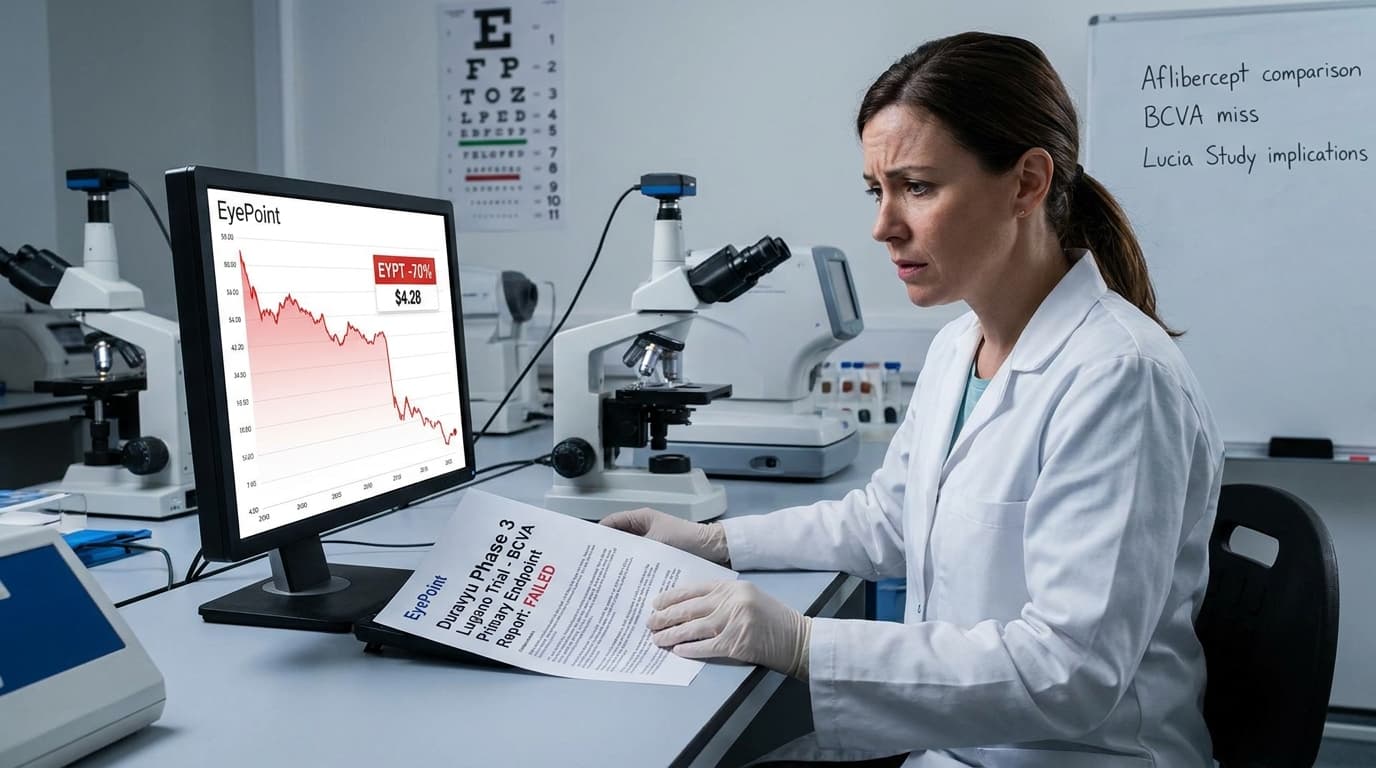
EyePoint Shares Fall 70% After Duravyu Misses Phase 3 BCVA Goal, Raising Stakes For Lucia In Wet AMD

The Lugano trial tested duravyu against aflibercept in about 400 patients with wet age-related macular degeneration and did not meet its main endpoint on best corrected visual acuity after two years. EyePoint highlighted ad hoc and secondary analyses, while Mizuho called the overall result mixed and shifted attention to the upcoming Lucia readout.
EyePoint’s duravyu has failed to beat approved treatment aflibercept in improving vision for patients with wet age-related macular degeneration, a late-stage setback that immediately hit investor confidence. The biotech’s stock dropped 70% at market open, falling to $4.28 per share as of 10 a.m. ET after the company disclosed that the Phase 3 Lugano trial missed its primary endpoint.
The result matters beyond a single study because duravyu is part of the next wave of attempts to reduce the burden of repeated anti-VEGF injections. EyePoint still has one more identically designed Phase 3 study, Lucia, but Lugano turned what had been a durability story into a credibility test around whether secondary advantages can offset a miss on vision.
The data
Lugano enrolled about 400 patients and compared EyePoint’s investigational tyrosine kinase inhibitor duravyu with aflibercept, the vascular endothelial growth factor inhibitor marketed by Regeneron as Eylea and also sold by a handful of biosimilars makers. The trial’s main goal was improvement in average change in vision after two years, measured by best corrected visual acuity using an eye chart.
EyePoint did not meet that primary endpoint. In materials for an investor call, the company said BCVA mean change from baseline was above five points for aflibercept versus between zero and five points for duravyu, without providing the specific figures.
The company then pointed to an ad hoc analysis that excluded nine of 211 duravyu patients who had vision loss of 15 or more letters for reasons it said were unrelated to wAMD. EyePoint said those cases confounded the result and that, once removed, duravyu was non-inferior to aflibercept. No patients in the aflibercept arm had vision loss of 15 letters or more unrelated to AMD.
Mizuho said that explanation was plausible, noting EyePoint’s point that 3–5% of patients taking aflibercept typically lose 15 or more BCVA letters in past Phase 3 trials, but the firm also said questions remain about what caused the vision loss in the nine duravyu patients.
What held up and what comes next
EyePoint reported positive secondary endpoints, including a 42% reduction in treatment burden versus Mizuho’s 30–35% expectation and almost two fewer injections through week 56 compared with Eylea. The company also reported a clean safety profile and high supplement-free rates up to week 32.
Those data are why Mizuho described the readout as mixed rather than uniformly negative. Even so, the firm said the primary miss is an overhang that cannot be fully dismissed until Lucia. A clean win there would, in Mizuho’s view, substantially de-risk the ad hoc narrative and support EyePoint’s planned new drug application filing in the first half of next year.
The competitive effect was immediate. BioSpace noted that the readout favors Ocular Therapeutix, whose own TKI candidate axpaxli recently posted a Phase 3 primary-endpoint win and remains on track, according to the company, for a fourth-quarter new drug application submission this year. In wet AMD, durability still matters, but only if it comes with a primary efficacy result regulators and investors can trust.
Join the BioIntel newsletter
Get curated biotech intelligence across AI, industry, innovation, investment, medtech, and policy delivered to your inbox.