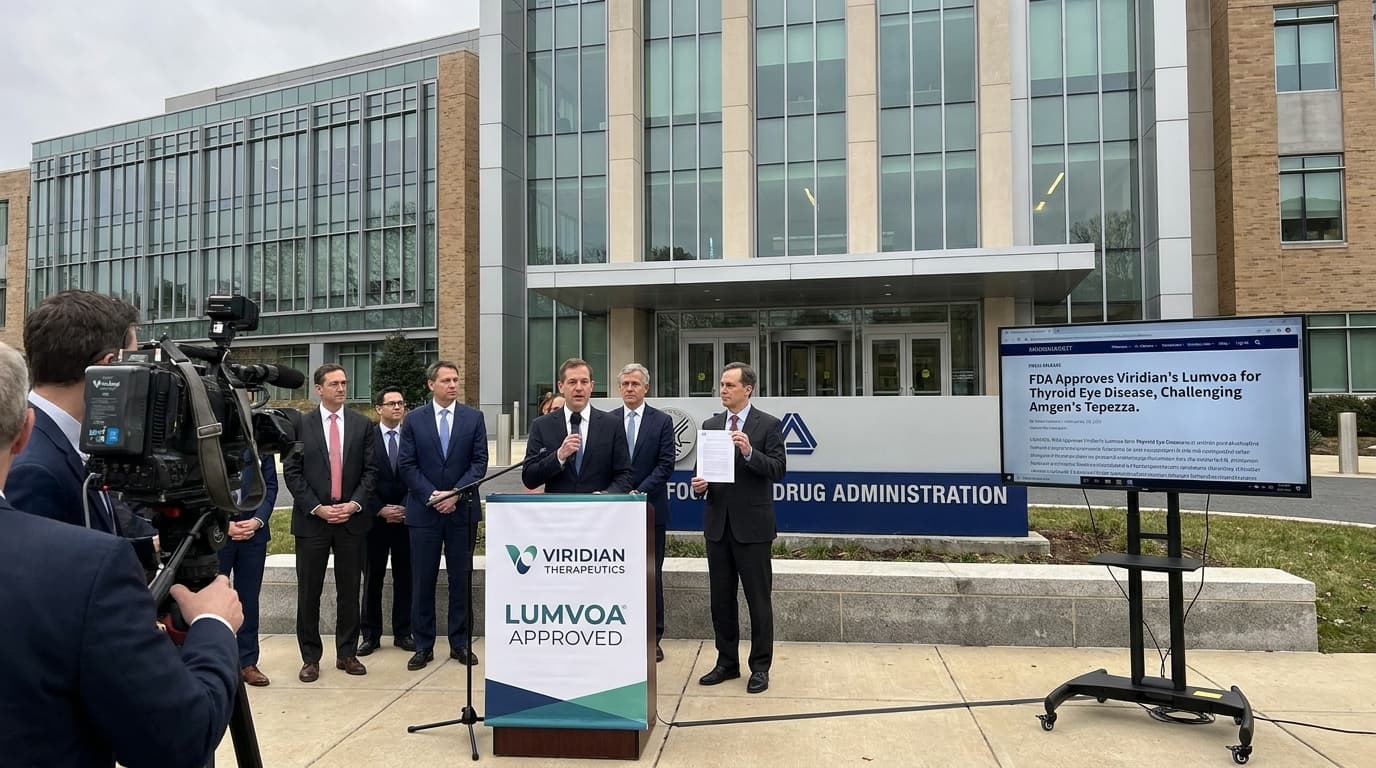
FDA Approves Viridian’s Lumvoa for Thyroid Eye Disease, Introducing Competition to a Blockbuster Amgen Therapy

Viridian’s newly approved therapy Lumvoa offers an alternative to Amgen’s market-dominating Tepezza for thyroid eye disease, potentially reshaping patient access and competitive dynamics in this specialty area. The FDA’s decision could have broader implications for pricing, market share, and innovation in rare autoimmune disorders.
The U.S. Food and Drug Administration (FDA) has approved Viridian Therapeutics’ Lumvoa for the treatment of both the chronic and active phases of thyroid eye disease (TED), according to a recent announcement. This development brings, for the first time, a new competitor to Amgen’s Tepezza, which until now had stood as the only FDA-approved therapy for this rare and potentially sight-threatening inflammatory eye disorder. The emergence of a new therapy could significantly alter the treatment landscape for TED patients and may usher in a new era of competition, pricing dynamics, and innovation in this specialized field.
Background: Understanding Thyroid Eye Disease and Its Therapeutic Landscape
Thyroid eye disease, sometimes known as Graves’ orbitopathy, is an autoimmune condition associated with inflammation and tissue remodeling behind the eye. Patients experience symptoms such as bulging eyes (proptosis), double vision, eye pain, redness, and, in severe cases, vision loss. Historically, treatment options were primarily supportive or surgical, focusing on the management of inflammation, with steroids often administered as a first-line approach.
The approval of Tepezza (teprotumumab), developed by Horizon Therapeutics and acquired by Amgen, marked a pivotal shift in the care of TED by offering the first targeted therapeutic option. Tepezza’s approval received significant attention, with high uptake among eligible patients and rapid ascension to blockbuster status despite the drug’s high price and notable side effects.
Lumvoa’s Approval: What It Means for Patients and Providers
Lumvoa, developed by Viridian Therapeutics, secured FDA authorization based on evidence demonstrating efficacy in both the chronic and active forms of TED. The significance of this development is multi-layered:
- Enhanced Patient Choice: Patients and clinicians now have an alternative to Tepezza, potentially addressing variability in individual response and tolerability that is common with biologic therapies.
- Impact on Access and Affordability: Increased competition may, over time, exert downward pressure on drug prices, improving affordability and payer coverage. Insurance providers could leverage the presence of two therapies to negotiate better terms for beneficiaries, which could also accelerate patient access to needed treatments.
- Potential for Improved Outcomes: With two FDA-approved options, treatment paradigms for TED could become more flexible. Physicians will have more tools at their disposal, adapting regimens to patient-specific needs, and, possibly, rotating between therapies if one proves less effective or is not well-tolerated by an individual patient.
The Competitive Landscape and Implications for Amgen
Tepezza has enjoyed a period of market exclusivity as the sole FDA-approved TED therapy, with global sales that rapidly propelled it to blockbuster status. This dominance faces new challenges in light of Lumvoa’s approval:
- Loss of Monopoly: Amgen must confront the loss of single-product control over a lucrative and specialized market. This could trigger strategic shifts, such as discounting, patient support enhancements, and expanded marketing initiatives.
- Intellectual Property and Payer Dynamics: Patent litigation and payer negotiations are likely to intensify, especially if the two therapies feature differing mechanisms of action, dosing regimens, safety profiles, or administration routes.
- Clinical Practice Evolution: The presence of two drugs may catalyze head-to-head clinical trials or comparative effectiveness research, further informing guideline updates and real-world best practices for TED management.
Unanswered Questions and Next Steps
Although Lumvoa’s FDA approval represents a notable advance, several critical questions remain:
- How will coverage policies adapt to the availability of two FDA-approved therapies? Payers may require step therapy, prior authorization, or other utilization management tools, affecting how quickly patients can access Lumvoa.
- What are the detailed clinical differences? Beyond efficacy in clinical trials, real-world data on side effect profiles, durability of response, and patient-reported quality of life will shape the adoption curve.
- Is further innovation on the horizon? The arrival of Lumvoa may stimulate renewed investment in TED, fostering additional entrants or combination strategies in future research and drug development pipelines.
The market and clinical impacts of Lumvoa’s approval will be closely watched by clinicians, payers, patients, and biopharma stakeholders. As more data emerge from real-world use and as competitive market forces take effect, the landscape for thyroid eye disease management is poised to enter a new era defined by patient choice, pricing evolution, and potential for better health outcomes.
Conclusion
The FDA’s approval of Viridian Therapeutics’ Lumvoa for thyroid eye disease marks a milestone in the management of this challenging condition. By providing a direct alternative to Tepezza, the therapeutic monopoly for TED comes to an end—a development that holds promise for patients and may catalyze broader changes in the pricing, accessibility, and innovation of rare disease biologics. The full ramifications are yet to be seen, but the stakes for patients and companies involved could be transformative.
Source: MedCity News
Join the BioIntel newsletter
Get curated biotech intelligence across AI, industry, innovation, investment, medtech, and policy delivered to your inbox.