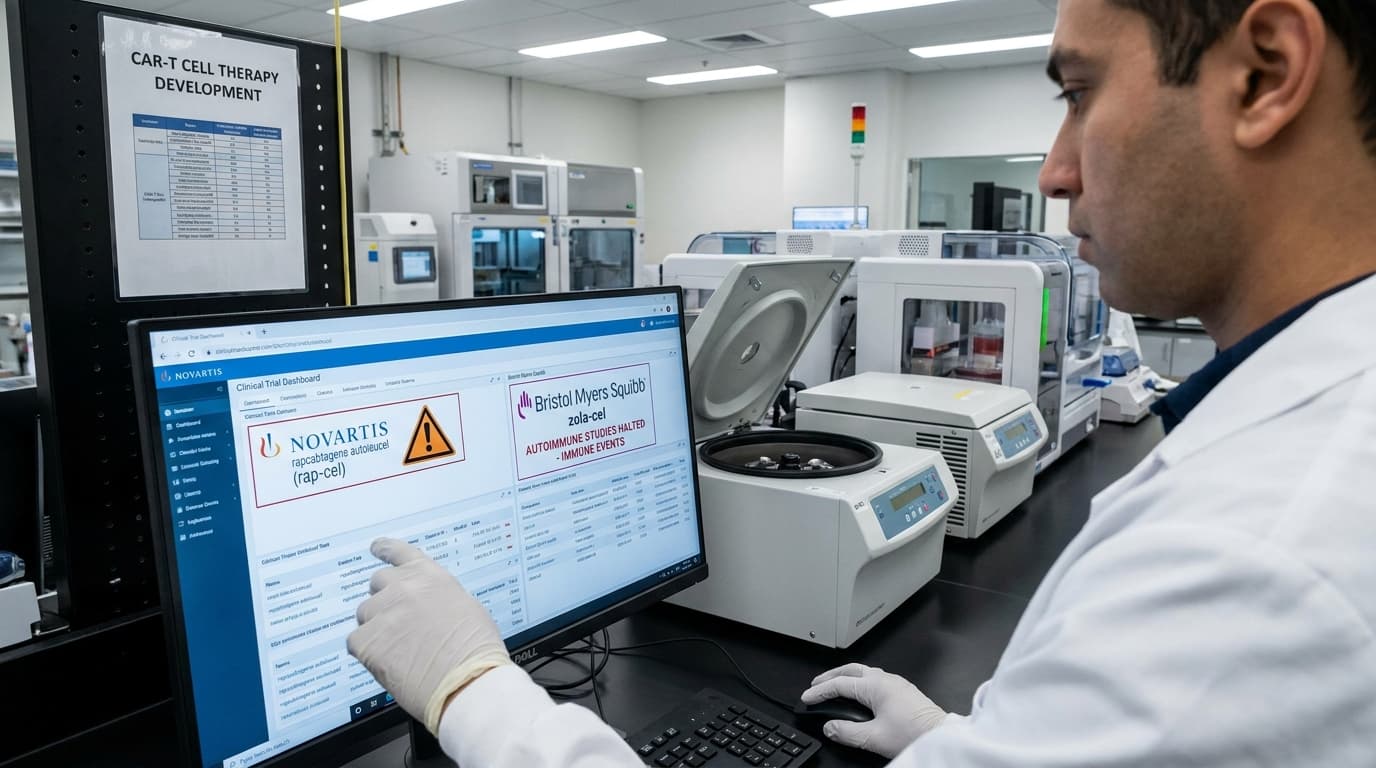
Novartis And Bristol Myers Halt Autoimmune CAR-T Studies After Immune Events, Pressuring A Fast-Moving CD19 Field

The two companies paused separate autoimmune CAR-T programs on the same day, each centered on autologous CD19-targeted candidates made with rapid manufacturing platforms. Novartis said its oncology program is not affected, while Bristol Myers said it is reviewing clinical data across zola-cel and aiming to resume enrollment as quickly as possible.
Novartis and Bristol Myers Squibb have both halted autoimmune CAR-T development activity after immune-related adverse events, interrupting one of the more closely followed expansion paths for cell therapy beyond cancer.
Novartis said it has temporarily halted development of rapcabtagene autoleucel, or rap-cel (YTB323), across several autoimmune diseases in immunology and neuroscience after three serious immune effector cell-associated hemophagocytic syndrome events. Bristol Myers separately paused enrollment in autoimmune trials of its autologous CD19-targeted CAR-T zola-cel (BMS-986353), with the company later describing the issue as transient and reversible inflammatory events.
The immediate significance is company-specific, but the broader signal is about platform risk. Both assets were developed using rapid manufacturing approaches, and William Blair analysts suggested that rapid manufacturing could be driving increased cell expansion and the reported toxicities.
The trials affected
Novartis said the temporary halt covers Phase 2 studies of rap-cel in systemic lupus erythematosus/lupus nephritis, systemic sclerosis, ANCA-associated vasculitis and idiopathic inflammatory myopathies. It also includes Phase 1/2 studies in rheumatoid arthritis and Sjogren’s disease, generalized myasthenia gravis, relapsing multiple sclerosis and non-active progressive multiple sclerosis.
The company said the pause is intended to allow a more comprehensive review of evolving clinical and safety data across the program. Novartis added that patients already treated in the trials will continue to be monitored as per protocol.
Bristol Myers did not list individual autoimmune studies in the report, but said it implemented a voluntary pause out of an abundance of caution while it reviews clinical data across the zola-cel program. The company said it is focused on completing that evaluation and resuming enrollment as quickly as possible.
Why the mechanism matters
Rap-cel and zola-cel are both autologous CD19-targeted CAR-T therapies designed to eliminate CD19-expressing B cells. In autoimmune disease, that approach has drawn attention because B-cell depletion may reset disease activity in conditions driven by pathogenic antibody production.
What makes these programs notable is not just the target but the manufacturing model. Novartis said rap-cel is made using its T-Charge platform, which allows for fewer exhausted T cells and removes the need for extended culture time outside the body. Bristol Myers said zola-cel is produced with its NEXT T platform, designed to promote more uniform and potent T cells that may support deeper and more durable responses.
Those design goals are attractive in efficacy terms, but the paired pauses suggest that faster, more potent products may also alter the toxicity profile in autoimmune settings, where risk tolerance can differ markedly from oncology.
The road here
Novartis said its ongoing oncology program for rap-cel is not affected by the halt. That program is in Phase 1/2 testing for chronic lymphocytic leukemia/small lymphocytic lymphoma, diffuse large B-cell lymphoma, adult acute lymphoblastic leukemia and high-risk large B-cell lymphoma.
The autoimmune CD19 CAR-T field was already crowded before these pauses. Fierce Biotech noted that Cabaletta Bio is aiming to submit resecabtagene autoleucel for approval in the second half of next year in myositis. Miltenyi Biomedicine reported in April that zorpocabtagene-autoleucel drove three autoimmune diseases into remission in one patient, and Fate Therapeutics recently reported improvements in treatment-resistant systemic sclerosis with its off-the-shelf candidate FT819.
That context matters because the pauses do not invalidate the autoimmune CAR-T thesis on their own, but they do raise the bar on how developers prove that manufacturing innovation improves the benefit-risk profile rather than simply intensifying cell expansion. In a field trying to move cell therapy into chronic, nonmalignant disease, that distinction could determine which programs remain commercially and clinically viable.
Join the BioIntel newsletter
Get curated biotech intelligence across AI, industry, innovation, investment, medtech, and policy delivered to your inbox.