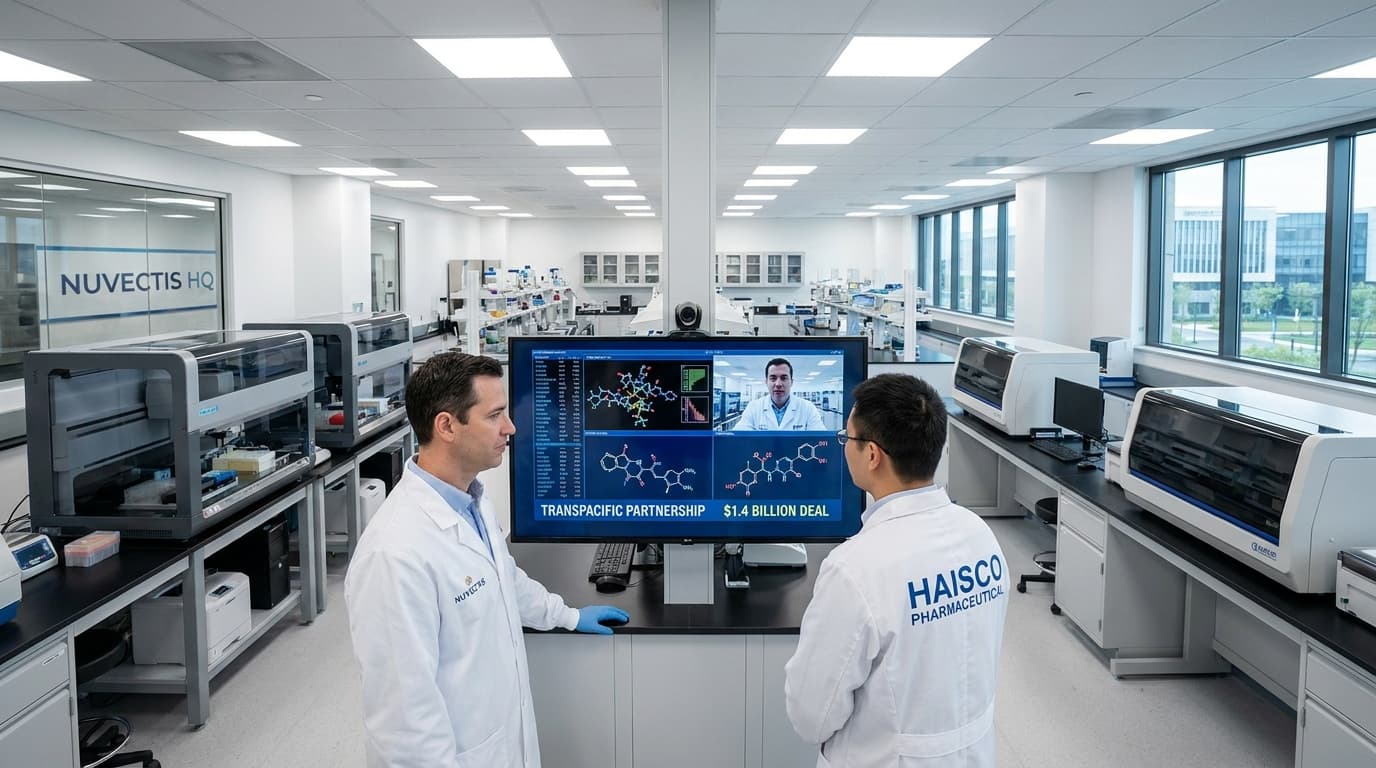
China’s Haisco and Nuvectis Forge $1.4B Deal on Late-Stage Programs: Expanding Transpacific Biotech Alliances

In a notable move expanding the transpacific scope of biotech dealmaking, New Jersey’s Nuvectis and China’s Haisco Pharmaceutical have entered an agreement that could be worth up to $1.4 billion. The deal, focused on two late-stage assets, illustrates how licensure partnerships and international alliances are becoming indispensable as companies navigate complex global pipelines.
Biotech Megadeal: Nuvectis, Haisco Ink Up to $1.4B Licensing Pact on Two Late-Stage Programs
Introduction
The life sciences landscape is continuously shaped by deals that not only provide capital inflows but also strategically distribute risk and expand the territorial reach of innovative therapies. One of the latest and most significant agreements to capture industry attention is the up-to-$1.4 billion licensing pact between Nuvectis, a biotech company based in New Jersey, and Haisco Pharmaceutical, a major player in the Chinese pharmaceutical sector. This deal centers on the out-licensing of rights to two late-stage drug programs and underscores a growing trend toward expansive international collaboration in an era where capital efficiency and global access are paramount.
The Structure: What the Deal Entails
While the biotech industry is no stranger to headline-grabbing licensing partnerships, the Nuvectis-Haisco alliance stands out both for its scale and for its cross-border design. Haisco will secure specific rights to two critically positioned, late-stage development programs from Nuvectis, enabling the Chinese company to leverage its domestic manufacturing, regulatory, and commercialization infrastructure to add value and speed to clinical and market progress. For Nuvectis, the deal not only provides substantial upfront payments, milestones, and future royalties but also opens the door to the vast, dynamic Chinese market—nowadays considered the second largest pharmaceutical market in the world.
The $1.4 billion headline figure is comprised of multiple tranches, including up-front licensing payments, development and regulatory milestones contingent on program progress, and commercial sales-based royalties. This non-dilutive capital arrangement is particularly appealing for both early- and late-stage companies seeking to advance expensive clinical development without giving up substantial equity stakes or control.
About the Companies
Nuvectis
A New Jersey-based biotech, Nuvectis has positioned itself as an emerging contender in clinical-stage drug innovation. By focusing its resources and scientific expertise on programs with the potential for significant efficacy in unmet areas, Nuvectis exemplifies nimble, asset-focused strategy in the sector.
Haisco Pharmaceutical
Haisco, one of China’s largest publicly listed pharmaceutical enterprises, continues to grow through a combined strategy of internal pipeline advancement and strategic alliances with global biotech companies. With strong access to the Chinese hospital market and robust relationships with regional regulators, Haisco has become a favored partner for Western firms seeking to bridge East-West commercial divides.
Trends Underlying the Deal
Rise of Transpacific Partnerships
The Nuvectis-Haisco licensing pact fits a mounting pattern: the growing interdependence of U.S. and Chinese biopharmaceutical ecosystems. As both markets become increasingly sophisticated and competitive, cross-licensing agreements are multiplying, with Western companies seeking Asian partners who can navigate local regulatory landscapes and manufacturing complexities, while Asian firms gain access to proprietary innovation not yet available in their home countries.
Capital Efficiency and Risk Sharing
The cost of drug development—especially late-stage, pivotal trials—continues to balloon. For companies like Nuvectis, a deal of this nature allows for resource optimization; precious investor capital can be allocated across a broader portfolio, while commercial risk is partially offloaded to an experienced partner. Haisco, for its part, gains access to innovative therapies at a cost structure designed for long-term scalability, risk mitigation, and competitive differentiation in its domestic market.
Regulatory Synergies and Market Expansion
Global regulatory requirements, from the FDA to China’s NMPA, can be an insurmountable hurdle for smaller firms. Haisco’s local expertise and regulatory relationships are potentially invaluable in moving Nuvectis’s assets more quickly through approval processes in China, perhaps even ahead of parallel FDA or EMA timelines. Such deals set the stage for harmonized development strategies, simultaneous global launches, and broader patient access.
Broader Implications for the Biotech Sector
Evolving Models of Innovation
Gone are the days when biotech firms could count on insular, unidirectional progress from preclinical stages through to global commercialization. Today’s market prizes agility, partnership, and leveraging core competencies—whether scientific discovery, regulatory navigation, manufacturing, or sales. By out-licensing rather than outright selling its assets, Nuvectis achieves greater leverage across multiple value inflection points and retains strategic optionality for future agreements.
Strengthening Global Drug Availability
At a time when health crises and geopolitical tensions can disrupt supply chains and clinical research efforts, these cross-border partnerships promote diversified resource allocation and supply network redundancy. Patients—and not just investors—stand to gain as more therapies become available globally, often sooner than if companies attempted to ‘go it alone’ in each market.
What Investors and Entrepreneurs Should Watch
Such deals are increasingly critical for investors seeking robust, risk-adjusted returns from biotech portfolios. Entrepreneurs, meanwhile, face a new imperative: Design drug and platform development for modular licensing and international partnership from the outset. The Nuvectis-Haisco partnership will be closely scrutinized as a model for how next-generation teams can multiply value by looking beyond traditional U.S. or E.U.-centric strategies.
Concluding Thoughts
The $1.4 billion deal between Nuvectis and Haisco Pharmaceutical stands as a powerful testament to the enduring appeal—and fundamental necessity—of international alliance in today’s biosciences industry. It will shape not only the commercial prospects of the drugs involved, but also the evolving playbook for how innovation is built, scaled, and made accessible in the complex reality of a multipolar pharmaceutical world.
As Chinese and Western regulatory, economic, and scientific spheres continue to intertwine, one can expect more such alliances, driving an accelerated pace of innovation and challenging conventional notions of where—and by whom—tomorrow’s breakthrough drugs will be discovered and delivered.
Join the BioIntel newsletter
Get curated biotech intelligence across AI, industry, innovation, investment, medtech, and policy delivered to your inbox.