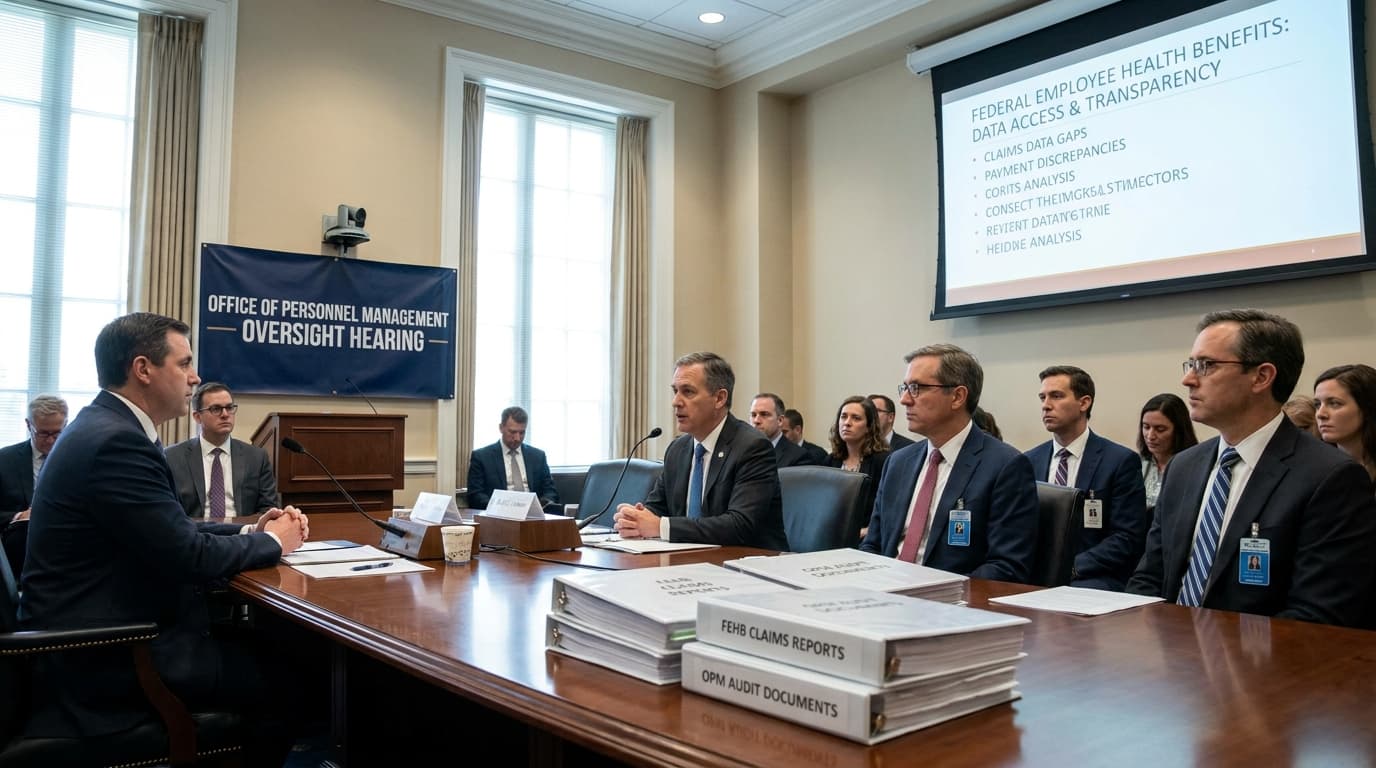
Why the Office of Personnel Management Needs Access to Government Employee Health Plan Claims Data

Without transparent and detailed access to claims data, the Office of Personnel Management (OPM) cannot adequately address billing inconsistencies or assess the efficiency and fairness of healthcare spending within federal employee health plans. This issue raises substantial concerns about data access, oversight, and accountability in the administration of one of the nation’s largest employer-sponsored health programs.
Introduction
As healthcare spending in the United States continues to escalate, the importance of transparency and oversight in employer-sponsored health plans cannot be overstated. Nowhere is this more critical than in the administration of health benefits for federal employees, a population comprising millions of individuals across the country. The Office of Personnel Management (OPM) stands at the center of this massive operation, tasked with ensuring the efficient allocation of resources, the fairness of payments, and the effectiveness of care. However, OPM's ability to fulfill these responsibilities is significantly hampered by a persistent lack of access to the granular claims data underpinning government employee health plans.
The implications of this data gap are broad, affecting everything from payment disputes to the ability to identify and correct billing discrepancies. As healthcare claims data becomes increasingly central to policy evaluation and system reform, federal agencies’ lack of access raises fundamental questions about the oversight and stewardship of public funds.
The Scope and Significance of Federal Employee Health Benefits
Before digging into the issues surrounding claims data, it's important to understand the magnitude of the program under OPM's purview. The Federal Employees Health Benefits (FEHB) program covers nearly nine million federal employees, retirees, and their dependents. It’s one of the largest employer-sponsored health insurance programs in the United States, channeling tens of billions of dollars annually through contracts with a diverse selection of private insurers.
Given this scale, even small inefficiencies or discrepancies in payment can translate into enormous financial consequences for the federal government — and, by extension, for the American taxpayer. Without visibility into the exact amounts charged by providers or the intermediary fees imposed by third-party administrators, OPM faces an uphill battle in ensuring that public dollars are spent wisely.
The Centrality of Claims Data in Health Plan Oversight
Claims data serves as the bedrock upon which every robust health plan is evaluated and improved. For regulators and administrators, access to detailed claims records — including the amounts billed by providers, adjustments made by insurers, and fees assessed by middlemen — is essential for:
- Identifying overpayments and underpayments
- Tracking trends in healthcare utilization
- Assessing plan performance
- Negotiating new contracts with insurers
- Rooting out waste, fraud, and abuse
Without this detailed data, OPM is akin to a ship’s captain asked to navigate treacherous waters with only a vague map. The agency finds itself forced to rely on summary statistics and self-reported data from the very insurers and intermediaries whose financial practices it is supposed to oversee. This arrangement raises valid concerns about conflicts of interest and potential gaps in accountability.
Payment Discrepancies and the Role of Middlemen
One of the most acute problems stemming from restricted access to claims data involves payment discrepancies. When OPM cannot see precisely what providers billed and what third parties charged in administrative fees, it becomes nearly impossible to:
- Validate reimbursements and adjudicate disputes
- Benchmark costs across different plans and providers
- Identify situations where the government may be overpaying for care or administrative services
In recent years, the expanding role of third-party administrators (TPAs) and pharmacy benefit managers (PBMs) has further complicated the flow of funds within the FEHB program. These middlemen negotiate discounts, handle billing, and assess their own fees in an often opaque environment. For OPM, the inability to audit transaction-level detail means blind spots that can persist for years — allowing errors, inefficiencies, or even malfeasance to go undetected and uncorrected.
Broader Implications for Oversight and Accountability
The importance of data transparency in public programs goes beyond mere accounting. It extends to the government’s ability to:
- Set sound reimbursement policies
- Spot outlier cases that may signal fraud or abuse
- Evaluate plan performance based on real-world outcomes
- Adjust policy levers for improved patient and taxpayer value
With incomplete claims data, each of these pillars is compromised. Policymakers and watchdogs have repeatedly noted that the integrity of the FEHB program — as with any large healthcare system — is only as robust as the data and tools its administrators wield. When OPM lacks the data needed to determine the true cost and effectiveness of health spending, transparency, public trust, and program sustainability all suffer.
Obstacles to Obtaining Claims Data
Why, then, does OPM not possess full access to this data by default? The reasons are rooted in a mixture of statutory language, contractual arrangements, and industry practice. Many private insurers and TPAs argue that claims data contains proprietary information or is otherwise shielded by contracts. Some have suggested that furnishing comprehensive claims data to OPM could expose sensitive provider negotiations or run afoul of privacy regulations — though critics counter these claims, arguing that other large purchasers, including state governments and private corporations, routinely access such data without issue.
Moreover, the continued shift toward value-based care and alternative payment arrangements only increases the need for granular, high-quality data. As new reimbursement models are introduced, the complexity and opacity of financial flows can rise — particularly if OPM remains on the outside, looking in.
Real-World Impact: Examples of Data Limitations
To illustrate the stakes, consider hypothetical but realistic situations that OPM might encounter:
- Unexplained Fee Increases: Administrative fees charged by TPAs jump from one year to the next, but without transaction-level data, OPM cannot ascertain whether these reflect true cost increases or accounting shifts.
- Claims Denial Patterns: If a subset of federal employees sees a sudden spike in claims denials for a particular service, OPM’s lack of granular data prevents timely identification and remediation.
- Provider Price Variations: OPM is unable to compare what different providers charge for the same procedure, or to spot outliers that might suggest negotiation leverage or inefficiency.
In each case, the absence of full claims data leaves the agency and its stakeholders at a disadvantage.
Calls for Greater Transparency
Policy advocates, government watchdogs, and consumer groups have long pushed for greater transparency, arguing that public money should come with public accountability. Enhanced access to claims data could enable OPM to:
- Benchmark spending against other large purchasers
- Engage in more effective procurement negotiations
- Monitor clinical outcomes and link them to specific spending patterns
- Launch targeted audits of high-risk claims areas
Recent years have seen some progress, with legislative proposals and OPM statements calling for improved data access. However, substantial barriers remain, and for now, OPM must navigate a complex and often adversarial landscape to pry data from private carriers.
Legislative and Regulatory Efforts
Several lawmakers have signaled interest in the issue, suggesting the possibility of congressional action to compel greater data sharing by FEHB carriers and middlemen. Regulatory change could also emerge from within OPM, through stronger contracting requirements and enforcement mechanisms in future plan years.
These efforts, however, are not immune to pushback from industry stakeholders, who may lobby to preserve proprietary advantages or resist changes that increase their administrative burden. The contours of this debate — balancing transparency, proprietary business interests, and the public good — are likely to evolve in the coming years.
The Road Ahead: Building an Accountable Health System for Federal Employees
What does the future hold for OPM and its relationship with plan data? Fundamentally, the drive for enhanced data access is rooted in a desire for greater accountability and value for taxpayer dollars.
It also resonates with broader trends in the healthcare industry, where data-driven oversight is becoming the norm among major purchasers. Whether OPM can persuade, contract for, or legislatively mandate improved access remains to be seen. Nevertheless, the underlying rationale — that robust data is essential for effective oversight — continues to grow stronger as other segments of the healthcare industry embrace similar measures.
Conclusion
The challenges facing the Office of Personnel Management in overseeing government employee health benefits are formidable, but not insurmountable. As pressure mounts for greater transparency, accountability, and efficiency in healthcare spending, access to granular claims data will become an increasingly critical tool in OPM’s arsenal. Policymakers, watchdogs, and beneficiaries alike will be watching closely to see whether the agency can break through persistent barriers and usher in a new era of evidence-based oversight for one of the country’s largest and most important healthcare programs.
For now, the central message is clear: without access to claims data specifying exactly what providers billed and what middlemen charged, OPM cannot fix payment discrepancies effectively. Only with full transparency and robust data analysis can the federal government fulfill its mandate to steward public funds and protect the interests of its employees and retirees.
Sources: MedCity News
Join the BioIntel newsletter
Get curated biotech intelligence across AI, industry, innovation, investment, medtech, and policy delivered to your inbox.