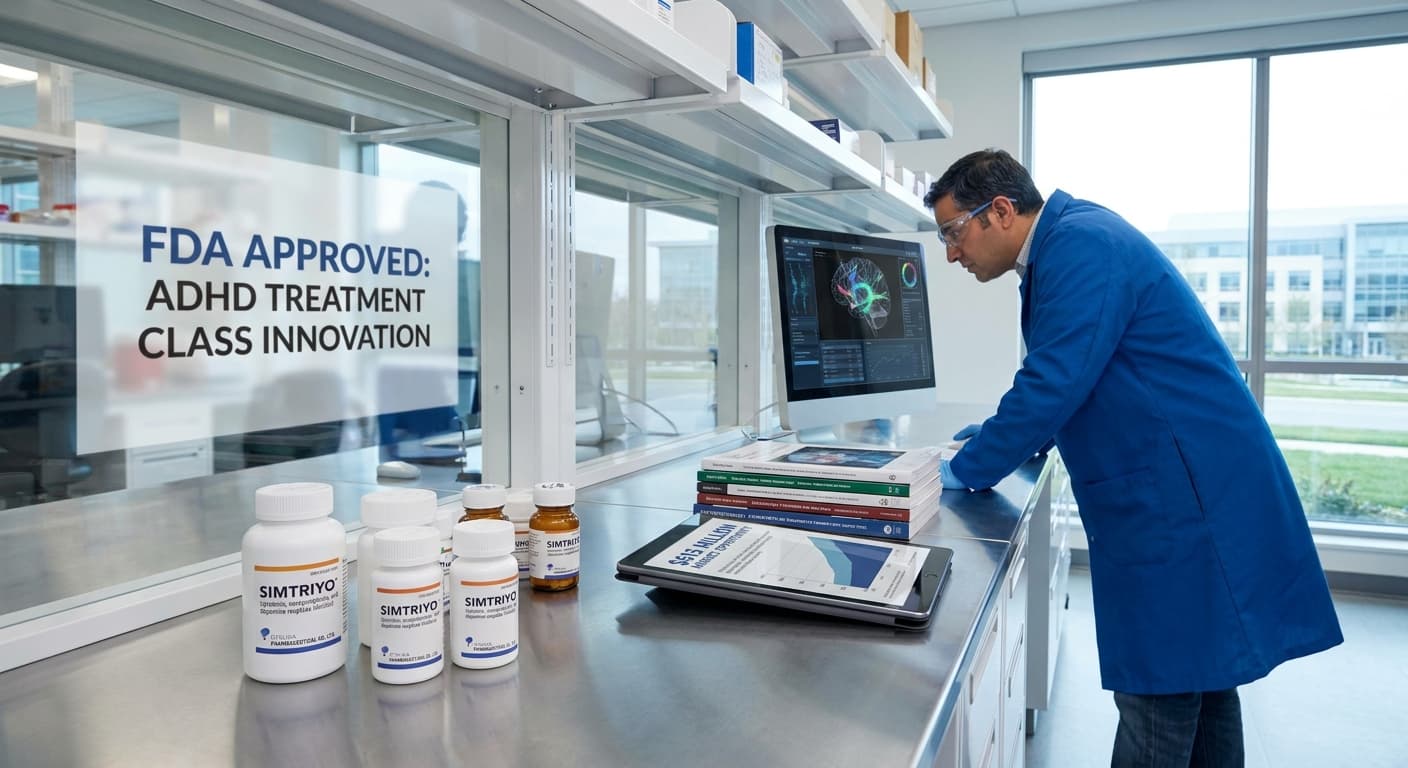
Otsuka’s Simtriyo Approval Ushers in First Triple Reuptake Inhibitor for ADHD and a New Drug Class

In a major regulatory development, Otsuka wins FDA approval for Simtriyo, the world’s first triple reuptake inhibitor for ADHD. The launch opens a new chapter in ADHD drug innovation as the company prepares for commercialization pending DEA scheduling.
Introduction
Attention Deficit Hyperactivity Disorder (ADHD) has long presented a formidable therapeutic challenge, not only because of its complex pathophysiology but also due to the limitations and side effects associated with available treatment options. Now, Otsuka Pharmaceutical’s newly FDA approved Simtriyo is set to disrupt the landscape by delivering the first approved norepinephrine, dopamine, and serotonin reuptake inhibitor—a fundamentally new drug class for ADHD treatment. With its anticipated launch later this year, following Drug Enforcement Agency (DEA) scheduling, Simtriyo is projected to address a market opportunity estimated at $615 million, and potentially much more as prescriber confidence and clinical experience grow.
What Makes Simtriyo Different?
Simtriyo’s approval is significant because it introduces the first agent to inhibit reuptake of all three key neurotransmitters: norepinephrine, dopamine, and serotonin. This pharmacological profile is fundamentally distinct from currently marketed ADHD medications, which most often target one or two neurotransmitters—primarily dopamine and norepinephrine in the case of stimulants like methylphenidate and amphetamine derivatives, and norepinephrine alone for some non-stimulant options.
Whereas selective norepinephrine reuptake inhibitors (such as atomoxetine) or dopamine-releasing agents target narrow neurochemical pathways, Simtriyo’s triple mechanism is designed to modulate a broader neurochemical spectrum. Theoretically, this could lead to improved management of core ADHD symptoms, including in patient cohorts that do not respond to existing pharmacotherapy.
FDA Approval: The Regulatory Pathway
FDA approval for Simtriyo reflects both the persistence of Otsuka in drug development and an increased willingness by regulators to embrace mechanistically novel agents in behavioral health. The process leading to approval included intensive evaluation of preclinical pharmacology, human safety and tolerability, and efficacy data from pivotal clinical trials enrolling children, adolescents, and adults diagnosed with ADHD.
The company will now work through the required DEA scheduling process. As is customary for psychoactive central nervous system medications, the DEA must assess and categorize the potential for abuse, misuse, and diversion before Simtriyo is commercially available in the United States. The timing of this process will influence the precise launch date, although Otsuka has indicated intent to move forward expeditiously.
Market Potential and Commercial Outlook
According to Otsuka, the addressable market for Simtriyo is vast, with projections valuing the opportunity at $615 million. Analysts suggest this estimate could be conservative depending on several factors:
- Patient Stratification: The triple reuptake mechanism may provide benefit to patients who have failed or been intolerant to stimulant class medications, which dominate the ADHD market but carry risk for abuse and adverse effects.
- Pharmacoeconomic Benefit: Improved response rates, better tolerability, and reduced polypharmacy could position Simtriyo favorably for payer adoption, assuming competitive pricing and demonstration of real-world utility.
- Expansion of Indications: Given the overlap in neurobiology between ADHD and other neuropsychiatric conditions such as major depressive disorder and certain anxiety syndromes, Simtriyo’s unique mechanism may prompt further investigational studies in these related pathways, possibly expanding its label in future regulatory cycles.
Clinical and Patient Impact
The introduction of a new mechanism is not only a scientific milestone but could have practical effect for patients and prescribers who have faced limited options. Current stimulant medications are effective for many but also present risk for misuse and have contraindications in populations vulnerable to substance use disorders or with comorbid cardiovascular issues. Non-stimulants, while safer in those respects, often work more slowly or exhibit limited efficacy for certain patient subgroups.
Simtriyo, though not likely to be a panacea, offers a novel toolkit for clinicians. The triple inhibition model provides a hypothesis-driven approach to address multiple neurochemical derangements simultaneously, potentially moderating core symptoms (inattention, hyperactivity, impulsivity) and associated mood disruptions. It will be critical for future real-world data to elucidate both the unique advantages and potential unforeseen challenges or safety signals of this approach.
The Broader Biopharma Context
Otsuka’s approval comes during a period of heightened innovation and disruption in neuropsychiatric medicine, as molecular insights and technology converge to support new approaches. Simtriyo’s entry could influence ongoing and future drug development programs, with other companies likely to move forward with their own triple reuptake candidates or related multi-target strategies.
The success or shortcomings of Simtriyo may reinforce or recalibrate the regulatory appetite for mechanistically novel therapies. Moreover, many clinicians and advocates have pressed for greater diversity in pharmacologic options, following years of relative stasis in the ADHD field dominated by reformulations and incremental improvements of existing medications.
DEA Scheduling and Launch Logistics
The DEA’s involvement at this stage is standard for drugs with potential for central nervous system impact. Scheduling will determine prescribing restrictions, storage, and dispensing rules, as well as prescriber education requirements. Otsuka will need to work closely with regulators, pharmacies, and physicians to ensure appropriate patient access without exacerbating concerns about diversion or misuse.
It is not yet clear whether Simtriyo will be a Schedule II, III, or IV substance, but the companies’ communications suggest a proactive stance on risk evaluation and mitigation strategies (REMS), as is common with novel psychoactives.
Future Research Directions
Numerous clinical questions remain that will be closely watched by the neuropsychiatric and regulatory communities:
- Long-term Efficacy and Safety: How will Simtriyo perform over months and years? Will its multi-target approach provide more durable remission, or might tolerance and adaptation mitigate benefit over time?
- Comparative Effectiveness: Where will Simtriyo find its niche compared to existing stimulants and non-stimulants? Randomized head-to-head trials and independent pragmatic studies will be essential.
- Safety, Abuse, and Diversion: Will the risk-benefit profile support widespread uptake, or will scheduling and real-world data reveal new concerns?
- Extensions to Pediatric and Geriatric Populations: Although initial trials included multiple age groups, expanded post-market surveillance is vital to identify population-specific effects and ensure responsible use.
Conclusion
The FDA approval of Otsuka’s Simtriyo represents a transformative milestone for ADHD therapeutics, introducing not only a new medication but an entirely new drug class. With an estimated $615 million market opportunity on the horizon, the implications for patients, prescribers, and industry alike are considerable. The ultimate impact will depend on real-world experience, payer dynamics, prescriber receptivity, and ongoing regulatory oversight. Yet, for now, the arrival of Simtriyo signals renewed momentum in a field that, for many years, has waited for genuine pharmacologic innovation.
Source: Otsuka’s ADHD approval opens up new drug class with $615M opportunity
Join the BioIntel newsletter
Get curated biotech intelligence across AI, industry, innovation, investment, medtech, and policy delivered to your inbox.