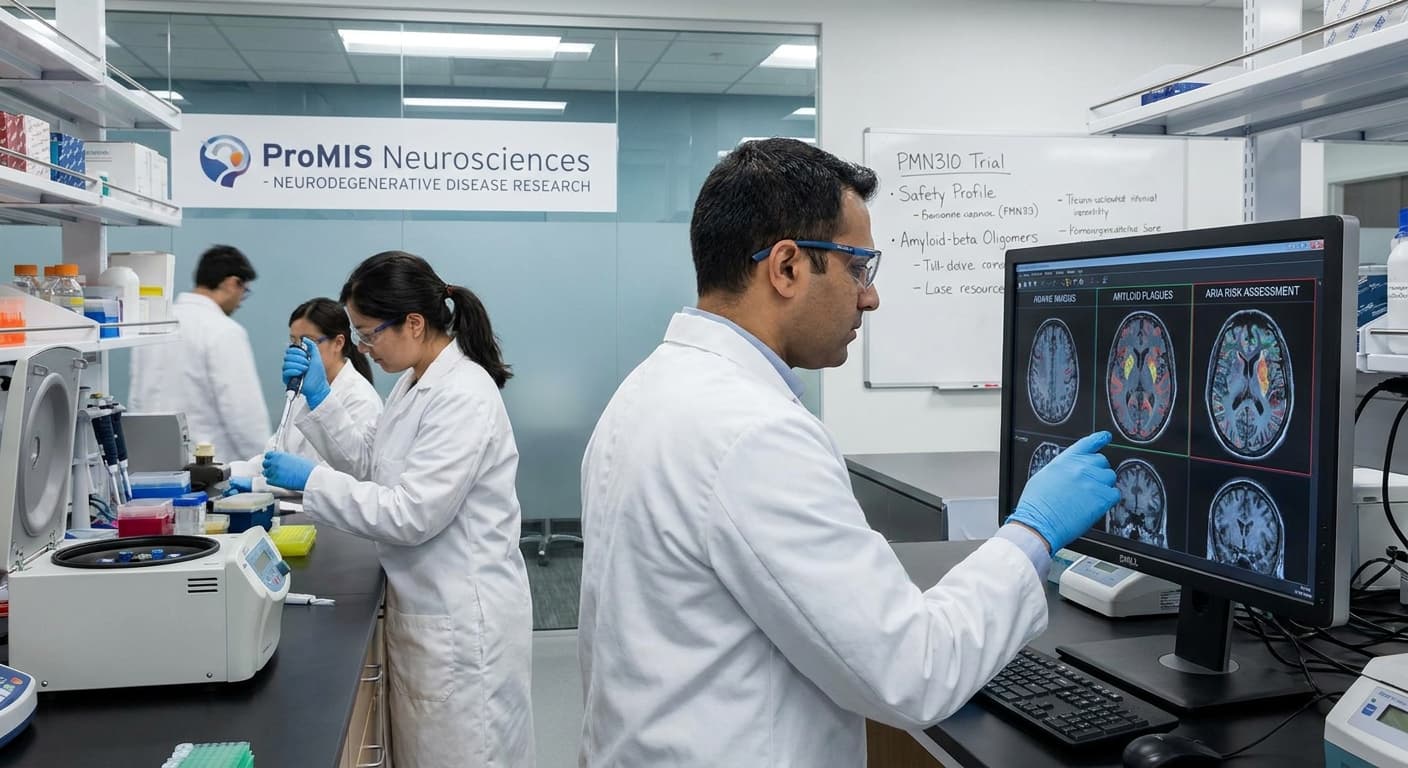
Preliminary Trial Results Point to Emerging Path for Safer Alzheimer’s Therapies

The pursuit of safer treatment options for Alzheimer’s disease—particularly those targeting amyloid—has reached another milestone. Preliminary results from ProMIS Neurosciences highlight the delicate balance between efficacy and safety and may provide new optimism for both clinicians and patients seeking effective interventions.
In the ever-evolving landscape of Alzheimer’s disease research, one of the perpetual quests has been the development of effective and safe treatments that specifically target amyloid accumulation in the brain. For years, both researchers and clinicians have grappled with the complexities of amyloid biology, with previous therapies often failing to achieve the desired balance between reducing amyloid burden and minimizing serious adverse effects such as amyloid-related imaging abnormalities (ARIA).
Recently, new early-stage clinical data from ProMIS Neurosciences have reignited cautious optimism in the field, suggesting a potential path forward for safer amyloid-clearing drugs. This development could mark a crucial turning point in the approach to Alzheimer’s therapies, combining scientific ingenuity with practical clinical considerations.
The Long Road of Amyloid-Targeting Therapies
Alzheimer's disease (AD) continues to confound the medical community with its multifactorial etiology, progressive nature, and staggering societal burden. Among the diverse biological hallmarks of the disease, amyloid-beta plaques stand out as a defining feature and a persistent therapeutic target. Decades’ worth of failed trials, inconclusive results, and high-profile disappointments have led some in the field to question the amyloid hypothesis altogether, even as a handful of antibody-based drugs have finally gained regulatory traction.
The core challenge, as many clinicians and trialists know, is that drugs designed to clear amyloid can trigger ARIA, a potentially hazardous condition seen on brain imaging that ranges from asymptomatic edema to life-threatening bleeding. Not only does ARIA complicate patient management, but it also forces drug developers to moderate dosing and ultimately limits the treated population. Safety, therefore, is not just a regulatory box to be checked, but a pivotal factor influencing both trial success and real-world adoption of disease-modifying therapies.
ProMIS Neurosciences: A New Approach Emerges
Against this backdrop, ProMIS Neurosciences has reported preliminary trial data suggesting its amyloid-clearing agent may offer a superior safety profile compared to existing options. While details remain early and further studies are required, the concept underpinning their approach appears to involve targeting a pathologically relevant form of amyloid-beta while sparing other forms less likely to provoke ARIA. This could theoretically reduce the dangerous side effects seen with less selective drugs.
The significance of these results comes not just from the possibility of reducing ARIA, but from the implications it portends for future clinical trial designs and, ultimately, real-world therapy. If a drug can be shown to maintain efficacy in clearing amyloid plaques while reducing or eliminating ARIA, it would broaden eligibility for treatment, reduce costs related to MRI monitoring, and free patients from periodic anxiety tied to imaging findings.
Implications for Alzheimer’s Treatment Landscape
Broadening the Patient Population
One of the main bottlenecks in current Alzheimer’s amyloid therapies is the highly selective nature of patient eligibility. Many older adults who might otherwise benefit from disease-modifying treatments are either excluded due to comorbidities or discontinue therapy after adverse event monitoring picks up ARIA. If ProMIS's approach can indeed realize both lower ARIA rates and robust amyloid clearance, clinicians may soon have a treatment suitable for a much wider group of people, including those with cardiovascular or bleeding risks.
Streamlining Clinical Practice
The practical burdens associated with ARIA management ripple across the health system—recurrent MRIs for monitoring, labor-intensive follow-ups, and the logistical challenge of rapid-response care for emergent ARIA. A safer amyloid-clearing therapy would offer pragmatic gains: reducing the monitoring burden, simplifying care algorithms, and making Alzheimer’s therapy more accessible beyond academic centers.
Impact on Research and Development
An inflection point in amyloid therapy safety could also shift R&D priorities. For years, much of the clinical risk was shouldered by patients enrolled in trials, and negative safety signals could abruptly terminate promising programs. With improved safety margins, the wider field of neurodegeneration research could see a resurgence of investment and momentum, venturing into combinatory approaches, earlier intervention, and potential preventive strategies.
The Cautious Optimism of Early-Stage Data
While the preliminary data energize the field, historical precedent in Alzheimer’s drug development demands a sober perspective. Early results, particularly from open-label and dose-escalation cohorts, do not always translate to successful pivotal studies, and long-term safety remains to be established. Further, robust, placebo-controlled evidence will be required to justify regulatory approval and widespread adoption.
Regulators, too, will need to exercise vigilance. Lessons learned from the accelerated approval pathway controversies—where post-marketing safety events triggered intense scrutiny—continue to reverberate in policymaking circles. Yet, the promise that undergirds the latest finding is the hope that, with better-tolerated drugs, these pitfalls can be avoided.
Challenges That Remain
Despite the optimism, significant scientific and operational questions remain, including:
- Target Selectivity: Will the molecular specificity of the ProMIS agent truly confer a meaningful safety advantage without sacrificing amyloid-targeting potency?
- Clinical Outcomes: Will improved safety profiles convert to meaningful functional gains for patients, such as slowed cognitive decline or preserved activities of daily living, or will the benefit be limited to imaging and biomarker changes?
- Long-Term Data: Alzheimer’s, by its nature, is a slow-moving disease. Extended follow-up will be needed before safety and efficacy claims can decisively influence clinical guidelines and payer policies.
A Field Marked by Cautious Progress
The history of Alzheimer’s drug development is replete with stories of hope, setback, retooling, and incremental progress. Each new data release—especially those that hold the promise of breaking the safety-efficacy impasse—generate intense debate and widespread interest from stakeholders, including academic neurologists, biotech investors, patient advocacy groups, and public health policymakers.
If the ProMIS Neurosciences approach is borne out by further study, it could become a model for future drug classes as well. The ripple effect would not only be seen in amyloid-targeted agents, but potentially in other fields where the therapeutic risk profile prevents promising molecules from delivering community-wide benefit.
The Road Ahead: What to Watch
Looking forward, several markers of progress will be closely observed by the research and clinical communities:
- Peer-Reviewed Publication: The preliminary nature of current data leaves key questions unanswered. Detailed results subject to independent peer review will be a litmus test for the field’s enthusiasm.
- Phase 2 and 3 Trials: Enrolling more patients with diverse clinical backgrounds, including those at high risk for ARIA, will be critical.
- Regulatory Feedback: Engagement with the U.S. FDA and global regulators will help set standards for the next generation of Alzheimer’s drugs, influencing trial endpoints, safety monitoring, and patient selection criteria.
- Patient and Provider Perspectives: Feedback from those most affected—the patients and their families—as well as the clinicians administering these therapies, will ultimately shape how a new drug is integrated into real-world practice.
Conclusion
The battle against Alzheimer’s disease is often described as a marathon, not a sprint. Early results from ProMIS Neurosciences’ amyloid-clearing drug are providing a fresh surge of optimism, hinting at a future where effective and safer therapies could transform both the field and the lived experience of millions of patients and caregivers.
As the broader research and medical communities await more comprehensive results, the next steps will require rigorous validation, ongoing transparency, and sustained investment. Whether this preliminary victory heralds a new era in Alzheimer’s therapy will be determined in the years to come, but the groundwork appears promising for what could become the next landmark in neurodegenerative disease management.
Join the BioIntel newsletter
Get curated biotech intelligence across AI, industry, innovation, investment, medtech, and policy delivered to your inbox.