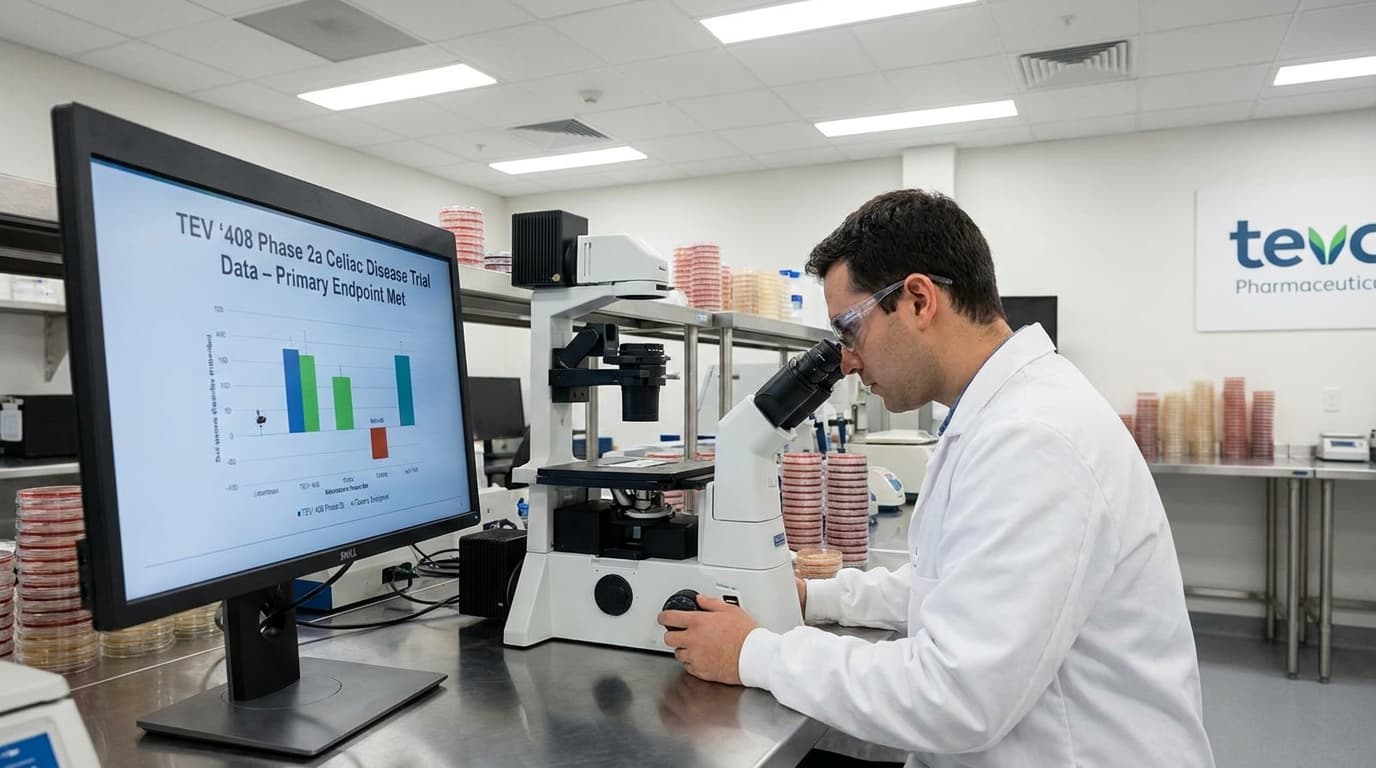
Teva Reports Phase 2a TEV ’408 Win In Celiac Disease, Extending Its IL-15 Bet

In the 50-patient study, adults with celiac disease received TEV ’408 or placebo before a six-week daily gluten challenge. Teva said the antibody significantly reduced intestinal damage versus placebo and reported no safety signals, while signaling that additional phase 2 work is needed before a phase 3 program can proceed.
Teva Pharmaceutical said its anti-interleukin-15 antibody TEV ’408 met the primary endpoint in a phase 2a trial in adults with celiac disease, giving the company a midstage efficacy signal in a field with no approved IL-15 inhibitors.
The trial enrolled 50 adults with celiac disease. Patients received either TEV ’408 or placebo and then, two weeks later, began eating gluten every day for six weeks. Teva reported that TEV ’408 reduced the amount of intestinal damage caused by gluten significantly more than placebo. The company also said it has observed no safety signals associated with the antibody.
The Data And What It Means
The result supports Teva’s argument that blocking IL-15 could address the immune-driven biology of celiac disease rather than only the consequences of gluten exposure. That is an important distinction commercially and scientifically, because celiac drug development has long struggled to move beyond supportive management approaches.
At the same time, Teva is not presenting this as a registration-ready package. A spokesperson told Fierce that more dose-ranging and additional analysis of the phase 2 data are needed before a phase 3 follow-up can proceed, and added that the celiac timeline remains subject to clinical results and regulatory alignment.
That caution matters. A positive midstage readout is useful, but the company is still working through dose selection and development design, which means the real signal here is validation of the target more than immediate de-risking of late-stage execution.
The Competitive And Pipeline Context
There are currently no approved drugs that inhibit IL-15, but Teva is not alone in pursuing the pathway. Similar antibodies are in development at Novartis, which picked up an IL-15 program from Calypso Biotech in 2024, and at argenx, which gained an option through its $2.2 billion buy of Forte Biosciences this summer. Novartis’ candidate targets IL-15 alone, like TEV ’408, while argenx’s approach also hits interleukin-2 by targeting CD122.
Evercore ISI analyst Umer Raffat wrote that comparing these antibodies is currently unwise, though he said Teva’s data was good but unsurprising and suggested the company “identified a potentially optimal dose.” The lack of movement in Teva’s stock, he wrote, may reflect that other anti-IL-15 antibodies have also shown activity in celiac disease.
Teva is also testing TEV ’408 in vitiligo and plans to launch a phase 2b trial in that indication later this year. Earlier this year, Royalty Pharma agreed to help fund the vitiligo study and a potential phase 3 follow-up with up to $500 million in exchange for a share of vitiligo sales if the drug is approved. Teva has described TEV ’408 as a potential “pipeline in a product,” though it has not yet laid out plans beyond celiac disease and vitiligo.
Join the BioIntel newsletter
Get curated biotech intelligence across AI, industry, innovation, investment, medtech, and policy delivered to your inbox.